

A correctly configured GPS tracker will not flatten a healthy car battery. It draws only a few milliamps in sleep mode, far too little to matter over weeks. When owners see rapid drain, the real culprit is almost always wrong settings, a tired battery, or poor installation, not the tracker itself. Check the sleep mode and battery health first.
TL;DR:
- Most battery drain issues are caused by incorrect tracker settings, poor installation, or pre-existing weak batteries, not the tracker itself in sleep mode.
- Modern trackers in Ultra Deep Sleep draw only 2 to 6 mA, which would take months to significantly drain a healthy car battery.
- Check for high reporting frequency, weak signal, or wiring faults before blaming the tracker for battery drain, and test the draw with a multimeter.
- Professional installation ensures proper sleep mode, wiring, and configuration, greatly reducing false battery drain complaints.
- Battery-powered trackers with infrequent, motion-triggered reporting can last several months, but hardwired units need correct sleep settings to prevent issues.
Table of Contents
- GPS tracker battery drain explained: current draw and sleep modes
- Common causes of a GPS tracker battery drain problem
- How to check if the tracker is actually the problem
- Fixing GPS tracker power usage: configuration steps that work
- When a battery-powered tracker beats a hardwired one
- What fitters see: installation quality and battery life
- Your priorities if you’re worried about drain
- Getting a fit that doesn’t leave battery drain to chance
- Sources
- FAQ
GPS tracker battery drain explained: current draw and sleep modes
Here’s the number that settles most arguments: a modern tracker in Ultra Deep Sleep pulls somewhere between 2 and 6 mA. Wake it into active transmission mode and that figure jumps to 28 to 45 mA on many popular devices, a difference of more than 20 times, according to manufacturer datasheet comparisons. That gap is the whole story of GPS tracker battery drain.
Datasheet snapshot: Ultra Deep Sleep: 2–6 mA. Deep Sleep: slightly higher, still under 10 mA. Active/transmit: 28–45 mA, sometimes more during a GPS fix or cellular handshake.
Trackers use tiered sleep states, and each one responds to a different trigger:
- Ultra Deep Sleep kicks in after extended stillness, ideal for long-term parking or storage.
- Deep Sleep activates after shorter idle periods, waking on ignition or motion.
- Active mode fires when the accelerometer detects movement or the ignition goes live, then reports position.
A typical car battery holds 40 to 70 amp-hours of capacity. A tracker sipping 4 mA in sleep mode would take months, not days, to make a dent. If your battery is dying in a fortnight, the tracker’s standby draw is rarely the arithmetic that explains it.
Common causes of a GPS tracker battery drain problem
Most cases blamed on the tracker actually trace back to something else entirely. Work through these in order:
- High-power default settings. Some devices ship configured for frequent, real-time reporting rather than the low-power tier suited to daily driving.
- Long idle periods without sleep configured. A vehicle left for weeks without Ultra Deep Sleep enabled, or without any battery maintenance, will run the tracker at a higher baseline draw the whole time.
- A pre-existing weak battery or charging fault. An ageing battery or a failing alternator struggles with any extra load, tracker included, and gets unfairly blamed.
- Installation faults. Poor wiring, a bad earth, or a tap into the wrong circuit can create a genuine parasitic draw that has nothing to do with the tracker’s own current draw.
- Excessive reporting frequency or weak signal. Frequent GPS fixes, constant cellular retries in a poor-signal area, and always-on LEDs or diagnostics all push consumption up. Reporting frequency, signal strength and installation quality are consistently the biggest drivers of genuine battery drain.
Real cases logged by fitters back this up: switching a device into Ultra Deep Sleep has resolved most “the tracker drained my battery” complaints, without any hardware changes at all, according to documented troubleshooting cases.
How to check if the tracker is actually the problem
Don’t guess. Test it.
- Run a parasitic draw test. Connect a multimeter in series with the negative battery terminal, let the vehicle settle for at least 30 minutes after the last door or ignition event, then read the current. Anything wildly above the tracker’s rated sleep draw points elsewhere, according to standard diagnostic guidance.
- Unplug OBD2 trackers temporarily. If the draw drops sharply the moment you unplug it, you’ve found your answer. If it barely changes, look at wiring or other accessories.
- Check the app’s voltage log. Most tracking apps record vehicle voltage over time and will flag a low-voltage alert before you notice anything on the dash.
- Rule out the battery and alternator first. A three-year-old battery under strain will drain regardless of what’s plugged in.
Pro Tip: Take your multimeter reading in the evening after the car has sat untouched for half an hour. Testing straight after a drive will always overstate the real standby draw, because residual system activity hasn’t settled yet.
Fixing GPS tracker power usage: configuration steps that work
Fixing this is mostly a software job, not a hardware one. Work through these steps before you consider anything more drastic:
- Confirm the correct sleep tier is active. For a vehicle that sits idle for long spells, Ultra Deep Sleep should be the default, not an option buried in a settings menu.
- Increase the reporting interval. Shift from constant real-time updates to a longer interval, and switch to motion-triggered reporting so the device only wakes when the vehicle actually moves.
- Relocate the device if signal is weak. A tracker hunting for cellular signal in a poor-reception spot burns far more power retrying than one with a clean connection. Positioning also affects how well the device performs off-road.
- Turn off LEDs and non-essential diagnostics. Small, but it adds up over weeks of standby time.
- Set voltage monitoring and low-battery alerts. This turns the tracker into an early warning system rather than a mystery drain source.
- For stored vehicles, use a trickle charger or unplug the OBD2 unit. If a Land Rover is going into storage for the winter, a proper storage routine paired with either a trickle charger or a temporarily disconnected tracker avoids the issue entirely.
Pro Tip: If you’re not confident adjusting settings yourself, ask your installer to walk through the app with you once. Most owners only need to see it done correctly one time to manage it confidently afterwards.
When a battery-powered tracker beats a hardwired one
Hardwired and OBD2 trackers draw from the vehicle’s own battery, which is exactly why configuration matters so much. A battery-powered unit sidesteps that risk entirely, useful for a vehicle parked for months, in storage, or off-grid where hardwiring isn’t practical.
- Battery-powered trackers typically run from a short to a long duration depending on reporting frequency and motion-triggered settings, according to runtime comparisons across tracker types.
- The trade-off is maintenance: someone has to recharge or replace that battery on a schedule, rather than relying on the vehicle to do it automatically.
- For an actively driven Land Rover, hardwired or OBD2 remains the simpler long-term option, since correct sleep settings remove the drain risk without adding a separate battery to manage.
What fitters see: installation quality and battery life
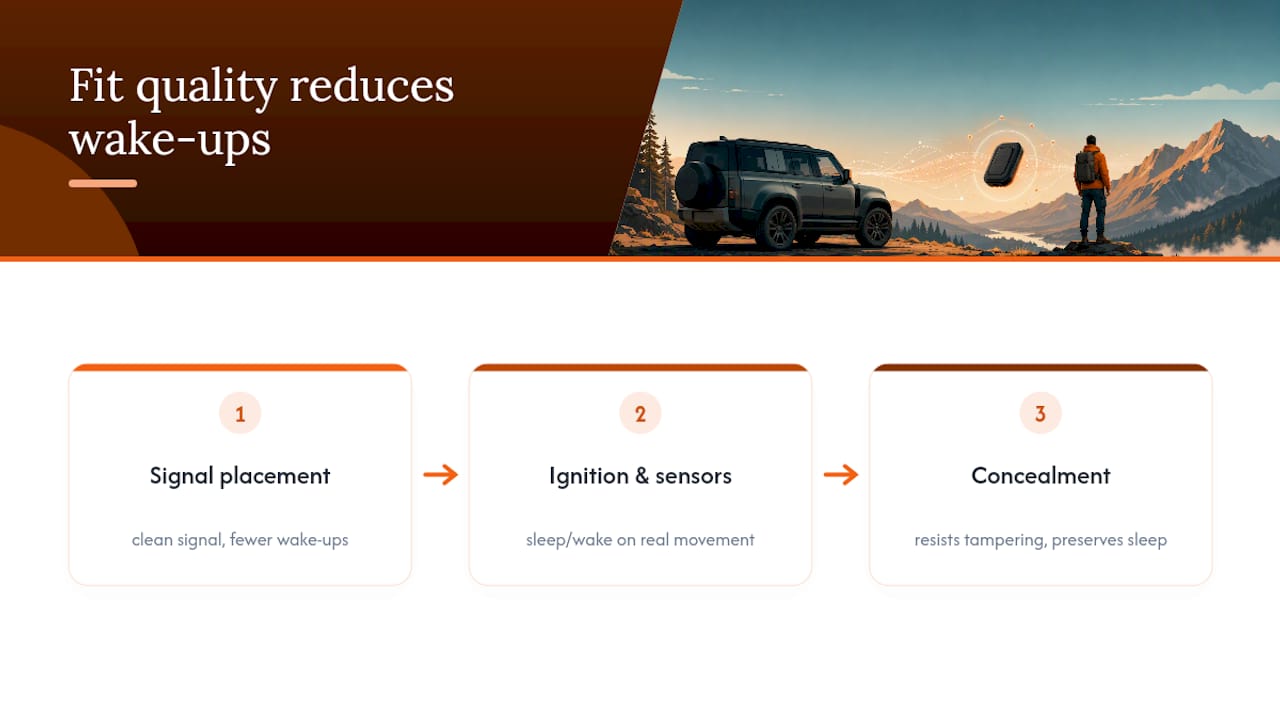
Wiring quality decides more about battery drain than most owners realise. A professional, Thatcham-approved installation taps into the correct circuit and earths properly, removing the parasitic-draw risk that a rushed DIY fit can introduce.
Placement matters too. Devices sited to maintain clean signal wake up less often chasing a connection, which keeps standby draw closer to the datasheet figure rather than above it. Professional fitters also configure ignition and accelerometer logic correctly from day one, so the tracker sleeps when it should and wakes only when the vehicle genuinely moves. Testing has also shown that properly hidden, professionally fitted units hold up better against real-world tampering attempts, a separate benefit of getting the fit right the first time.
Your priorities if you’re worried about drain
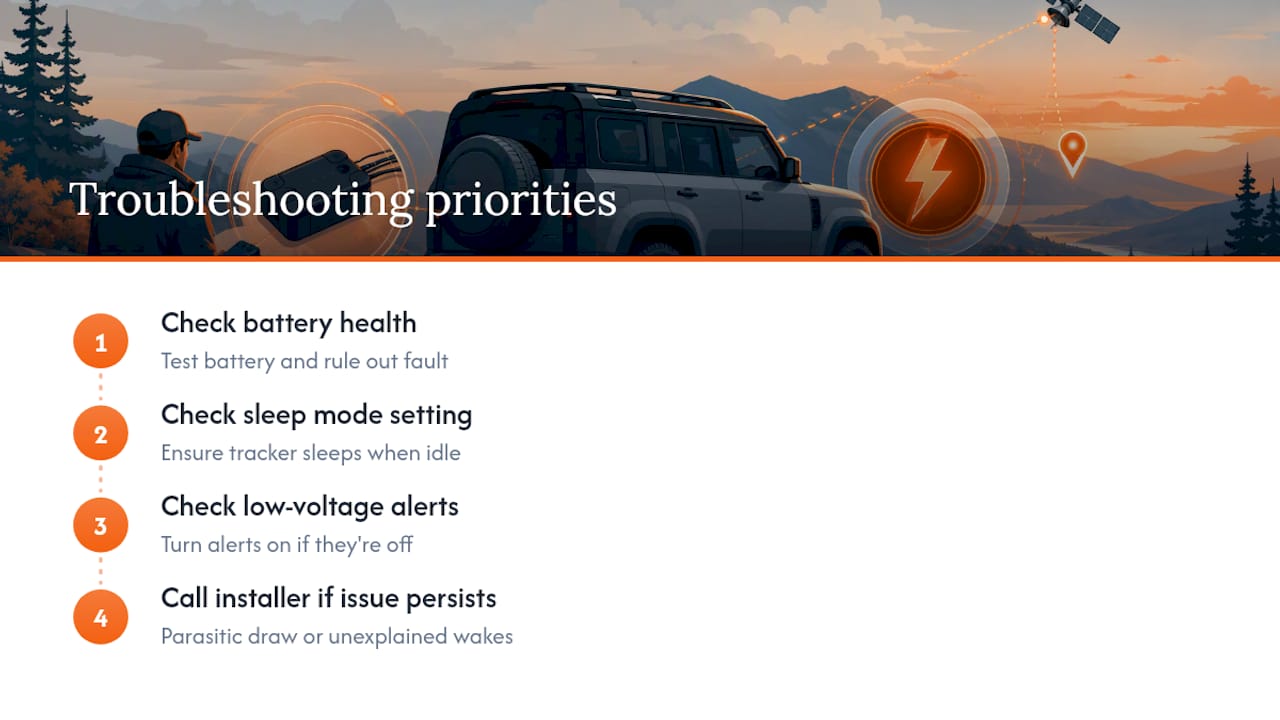
If you’re staring at a flat battery and blaming the tracker, check three things in order: battery health, sleep mode setting, and whether low-voltage alerts are switched on. Most problems solve themselves right there.
Call an installer when you find a genuine parasitic draw during testing, or when the device keeps waking unexpectedly with no obvious trigger. Otherwise, treat the tracker as what it’s designed to be: an early-warning system, not the thing you need warning about.
— Will
Getting a fit that doesn’t leave battery drain to chance
A key advantage for Land Rover owners is having Thatcham-approved trackers fitted professionally, with sleep settings configured correctly from installation day rather than left on risky defaults.

That matters more than most owners expect. A poor earth, a rushed wiring job, or a device left on real-time reporting are the actual causes of most drain complaints, and a professional fit removes all three at once. Installers set up Ultra Deep Sleep, motion-triggered reporting, and voltage alerts as standard, backed by 24/7 monitoring support if anything does look wrong later.
Browse the Thatcham-approved tracker range to see current models, or check the Land Rover-specific tracker collection if you’re after a backup unit or immobiliser alongside your main tracker. Get a fit booked before winter storage season, not after a flat battery forces the issue.
Sources
- GPS tracker battery drain: myths vs facts explained
- What actually impacts battery life in GPS trackers
- How long does a GPS tracker battery last? Full guide
- Can a GPS tracker drain your car battery?
FAQ
Does keeping GPS tracking on drain the battery?
Leaving GPS tracking switched on does not meaningfully drain a healthy battery, provided the device is set to an appropriate sleep tier. The drain that owners notice almost always comes from a device stuck on frequent real-time reporting rather than from tracking being active in principle.
How long will a GPS tracker battery last?
For battery-powered units, runtime ranges from about one week with frequent real-time reporting to several months with motion-triggered, infrequent updates, according to tracker runtime comparisons. Hardwired and OBD2 trackers run off the vehicle’s own battery indefinitely, so the question shifts to configuration rather than tracker battery life.
Why does GPS tracking drain battery so fast in some cases?
Fast drain usually points to a device left on high-power default settings, a weak or ageing vehicle battery, or a wiring fault from a poor installation. Reporting frequency and signal strength are the two biggest levers, since a tracker constantly hunting for signal or transmitting fixes will draw far more current than one in Deep Sleep.
Is there a GPS tracker with a long battery life for storage use?
Battery-powered trackers configured for infrequent, motion-triggered reporting can run for several months on a single charge, making them a reasonable choice for a vehicle in long-term storage. For a Land Rover parked over winter, pairing a hardwired tracker’s Ultra Deep Sleep mode with a trickle charger achieves a similar result without swapping devices.
Does Lrd-track configure sleep mode during installation?
Yes. Professional installers set the correct sleep tier, reporting interval, and voltage alerts as part of every Thatcham-approved fit, rather than leaving devices on factory defaults. Current pricing and product details are available on the Lrd-track product collections.