
Thatcham-approved trackers reliably assist recovery when Land Rovers go off-road, provided the device is correctly specified and professionally fitted. Two caveats matter: dense canopy and metal containers can degrade or jam signal temporarily. Your next step is simple. Confirm your insurer’s required category, then book accredited installation with a specialist.
TL;DR:
- Tracker accuracy significantly worsens under dense canopy, with accuracy dropping from about 1.9 meters in light cover to nearly 3.7 meters in thick forest.
- Thatcham S7 certification requires 24/7 monitoring, GPS, battery backup, and ongoing quality checks, but only accredited installation by specialists ensures insurer recognition.
- Off-road conditions like steep terrain or weather can cause brief location gaps, but continuous fixes are sufficient for recovery efforts.
- Proper antenna placement, backup battery maintenance, and avoiding metal obstructions improve tracker reliability in challenging environments.
- Choosing a dedicated Land Rover-specific installer ensures optimal placement, hardware durability, and compliance with certification standards.
Table of Contents
- What degrades GNSS signal and off-road tracker performance?
- What do Thatcham S7 and S5 certification actually guarantee?
- Why professional installation is non-negotiable for insurers
- How accurate is off-road tracking in practice?
- How to improve your off-road tracker’s reliability
- What happens when the monitoring centre gets an alert?
- How rugged terrain and extreme weather affect tracker performance
- Battery life and power management for off-road trackers
- Comparing tracker categories for off-road-capable Land Rovers
- Data security and privacy for off-road GPS tracking
- Maintenance and durability for off-road tracker hardware
- Why specialist fitting beats a generic tracker for Land Rover owners
- Getting an off-road capable Thatcham tracker fitted
- Sources
What degrades GNSS signal and off-road tracker performance?
Position quality depends on satellite geometry, measured as PDOP (Position Dilution of Precision). A low PDOP means satellites are well spread across the sky; a high PDOP, common under tree cover or in steep valleys, means the receiver is working with a poor geometric fix and error multiplies.
Dense canopy blocks direct line of sight to satellites, forcing the receiver to rely on weaker or reflected signals. That reflection effect, known as multipath, and its cousin NLOS (non line of sight), cause the position to jump or momentarily freeze rather than fail outright.
Vehicle build matters too. A Land Rover’s metal bodywork can shadow the antenna depending on where it sits, which is why placement is a professional job, not a guess.
- Open sky: strongest, most consistent fix
- Light canopy: minor drift, occasional short delay
- Medium to dense canopy: noticeably larger error and more frequent jitter
Statistic: Field research on forest roads recorded average DGPS positional accuracy shifting from around 1.9 metres under light canopy to roughly 3.7 metres under dense canopy. Multi-constellation receivers narrow that gap but cannot erase it, particularly in dense forest stands where NLOS and multipath persist.
What do Thatcham S7 and S5 certification actually guarantee?
Thatcham’s category system exists to set a floor, not a ceiling, on tracker reliability. Thatcham’s product definitions spell out exactly what each category must deliver:
- S7: 24/7 monitoring, GPS positioning, battery backup, and defined time-to-locate targets after an alert
- S5: everything in S7, plus Automatic Driver Recognition (ADR) and, on some models, remote immobilisation
- Both categories require a roaming SIM and periodic self health checks, so a fault gets flagged before it becomes a blind spot
Certification is not a one-off tick box. Thatcham runs an ongoing review programme, rechecking devices to make sure they keep performing as originally tested. Monitoring centres handling alerts must also meet BS 8591, the British Standard governing alarm receiving centres, which covers staffing, response protocols, and how quickly they act on a signal. Together, certification and BS 8591 compliance are what actually sway insurers on premium terms and what give a stolen Land Rover a genuine recovery chance.
Why professional installation is non-negotiable for insurers
DIY fitting voids Thatcham certification outright, even if the hardware itself is approved. Insurers only recognise a tracker as compliant when an accredited installer has fitted it, tested it, and signed off the paperwork.
During installation, a competent fitter will:
- Pair the ADR tag correctly so driver recognition works from day one
- Fit tamper detection so the unit flags interference immediately
- Confirm the roaming SIM connects and the backup battery holds charge
- Hand the device details across to the 24/7 monitoring centre
- Issue a written installation certificate for your insurer’s records
Before you book, run through a short checklist: confirm your insurer’s mandated category (S5 or S7), agree the feature set with the fitter, test the app alerts on collection, and keep that certificate somewhere safe.
Pro Tip: Photograph your installation certificate and store it in the same app or folder as your insurance documents. Renewal time is when owners most often lose track of it.
How accurate is off-road tracking in practice?
Numbers help set realistic expectations. Field studies on forested and rural roads report average horizontal error rising from around 1.9 metres in light canopy to roughly 3.3 metres in medium canopy and 3.7 metres in dense canopy, with 95th-percentile spreads pushing higher still in the worst conditions.
That is not a flaw specific to any one device. It is physics: fewer visible satellites, weaker geometry, more reflected signal.
- Under open sky: fixes update every few seconds with minimal drift
- Under moderate cover: occasional short gaps, usually seconds, rarely minutes
- Under dense cover or in steep terrain: intermittent gaps are normal and expected
What matters for recovery is not perfection every second, but continuity of pursuitable fixes. Thatcham’s S7 and S5 categories set defined time-to-locate targets for monitoring centres to work against, and a brief signal gap does not undo that process. The centre picks up the last confirmed position and coordinates with police from there, which is why realistic accuracy expectations matter more than chasing an impossible standard of constant precision.
How to improve your off-road tracker’s reliability
You cannot rewrite satellite physics, but you can stack the odds in your favour. Most of the gains come down to fitting quality and simple habits.
- Get antenna placement assessed by a professional, ideally somewhere with the clearest possible view of sky given your Land Rover’s shape
- Avoid parking or storing the vehicle where metal panels or containers shadow the antenna
- Keep the backup battery topped up; it is your fallback when the main power is cut
- Set geofence boundaries sensibly for rural or off-road routes, wide enough to avoid false alerts on every green lane
- Check ADR tag pairing before a long trip, not after an incident
Supplementary RF or VHF augmentation can help in specific scenarios, particularly where a vehicle might be concealed in a metal-lined container. Even RF-based tracking has environment-dependent limits, with missed signals increasing alongside stand density and terrain complexity, so treat it as a supplement to a certified core system, not a replacement.
Pro Tip: Run a test drive on your usual off-road route after installation and check the app logs the journey without long gaps. It is the cheapest way to catch a placement issue before it matters.
What happens when the monitoring centre gets an alert?
A 24/7 monitoring centre’s job starts the moment a signal triggers, whether that’s an ADR mismatch, unauthorised movement, or a tow-away sensor firing.
- The centre verifies the alert against expected vehicle behaviour and driver identity
- It attempts contact with the registered owner to rule out a false trigger
- If theft is confirmed or contact fails, it passes the last known and live position to police
- It continues relaying updates as long as signal allows, working from the last confirmed fix during any gap
- It stays on the line with responders until recovery or stand-down
An ADR-triggered alert tends to move faster because the system already suspects an unauthorised driver, whereas a post-theft GPS-only response relies on someone noticing the vehicle is gone first. Either way, your job as the owner is straightforward: preserve whatever last location data you have, follow the centre’s instructions, and never attempt to confront anyone yourself.
How rugged terrain and extreme weather affect tracker performance
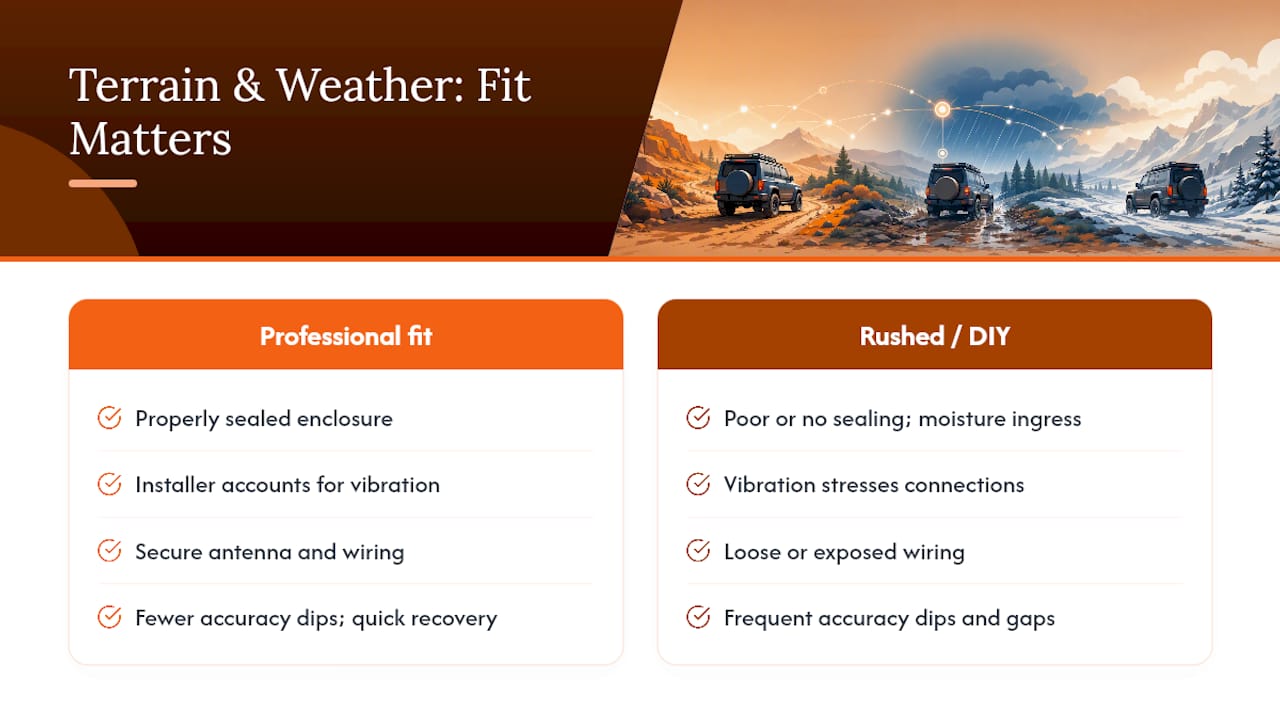
Terrain and weather rarely act alone. A Land Rover crossing a rocky riverbed under heavy rain faces compounding problems: reduced satellite visibility from valley walls, signal attenuation from moisture in the air and canopy, and physical vibration that stresses antenna connections and wiring over time.
Steep gradients and rock crawling create temporary sky obstruction as the vehicle tilts and turns, which briefly worsens PDOP even in otherwise open terrain. Heavy rain and low cloud add another layer of attenuation on top of whatever vegetation is already blocking the signal. Snow and ice bring a different risk entirely, not to accuracy but to hardware. Extreme cold can shorten battery life and, in poorly sealed installations, moisture ingress can corrode connectors over a season of hard use.
None of this means tracking fails outright in bad weather. It means brief accuracy dips and occasional short gaps become more frequent, and the system’s job is to recover a solid fix the moment conditions improve. A well-fitted unit with a properly sealed enclosure and a competent installer who has accounted for vibration and water exposure will weather these conditions far better than a rushed or DIY job. This is precisely why professional fitting on rugged vehicles matters more than it does on a car that only sees tarmac.
Battery life and power management for off-road trackers
Off-road trips often mean longer stretches away from a charging point and heavier demand on the vehicle’s electrical system, so power management deserves real attention rather than an afterthought.
Thatcham-certified units are built with battery backup as standard, precisely so the tracker keeps working if the main vehicle battery is disconnected or the wiring is tampered with. That backup typically needs to sustain the device for a defined period, long enough to survive a theft attempt where power is cut deliberately.
Three habits keep power management solid on a Land Rover used off-road regularly:
- Have the backup battery checked at routine service intervals, since it degrades over years even without frequent use
- Avoid leaving the vehicle unused for extended periods without a maintenance charge, since a flat main battery stresses backup reserves
- Ask your installer how the tracker draws power during extended off-grid trips, particularly if you run other accessories like winches or auxiliary lighting from the same circuit
Cold weather shortens battery performance across the board, off-road trackers included. If you regularly take your Land Rover into remote or wintry terrain, mention that usage pattern to your installer. It can influence which unit and backup configuration suits you best.
Comparing tracker categories for off-road-capable Land Rovers
Choosing between tracker categories comes down to what your insurer requires and how much proactive protection you want on top of that minimum.
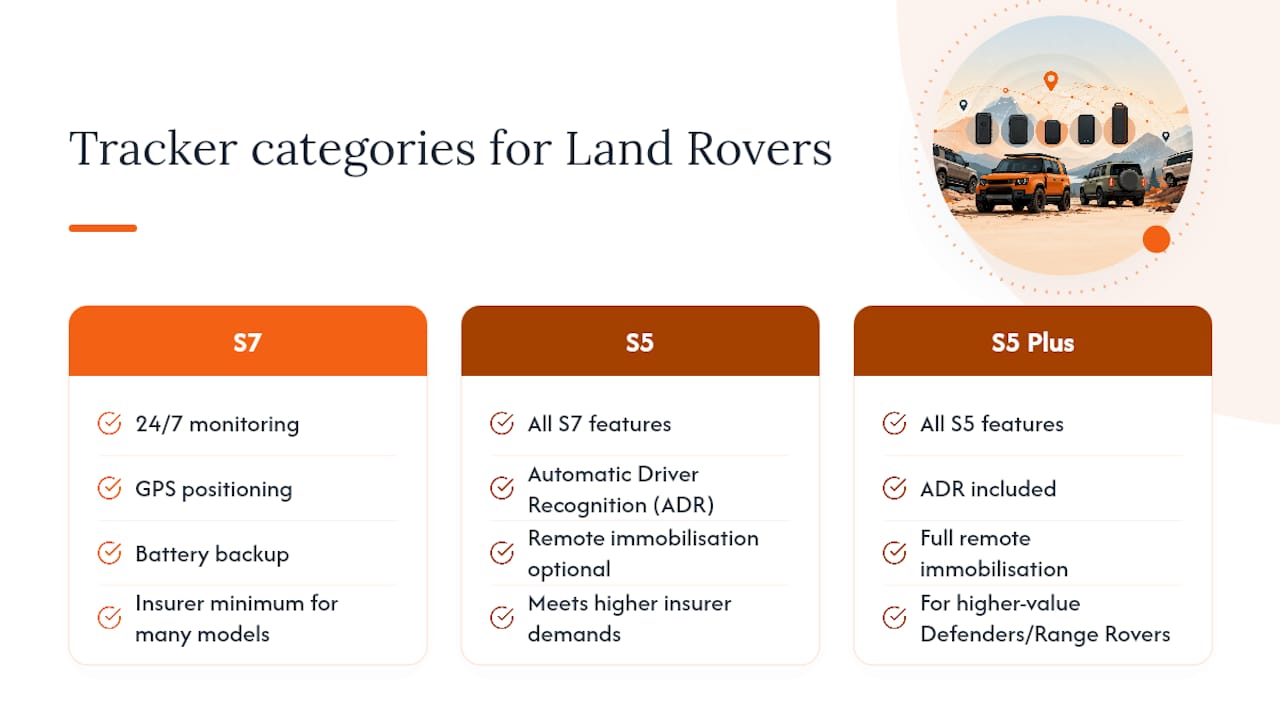
An S7-specified unit covers the core ground: 24/7 monitoring, GPS positioning, and battery backup, sufficient for many insurers on standard Land Rover models. An S5-specified unit adds Automatic Driver Recognition, which distinguishes an authorised driver from an unauthorised one before a vehicle even moves, plus the option of remote immobilisation on qualifying models. Some owners choose an S5 Plus specification for the added assurance of full remote immobilisation alongside ADR, useful for higher-value Defenders or Range Rovers that sit outside a monitored compound.
There is no universal right answer here. Buying a higher category than your insurer strictly requires can add worthwhile proactive protection, but it is an added cost that not every owner needs. The practical approach is to start with your insurer’s stated category, then decide whether the extra layer of ADR or immobilisation earns its keep for how and where you actually drive. For most Land Rover owners using their vehicle off-road regularly, the combination of correct antenna placement, a roaming SIM, and consistent 24/7 monitoring does more for real-world resilience than chasing the highest specification available.
Data security and privacy for off-road GPS tracking
A tracker that reports your Land Rover’s location constantly is only as trustworthy as the systems handling that data. Two things matter here: how the data reaches the monitoring centre, and who can access it once it arrives.
Reputable monitoring centres operate under BS 8591, which governs not just response speed but data handling protocols for alarm receiving centres generally. That standard exists partly to ensure vehicle location and owner details are not treated casually. Your app access should be protected the same way you would protect any account holding sensitive personal information, meaning a strong password and awareness of who else has the login.
Off-road use adds one wrinkle worth knowing. Because GPS trackers log continuous position data, that trail could theoretically reveal patterns, favourite routes, regular parking spots, home address, if it fell into the wrong hands. A properly fitted system with tamper detection reduces the risk of the device itself being physically compromised, but the account security side sits with you. Change your app password periodically, and never share login credentials even with people helping you drive or maintain the vehicle.
Maintenance and durability for off-road tracker hardware
Off-road driving is harder on hardware than daily commuting, and a tracker fitted for a Land Rover that regularly tackles green lanes, fords, or rock sections needs to cope with vibration, water exposure, and temperature swings that a city car never sees.
A quality installation accounts for this from day one: connectors properly sealed, wiring routed away from moving parts and heat sources, and the unit mounted somewhere it will not take a direct knock from debris. That groundwork matters more than any single feature on the device itself, because a technically excellent tracker fitted carelessly will fail faster than a solid mid-range unit fitted properly.
Ongoing maintenance is straightforward if you build it into your existing service routine:
- Ask your garage or installer to visually check the tracker’s connections and mounting during annual servicing
- Report any unusual app behaviour, missed updates, delayed alerts, promptly rather than waiting for a bigger fault
- Keep the vehicle’s main electrical system in good order generally, since a tracker’s backup battery works harder if the primary system is already stressed
Thatcham’s periodic review process on certified products exists precisely because hardware degrades and needs checking, not because the initial approval was ever meant to be permanent.
Why specialist fitting beats a generic tracker for Land Rover owners
A generic tracker treats every vehicle the same way. That is the wrong approach for a Defender, Discovery, or Range Rover that spends real time off-road, where antenna placement and mounting decisions carry more weight than on a car that never leaves tarmac.
Lrd-track specialises specifically in Thatcham-approved trackers for Land Rover models, which means installers who understand these vehicles’ particular metal shielding and body layouts rather than applying a one-size-fits-all fitting guide. That specialism extends to professional installation, app-based tracking, and round-the-clock monitoring, giving owners real-time visibility and immediate alerts if something goes wrong.
Choosing a supplier for insurance-approved tracking is not just about the hardware spec sheet. It is about who fits it, who monitors it, and who understands the specific challenges of your vehicle.
— Will
Getting an off-road capable Thatcham tracker fitted
Once you know which category your insurer requires, matching it to the right product is the easy part. Fitting services cover a full Land Rover range, from Defenders to Discoverys, with options scaled to different levels of proactive protection.
If your policy calls for the entry standard, the S7 tracker covers 24/7 monitoring, GPS positioning, and battery backup. If you want driver recognition on top, the S5 tracker adds ADR, and the S5 Plus brings remote immobilisation into the mix for owners who want the fullest layer of protection available. Defender owners specifically can start with the dedicated Defender tracker range.
Every fit includes accredited installation, with an installation certificate provided as standard for insurer records. Book your fitting, get the certificate, and your monitoring goes live from day one.
Sources
- Thatcham vehicle security product definitions and guidelines
- Effects of forest stand characteristics and topography on GNSS‑RF accuracy (PLOS ONE, 2018)