
Yes, a determined thief can sometimes find or disable a tracker. But a professionally installed, Thatcham-approved, monitored system that alerts on power loss or motion changes the odds firmly in your favour. Trackers aid recovery, not prevention. That’s the honest starting point, and it’s why layered security matters more than any single gadget.
TL;DR:
- Thatcham-approved, professionally installed trackers are significantly more resistant to theft attempts than cheap or DIY units, especially when concealed properly.
- Organized thieves use spectrum analyzers and non-linear junction detectors to locate and disable trackers, but legal restrictions limit jamming tactics.
- Power-cutting or wiring removal disables basic trackers instantly, yet units with backup batteries and tamper alerts still report despite these attacks.
- A layered security approach combining a tracker, immobilizer, alarm, driver ID recognition, and secure key storage greatly improves vehicle protection.
- Proper installation and validation of tracker response times, tamper alerts, and backup power are critical for effective recovery and theft deterrence.
Table of Contents
- Can thieves find trackers? How they actually go looking
- Can trackers be jammed or blocked?
- How thieves remove or disable trackers
- Tracker design features that make disabling harder
- Checking your Land Rover for a hidden tracker
- Layered security beats any single device
- Why professional installation and Thatcham approval change outcomes
- What police and recovery operators actually teach owners
- Fit LRD Track and close the gaps thieves rely on
- Sources
Can thieves find trackers? How they actually go looking
Yes, but it takes effort, and effort works in your favour. Casual thieves rely on speed. They want your Land Rover moving within minutes, so they’ll only check the obvious spots: under the dashboard, inside the glovebox, behind wheelarch liners, and clipped to the underbody near the exhaust. If a tracker sits somewhere a torch and a gloved hand can reach in under a minute, it’s already at risk.
Organised crews work differently. They’re patient, better equipped, and treat your vehicle as a puzzle to solve before they move it on.
- Handheld RF scanners and spectrum analysers, including devices like the tinySA Ultra, can detect 4G LTE cellular tracker signals at close range, often within about a metre of the transmitting unit.
- Non-linear junction detectors, originally built for counter-surveillance sweeps, pick up electronic components even when they’re powered off.
- OBD port checks take seconds. Any aftermarket dongle plugged into the diagnostic socket gets yanked immediately.
That gap between casual and organised thieves matters. A cheap plug-in tracker deters neither. A professionally installed, insurance-approved tracker wired into the loom and hidden away from the usual search zones forces even a well-equipped crew to spend time they don’t want to spend, especially with the clock running in a residential street or a car park with cameras.
Can trackers be jammed or blocked?
Yes, in theory. GPS jamming floods satellite frequencies so a device can’t calculate its position, while cellular jamming blocks the signal that reports that position back to a monitoring centre. Faraday enclosures, essentially signal-proof bags or boxes, achieve a similar effect by physically shielding the device from all radio waves.
In practice, jamming is less common in opportunist vehicle theft than most owners assume. It requires specific equipment, technical knowledge, and proximity to the vehicle for it to work reliably, and none of that suits a thief trying to disappear in minutes.
There’s also a legal barrier worth knowing. Using a jamming device in the UK is unlawful, and possessing one carries real risk for anyone caught with it, which limits how widely the tactic actually spreads among opportunist thieves even as organised crews experiment with it.
- GPS jamming disrupts satellite positioning signals
- Cellular jamming blocks the data connection reporting that position
- Faraday shielding physically blocks all radio transmission
Statistic callout: Police and recovery operators report that stolen vehicles are frequently held in a soak yard for 48 to 72 hours while thieves test for hidden trackers, rather than attempting to jam signals outright.
Treating a sudden loss of contact as an alarm condition, rather than a shrug, is how better monitoring services catch jamming attempts as they happen instead of discovering the vehicle gone hours later.
How thieves remove or disable trackers
Removal is the more common threat, not jamming. A tracker sitting loose behind a kick panel or zip-tied under the dash can be pulled out in seconds once a thief knows where to look. A unit properly concealed within the wiring loom, requiring partial disassembly to reach, is a different job entirely, and that difference is exactly why installation quality matters as much as the hardware itself.
Power-cut attacks are the next tactic. Cut the battery feed or the tracker’s dedicated wiring, and a basic unit goes dark instantly with no way to report its last position. Flatbed recovery trucks sidestep the problem completely by lifting the vehicle clear off the road, bypassing immobilisers and wheel locks alike.
The final tactic is patience rather than tools. Thieves move the vehicle to underground car parks, container yards, or other signal-dead locations, or hold it in a soak yard for days to see whether anything pings before they risk moving it further.
- Loose or obviously placed trackers get pulled out within seconds
- Cutting power or wiring silences a basic tracker instantly
- Flatbed transport bypasses immobilisers entirely
- Signal-dead storage and soak yards test for trackers over days
Cheap trackers, or ones fitted without care, are the easiest to defeat on every single one of those fronts.
Tracker design features that make disabling harder
The single biggest factor separating a tracker that survives an attack from one that doesn’t is backup power. A unit with its own internal battery keeps reporting even after the main feed is cut, turning a power-cut attack into the loudest possible warning rather than silence.
Tamper alerts matter just as much. A tracker that flags disconnection, movement outside expected hours, or physical interference gives you and the monitoring centre a head start before the vehicle is even gone.
Reporting frequency is the detail most owners overlook. A tracker on a fixed schedule is far easier for a thief to test than one that pings on motion, because a scheduled unit gives a predictable window to work around. Event-driven pings shrink that window to nothing.
- Backup battery power keeps the unit reporting after wiring is cut
- Tamper and disconnection alerts trigger instant notification
- Motion-activated pings beat fixed-schedule reporting
- Multi-channel positioning (cellular, satellite, RF fallback) keeps working when one method fails
Pro Tip: Ask any installer whether their tracker reports on a timer or on motion. If the answer is “every few hours,” you’re looking at a device built for fleet management, not theft recovery.
Professional concealment and tamper-resistant mounting round out the picture. Where and how a tracker is fitted decides whether a thief finds it in ten seconds or gives up after ten minutes.
Checking your Land Rover for a hidden tracker
If you suspect a tracker has been fitted without your knowledge, a methodical sweep beats a frantic one.
- Start with the obvious zones: under the dashboard, inside the glovebox, behind wheelarch liners, and along the underbody near the fuel tank and exhaust.
- Check the OBD port under the steering column for any device plugged in that you didn’t put there.
- Feel along wiring looms for anything taped, zip-tied, or spliced in that looks out of place.
- If you own or can borrow an RF detector or a basic spectrum analyser, sweep the cabin and boot; these can pick up transmitting devices that a visual check misses.
- Don’t rely on your phone alone. Smartphone “bug detector” apps mostly measure electromagnetic fields crudely and miss most professionally hidden trackers.
- If you find a device, don’t touch it more than necessary and don’t confront anyone connected to it. Photograph it in place, contact the police, and speak to a professional installer or your monitoring provider about next steps.
Layered security beats any single device
A tracker on its own is a recovery tool, not a deterrent. Industry guidance is consistent on this point: the vehicles that get stolen and never come back are usually the ones relying on one layer of protection instead of several.
Build the stack properly and each layer covers a gap the others leave open.
- Choose a Thatcham-approved, insurance-recognised tracker and insist on professional fitting rather than a DIY plug-in unit.
- Pair it with an immobiliser and alarm, so a thief faces resistance before they even reach the ignition.
- Set the tracker to immediate motion and tamper alerts, and confirm your monitoring provider offers rapid response with remote immobilisation.
- Add driver ID recognition so an unrecognised key or fob triggers an alert on its own.
- Keep basic habits tight: store keys away from doors and windows, park under a camera or in a locked compound where you can, and report anything suspicious straight away.
Pro Tip: A tracker paired with an immobiliser in one unit closes the gap between “we know where it went” and “it never left the drive.” Ask whether remote immobilisation is included before you buy.
Why professional installation and Thatcham approval change outcomes
Thatcham Research’s own testing standards confirm what recovery operators see on the ground: professionally installed, approved trackers resist tampering far better than bolt-on alternatives, and they measurably improve recovery rates when a vehicle does go missing.
The operational logic is simple. A soak yard only works against you if the alert takes hours to arrive. A system that pings on motion, holds backup power through a wiring cut, and reaches a monitored response team within moments shortens that window dramatically, sometimes to nothing at all.
Before choosing an installer, ask three questions: does the unit detect tamper and disconnection, does it carry its own backup battery, and what’s the actual response time once an alert fires? Those three answers tell you more than any spec sheet.
What police and recovery operators actually teach owners
Speak to anyone who works recovery cases and the same theme comes up: time is the only currency that matters. The soak yard tactic exists precisely because thieves know most trackers either don’t report fast enough or get found and stripped before anyone notices the vehicle is missing. Every hour a stolen Land Rover sits untouched is an hour thieves buy to test it properly.
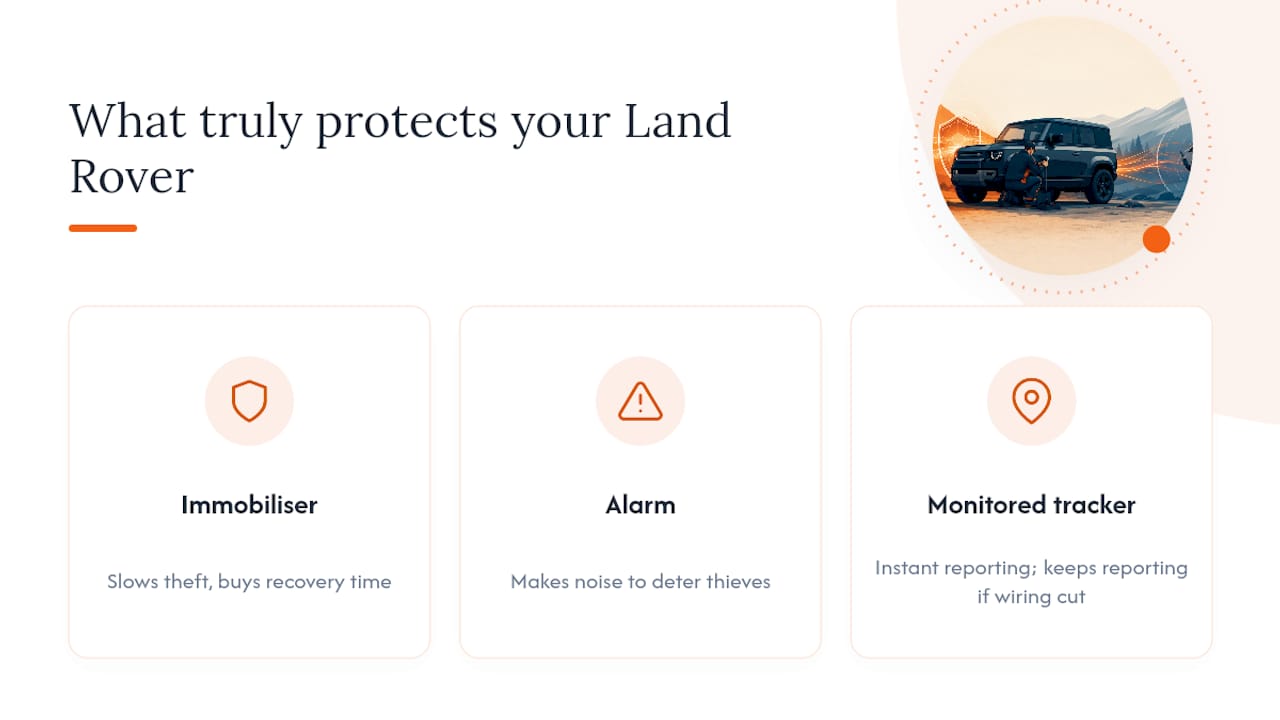
That’s why I’d push back gently on the idea that a tracker “protects” your vehicle. It doesn’t, not on its own. What protects your vehicle is the combination: an immobiliser that slows the theft down, an alarm that makes noise, and a monitored tracker that reports instantly and keeps reporting even when the wiring gets cut. Expect a tracker to help you get your Land Rover back, not to stop someone trying in the first place. Owners who understand that distinction make better decisions about where their money goes.
— Will
Fit LRD Track and close the gaps thieves rely on
Lrd-track builds Thatcham-approved trackers specifically for Land Rover models, which means the concealment, the wiring, and the alert logic are designed around the vehicles thieves target most.
Every unit pairs with professional, UK-wide fitting so the device ends up somewhere a quick tactile search won’t find it, backed by 24/7 monitoring that treats a power cut or unexpected motion as an alarm rather than a delayed data point. For Defender, Discovery, and Range Rover owners, that means real-time alerts, driver ID recognition, and remote immobilisation working together instead of relying on one gadget to do everything.
If you want a tracker and immobiliser working as one system, look at the Defender tracker range with nationwide installation and get fitting booked in before your next long trip, not after your Land Rover has already gone missing once.
Sources
- Stolen cars in Wiltshire sit in hiding for days while thieves wait out the trackers (Wiltshire999s, 2026)
- Security technology (Thatcham Research)