

Fitting a tracker or immobiliser does not automatically void a UK manufacturer warranty. A dealer must prove the device caused the specific fault before refusing a claim, not just point at the wiring and walk away. Two things protect you here: keep every scrap of fitment paperwork, and use a professional installer from day one. Do that, and there’s very little a dealer can legitimately hold against you.
TL;DR:
- The law places the burden of proof on dealers to demonstrate that a fitted tracker directly caused a fault before denying a warranty claim.
- Statutory rights under the Consumer Rights Act 2015 remain intact alongside manufacturer warranties, and verbal claims of warranty voidance are not legally binding.
- Proper documentation, such as signed fitment certificates and wiring schematics, significantly reduces the risk of losing warranty coverage over aftermarket devices.
- Thatcham-approved trackers installed with non-invasive wiring methods and retaining documentation are the safest options to avoid warranty disputes.
- Invasive or poorly documented installations, especially involving cutting into factory wiring or CAN-bus systems, pose the most genuine risk of creating causation links that dealerships can exploit.
Table of Contents
- Tracker void warranty claims: what UK law actually says
- Denied claim or voided warranty: what’s the real difference?
- Trackers vs immobilisers: where the real warranty risk sits
- Fitting a tracker without creating warranty headaches
- If a dealer says your warranty is void: your next steps
- What installer best practice actually looks like
- What the industry gets wrong about warranty risk
- Thatcham-approved tracking for Land Rover owners, fitted right the first time
- Sources
- FAQ
Tracker void warranty claims: what UK law actually says
Here’s the bit dealers sometimes gloss over: your statutory rights don’t bend to suit a service desk policy. The Consumer Rights Act 2015 gives you a right to goods that are of satisfactory quality and fit for purpose, and that right runs alongside any manufacturer or dealer warranty, not underneath it.
A manufacturer’s warranty is a commercial promise on top of your statutory protections. It can add benefits, but it cannot take away what the law already gives you. If a service manager tells you fitting a tracker “voids everything,” they’re describing dealer policy, not the law.
This matters for how a warranty dispute actually plays out. The legislation itself, including specific sections covering these protections, shapes what a dealer is required to prove before they can lawfully knock back your claim.
Practically, that means:
- The dealer carries the burden of showing your tracker caused the fault, not the other way round.
- A blanket “any modification voids the warranty” line has no legal weight on its own.
- Statutory rights under the Act apply regardless of what’s printed in a dealer’s internal handbook.
- You’re entitled to ask for the specific reasoning behind a refusal, in writing.
None of this means you can fit anything, anywhere, with no consequences. It means the law puts the evidential burden on the dealer, not on you. That distinction is the entire article in one sentence.
Denied claim or voided warranty: what’s the real difference?
Dealers and owners often use “voided warranty” loosely, and that loose language causes most of the panic. In reality, there’s a specific legal test that has to be met before a claim can be lawfully refused.
- Causation is the test, not correlation. A dealer must show the tracker or immobiliser directly caused the failed component, not simply that it was fitted somewhere nearby.
- A denied claim is narrow. Warranty providers usually deny the individual repair linked to the modification, not the whole vehicle warranty. Full-vehicle avoidance is generally reserved for extreme cases: salvage history, odometer fraud, or serious neglect.
- Ask for the evidence, not the opinion. Request the diagnostic report that shows the fault trail, and ask which wiring or component the tracker is alleged to have affected.
- Get it in writing. A verbal “that’ll have voided it” from a technician on the ramp isn’t a decision, it’s a guess. Insist on a written explanation before you accept it.
If a dealer can’t produce a diagnostic report linking your GPS tracker to the actual fault, you’re looking at an unsupported assertion, not a lawful denial. That’s worth remembering the next time someone at a service desk reaches for the word “void” a little too quickly.
Trackers vs immobilisers: where the real warranty risk sits
Not all aftermarket security devices carry the same risk, and lumping them together is where a lot of confusion starts.
- Passive GPS trackers log location data without any live monitoring link. They’re typically the least invasive to fit.
- Monitored, Thatcham-approved trackers add 24/7 tracking and alerts, usually via a professional install that respects the vehicle’s existing wiring loom.
- Hardwired installs tap into the vehicle’s power supply directly, which raises the stakes if done badly.
- CAN-bus immobilisers interact with the vehicle’s internal data network, the part manufacturers are most protective of.
The failure modes that actually get blamed on aftermarket kit tend to be specific: incorrect wiring causing a short circuit, a poorly earthed connection draining a battery, or CAN-bus interference triggering fault codes the ECU wasn’t expecting. Technically invasive changes, such as cutting into the CAN bus, rerouting factory circuits, or splicing into manufacturer connectors, are the modifications most likely to hand a dealer a genuine causal link.
Pro Tip: Ask your installer whether the tracker uses an inline module rather than a spliced connection. Inline fitting taps into the circuit without cutting factory wiring, which is exactly the kind of non-invasive approach that keeps a dealer’s causation argument weak.
Thatcham approval matters here because it’s the benchmark insurers and installers already recognise, which means a Thatcham-approved unit is far less likely to be the product of guesswork wiring in the first place.
Fitting a tracker without creating warranty headaches
Getting this right isn’t complicated, but it does need a bit of forethought before the installer arrives.
- Choose Thatcham-approved equipment, particularly if your insurer specifies it as a policy condition. Our guide to Thatcham-approved GPS trackers breaks down which approval categories matter for which vehicles.
- Book a vehicle-specific, professional installer and ask them explicitly to avoid cutting into manufacturer wiring where a non-invasive alternative exists.
- Keep every document: purchase receipt, install report, activation confirmation, and ideally a short wiring schematic showing exactly what was connected and where.
- Get the VIN recorded on the paperwork and ask the installer to sign a short fitment certificate confirming the make, model, and method used.
Pro Tip: A signed fitment certificate takes an installer two minutes to produce but can save you weeks of back-and-forth at a dealer service desk. Ask for one every single time, even if the installer seems surprised you’ve requested it.
For CAN-bus specific installs, our checklist for avoiding MOT and warranty issues on CAN-bus immobilisers covers the technical checks worth running before the vehicle leaves the workshop.
If a dealer says your warranty is void: your next steps
Don’t accept a verbal refusal at face value. Work through this in order.
- Ask for the exact clause. Request the specific wording from the warranty document the dealer is relying on. A genuine refusal has a paper trail; a bluff usually doesn’t.
- Get a VIN-based warranty status check. Contact manufacturer customer services or check the vehicle’s recall and safety status directly. Dealerships sometimes have registration or reporting errors on their end, and a VIN check separates an administrative mix-up from a genuine technical dispute.
- Insist on a written diagnostic report that specifically links the fault to the aftermarket device, not a general note that a tracker was present.
- Escalate methodically if the service manager won’t budge: manufacturer customer service next, then Citizens Advice, Trading Standards, or the Motor Ombudsman if things stall further.
Keep copies of everything at each stage. A VIN-based printout or manufacturer service screen is often the single most persuasive piece of paper you can put in front of a dealer, because it settles the administrative question before you even get to the technical one.
What installer best practice actually looks like
Thatcham-approved fitment, nationwide installer coverage, and 24/7 monitoring aren’t just features on a spec sheet, they’re the practical habits that stop disputes before they start. A properly trained installer checks the VIN against the correct wiring diagram for that exact model year, avoids cutting into factory circuits wherever a non-invasive route exists, and signs off the work with paperwork the owner can actually use later.
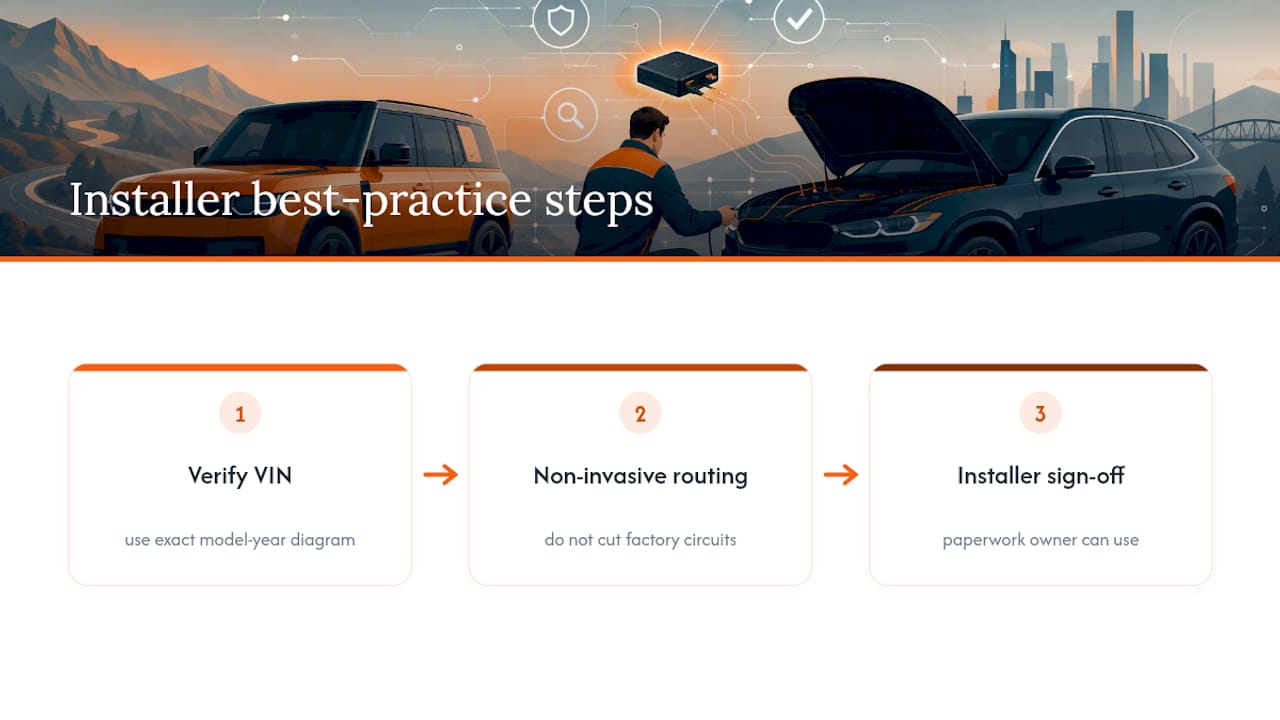
Consumer advocates have noted that some dealers use “void” as a scare word rather than a documented finding, which is exactly why installer sign-off and clear documentation matter so much. A hardwire installation done properly, with the paperwork to prove it, removes most of the ambiguity a dealer could otherwise exploit.
What the industry gets wrong about warranty risk
Most advice on this topic treats “will it void my warranty?” as a yes or no question. It isn’t. It’s a question of evidence, and the evidence burden sits with the dealer, not you.
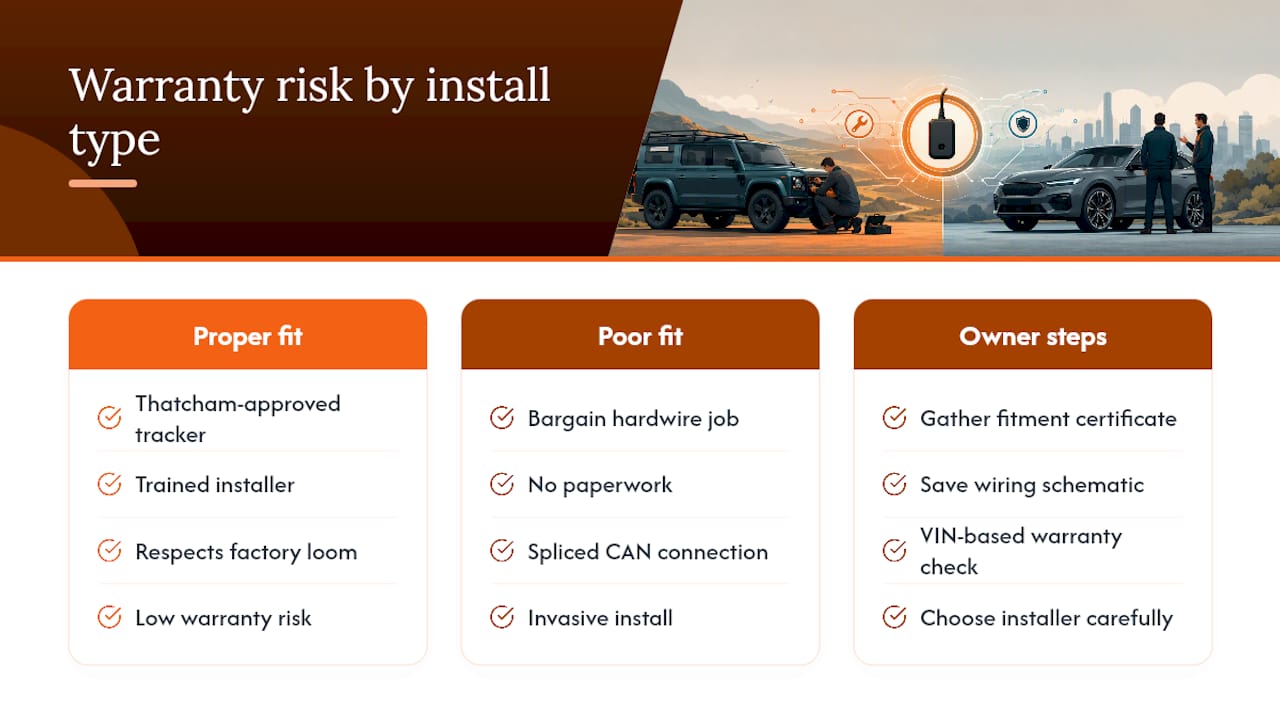
The conventional wisdom tends to overstate the risk of trackers specifically while underplaying the real culprit: invasive, badly documented installs of any kind, whether that’s a tracker, an infotainment retrofit, or an ECU remap. A Thatcham-approved tracker fitted by a trained installer who respects the factory wiring loom is a low-risk addition. A bargain hardwire job with no paperwork and a spliced CAN connection is a different animal entirely, and owners rarely distinguish between the two when they’re worried.
If you take one thing from this, prioritise documentation over anxiety. A signed fitment certificate, a saved wiring schematic, and a VIN-based warranty check cost you almost nothing to gather and dismantle the vast majority of “void” claims before they go anywhere. BMW and Land Rover owners in particular, given how tightly integrated modern CAN-bus systems are, should treat installer choice as the real decision, not whether to fit a tracker at all.
— Will
Thatcham-approved tracking for Land Rover owners, fitted right the first time
We offer an alternative to generic high-street fitters for Land Rover security. Each tracker is Thatcham-approved and professionally installed with attention to your vehicle’s wiring, supported by 24/7 monitoring and real-time theft alerts.

That combination matters directly for everything covered above. A professional, non-invasive install with signed paperwork and a recorded VIN is exactly the evidence trail that keeps a warranty dispute from ever getting started. Our nationwide installation service covers Defender, Discovery, and Range Rover models across the UK, and every fitment comes with the documentation you’d want on hand if a dealer ever raised an eyebrow.
If you’re ready to protect a Defender specifically, browse the Land Rover Defender tracker range and book UK-wide installation directly.
Sources
The Consumer Rights Act 2015 sets out your statutory protections in full. For a technical fault dispute, contact your manufacturer’s customer service team for a VIN-based warranty check, and use gov.uk’s recall checker to rule out unrelated safety issues before assuming a tracker is to blame.
This article is general information, not a substitute for advice from a qualified lawyer. Consult a qualified legal professional about your own circumstances before acting on anything here.
FAQ
What voids a car warranty in the UK?
Only modifications proven to directly cause a specific fault typically void cover for that repair; full-warranty voidance is rare and usually reserved for salvage history, odometer fraud, or serious neglect.
Are warranty void stickers legal in the UK?
A sticker claiming a modification “voids warranty” has no automatic legal force. Under the Consumer Rights Act 2015, the dealer still has to prove causation regardless of what a sticker says.
Is the EU two-year warranty valid in the UK?
UK statutory consumer protection under the Consumer Rights Act 2015 already provides broadly comparable rights to goods of satisfactory quality, and this domestic law is what applies to UK purchases now, not EU directives.
What is the cancellation fee for a tracker subscription?
Cancellation terms vary by provider and depend on the specific monitoring plan and contract length, so check the terms attached to your particular subscription before assuming a fixed figure applies.
Does fitting a Thatcham-approved tracker reduce warranty risk?
Yes, because Thatcham-approved devices are fitted to a recognised installation standard that insurers and manufacturers already accept, which limits the wiring errors dealers could otherwise point to as a cause of failure.