
Yes, a tracker is worth buying if your vehicle sits in a high-theft category or you’d struggle to replace it outright. For a Land Rover Defender or Discovery, that’s almost always the case. Look for Thatcham approval and professional installation before anything else. Which category you need depends on your vehicle and your insurer, covered next.
TL;DR:
- Thatcham S7 trackers provide basic location tracking and theft alerts, but S5 and S5 Plus models include driver recognition and remote immobilization features.
- Hardwired, professionally installed trackers are more tamper-proof and preferred by insurers than plug-in or battery-powered units, especially in high-theft areas.
- Costs for trackers start around £200 for S7 and can go higher for S5 and S5 Plus systems, with monthly monitoring subscriptions typically adding £15 or more.
- GPS-only trackers are vulnerable to jamming, whereas VHF-capable or dual-band systems maintain signals in challenging environments like underground parking.
- Ensuring the tracker has Thatcham approval and a clear certification is crucial for insurance discounts and effective recovery response.
Table of Contents
- Types of trackers and what Thatcham categories actually mean
- What trackers actually give you back for the money
- What a tracker actually costs in the UK
- Where trackers fall short, and why that’s still fine
- How to decide: a practical checklist before you buy
- Factory telematics versus a proper theft-recovery tracker
- LRD Track’s experience with Land Rover security
- When I’d actually pay for a tracker
- Getting a Thatcham-approved tracker fitted to your Land Rover
- Sources
Types of trackers and what Thatcham categories actually mean
Not all trackers do the same job, and that’s precisely where confusion creeps in. UK insurers lean on Thatcham classifications to judge whether a device is fit for purpose. The categories are not marketing labels. They’re tested standards.
S7 is the entry point. It tracks location and sends theft alerts, giving you a fighting chance of recovery without the extra bells. S5 builds on that with driver recognition (the system knows if an unrecognised person is driving) and remote immobilisation, letting a monitoring centre cut the engine if the vehicle’s stolen. S5 Plus does the heavy lifting when things go properly wrong, adding VHF transmission so the vehicle can still be located when GPS signal drops out entirely, which happens more often than owners expect.
How the unit gets fitted matters just as much as the category:
- OBD plug-in devices are quick to install and cheap, but they sit in plain sight under the dashboard and can be unplugged in seconds.
- Hidden battery-powered units are harder to spot but need periodic servicing to keep the battery alive.
- Hardwired, professionally hidden installs connect straight into the vehicle’s electrics and are the closest thing to tamper-proof.
Thatcham approval matters because it’s the reference point insurers actually check. Without it, a discount or mandated fitment simply won’t apply, whatever the tracker’s specification sheet claims. Our Thatcham S5 guide for Land Rover owners breaks down exactly which models qualify.
What trackers actually give you back for the money
The real return sits in three places: faster recovery, lower premiums, and fewer sleepless nights. When a monitored tracker flags a theft, police recovery teams work with a live location feed rather than a cold trail, and that speed is the entire point of owning one.
Pro Tip: A tracker without active monitoring is just a chip that knows where your car is. The value comes from someone acting on that data at 3am, not the hardware itself.
The practical benefits break down like this:
- Faster, evidence-backed recovery — monitoring centres can hand police a precise location rather than a last-known address.
- Immobilisation on demand — S5 and S5 Plus units let a control room stop the engine remotely once theft is confirmed.
- Driver ID — flags when someone unrecognised is behind the wheel, often before the vehicle’s even left the drive.
- Insurance leverage — some insurers require a Thatcham-approved tracker on higher-risk models before they’ll offer cover at all, and a compliant install can meaningfully affect your premium.
- Everyday extras — mileage logs and location history are useful if you run a Land Rover for work, not just security.
None of this prevents theft on its own. What it does is turn a stolen vehicle into a recoverable one, which for a Defender or Discovery is the difference between an insurance claim and getting your own vehicle back.
What a tracker actually costs in the UK
Budget in two parts: the hardware and fitting, then the ongoing subscription that keeps the monitoring live.
Entry-level S7 units typically start from around £200, with subscriptions of roughly £15 a month for the monitoring service, according to Carwow’s pricing breakdown. S5 systems cost more upfront, reflecting the immobilisation and driver ID hardware, and VHF-capable S5 Plus units sit higher still because of the extra transmitter.
A few things worth budgeting for beyond the headline price:
- Professional hardwired fitting usually costs more than a plug-in install, but it’s often what insurers expect for higher categories.
- Subscription fees fund the actual recovery service, not just the app, so lapsing on payments can quietly switch off monitoring without disabling the physical unit.
- Missed payments can also affect whether your insurer still recognises the tracker as active, which matters if you ever need to claim.
Our full UK tracker cost breakdown covers model-specific figures if you want exact numbers for your Land Rover.
Where trackers fall short, and why that’s still fine
No tracker stops a determined thief in the moment. What it does is improve the odds of getting the vehicle back, and understanding the limits helps you buy the right level of protection rather than the cheapest one.
- Signal jamming — cheap GPS-only jammers are widely available to organised thieves, which is why dual-band or VHF-capable systems hold an edge: they keep transmitting even when GPS is blocked.
- Physical removal — OBD plug-in units can be found and pulled in seconds by anyone who knows where to look, which is precisely why hardwired installs are considered the stealth standard.
- Coverage blind spots — GPS struggles underground and in dense multi-storey car parks; VHF fallback closes that gap.
- Battery-powered units — convenient to fit but they need checking, because a dead battery is a silent failure you won’t notice until it’s too late.
Trackers work best as recovery-support tools rather than theft-proof shields, and that’s worth being honest about before you buy. The strongest setups pair a hidden, hardwired tracker with an immobiliser, secure parking, and basic habits like never leaving keys near the front door. Our piece on how Land Rovers actually get stolen shows exactly why layering matters.
How to decide: a practical checklist before you buy
Start with an honest risk assessment rather than the marketing on a tracker’s box.
- Vehicle value — the more expensive the replacement cost, the easier the case for a higher Thatcham category.
- Parking situation — a driveway with CCTV is a different risk profile to street parking near a main road.
- Work use — a van or Defender used for trade work with tools inside carries added exposure.
- Previous incidents — a past theft attempt on your model or in your postcode is a strong signal to upgrade.
Once you know your risk profile, matching it to a tracker type is straightforward: lower-risk vehicles are usually well served by S7, while higher-value or frequently targeted models justify S5 or S5 Plus with immobilisation and VHF backup.
Before booking any installer, ask these four questions:
- Which Thatcham category does the device carry, and can you show the certificate?
- Does the system include remote immobilisation, and who operates the monitoring centre?
- What’s the typical response time once a theft alert triggers?
- Will I receive proof of fit for my insurer, and does it list the exact installation date?
Walk away from anyone who can’t answer the certificate question clearly. A missing or vague Thatcham reference is the biggest red flag in this market, because monitored recovery response is what actually gets a stolen vehicle back, not the tracker sitting quietly on its own.
Factory telematics versus a proper theft-recovery tracker
Built-in manufacturer telematics and an insurance-approved tracker solve different problems, and mixing them up is a common, costly mistake.
- OEM telematics systems are generally designed for servicing reminders and remote app features, not certified theft recovery.
- A genuine Thatcham-approved device is independently tested against theft scenarios and recognised by insurers.
- Buying a used Land Rover that already has a tracker fitted? Ask for the original certificate and confirm whether the subscription transfers to you or needs restarting.
- Professional hardwire installation, done once by a specialist, tends to beat factory systems on stealth and on insurer acceptance, since the unit is hidden and verified rather than a standard fitment every thief already knows about.
If you’re unsure what’s already on your vehicle, our guide to Thatcham-approved trackers explains what documentation to look for.
LRD Track’s experience with Land Rover security
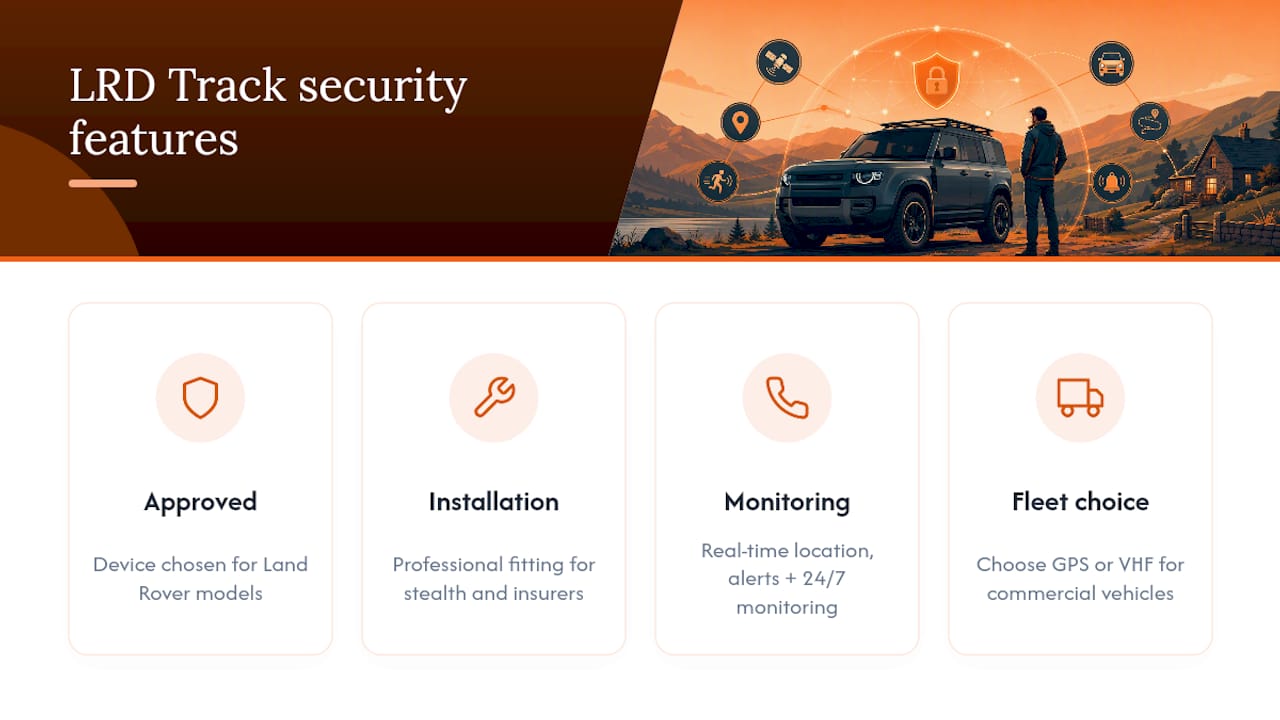
Land Rovers sit near the top of UK theft league tables, and that’s the entire reason LRD Track exists. Every device fitted is Thatcham-approved, chosen specifically for Defender, Discovery, Range Rover, and Grenadier models rather than adapted from a generic catalogue.
Installation is carried out professionally, not as a DIY plug-in job, which matters both for stealth and for insurer acceptance. The accompanying app gives real-time location and alerts, backed by 24/7 monitoring, so a theft in progress triggers a response rather than sitting unnoticed until morning. Fleet operators and logistics firms face a similar equation when choosing between GPS and VHF-capable systems, as this breakdown of courier GPS tracking sets out for commercial vehicles.
When I’d actually pay for a tracker
I’d fit one without hesitation on a Defender parked on a driveway near a main road, a Discovery used for work with tools left inside overnight, or any Land Rover that’s had a previous theft attempt nearby. I’d be far more cautious about relying on a cheap consumer tag marketed for luggage, since it lacks monitored recovery entirely. For a Land Rover specifically, a specialist install is the sensible route.
— Will
Getting a Thatcham-approved tracker fitted to your Land Rover
If you’ve read this far and decided a tracker earns its place on your Defender, Discovery, or Range Rover, there are Thatcham-approved S7 and S5 installs available, done professionally, with nationwide fitting rather than a postcode lottery.
Booking is straightforward. You choose the category that matches your risk profile, an installer fits it hardwired rather than as a quick plug-in, and you receive a certificate your insurer may want to see. Subscription terms and monitoring cover should be explained upfront, not buried in small print. For owners weighing up the entry-level route, the S7 tracker for Land Rovers covers the basics properly; for those wanting immobilisation and driver ID, the S5 tracker with driver ID is the stronger fit. Start by checking Defender-specific tracker options for your model.
Sources
- Car Tracker: Do I Need One and How Much Does It Cost? | Carwow
- Vehicle tracking: tracker review and guidance — Expertsure