
Monitored, Thatcham-approved tracker alerts are commonly treated as higher priority once verified, but that priority still depends on force resources and confirmed location data. If your Land Rover is being stolen right now, call 999 immediately. If you’ve already found an unfamiliar device or your vehicle is missing, call 101 and notify your tracker’s monitoring centre straight away, and don’t touch anything you didn’t fit yourself.
TL;DR:
- Verified tracker alerts require confirmation of movement, a reliable GPS fix, and proper documentation before police action, not just app notifications.
- Responding quickly within the “golden hour” with continuous, timestamped location data significantly improves the chances of vehicle recovery.
- Accurate and continuous data from Thatcham-approved trackers, professionally installed, are essential for police to treat theft alerts as credible and act promptly.
- Chain of custody and verified evidence logs are crucial for prosecutor trust and legal validation in court; sporadic or poor accuracy logs are often unhelpful.
- Proper owner preparation, including active subscriptions, device ID records, and integrated backup devices, strongly influences the speed and success of police recovery efforts.
Table of Contents
- Police response to tracker alerts: how verified reporting works
- What to do the moment you get an alert
- What actually determines how fast police respond
- How tracker data holds up as evidence
- Getting your preparation right before you ever need it
- A specialist installer’s view on supporting police recovery
- Police recovery versus private tracking firms: who does what
- Where the law limits what police can do with tracker data
- Why some tracker alerts don’t get the response owners expect
- Get proper police-recognised tracking before you need it
- Editorial take: what the conventional advice gets wrong
- Sources
Police response to tracker alerts: how verified reporting works
Not all tracker alerts land on a control room desk the same way. A “verified response” means a monitoring centre has confirmed the vehicle is actually moving without authorisation, obtained a reliable location fix, and packaged that information before it reaches police. That’s a different proposition to a raw phone notification pinging on someone’s mobile with no human checking whether it’s real.
The distinction matters because police allocate resources based on how actionable an alert is. A Secure Operating Centre (SOC), the monitoring hub behind an accredited tracker, exists precisely to close that gap. When a device signals unexpected movement, the SOC typically works through a short but rigorous sequence:
- Confirm the movement isn’t the registered driver using the vehicle normally.
- Pull a reproducible GPS fix, ideally repeated over a few minutes to prove the vehicle is genuinely in transit.
- Cross-check registration, device ID, and last known location against the account on file.
- Compile an evidence packet, timestamps, coordinates, and vehicle details, ready to hand to a police force.
- Contact the relevant control room directly, rather than leaving the owner to explain everything from scratch.
This is where monitored alerts supplying live location and SOC verification give dispatchers something concrete to act on, rather than a vague report filed hours after the fact. Forces increasingly treat a verified, moving-vehicle alert as closer to a crime in progress than a standard theft report, because pursuit and interception only work if the location data is fresh and trustworthy. An SOC that can supply a timestamped, repeatable fix is doing the job a lone owner with a phone app usually cannot do under pressure.
What to do the moment you get an alert
Acting fast and acting correctly matters more than acting dramatically. Here’s the order that actually helps:
- Call 999 if the theft is happening now, meaning you can see the vehicle being taken or it’s moving away in real time. This is treated as an emergency.
- Call 101 if you’ve discovered the vehicle missing after the fact, and give the operator your registration, the tracker’s last confirmed fix, and the device ID if you have it.
- Contact your monitoring centre in parallel, not instead of the police, so they can escalate the same verified data through their own police liaison channel.
- Do not approach the vehicle yourself if you locate it live on the app. Share the location with police and let them handle interception; a moving stolen vehicle is not something to confront alone.
- If you find an unknown tracker fitted to your own car, leave it exactly where it is. Police advise against handling or removing a device you didn’t fit, because it may carry forensic evidence, fingerprints or otherwise, that helps trace who placed it. Photograph its position and note where you found it instead.
- Have your dashcam timestamps ready. If your car has one, note the approximate time it last recorded the vehicle in your possession; this narrows the investigation window considerably.
Clear, specific information beats a panicked phone call every time. The more precise you are about registration, device ID, and last fix, the faster the alert becomes actionable.
What actually determines how fast police respond
Response speed isn’t fixed. It swings on a handful of practical variables that have nothing to do with how much you paid for your tracker.
Local resourcing is the biggest factor. A force juggling several live incidents simultaneously will triage; a verified moving-vehicle alert competes with everything else happening that shift. Patrol availability in a given area at a given hour genuinely changes outcomes.
Jurisdiction handovers slow things down. A vehicle that crosses from one force’s area into another’s requires a handover, and that transition point is where delays creep in. This is one reason police increasingly cross-reference tracker data with automatic number-plate recognition and commercial databases, because integrated systems help investigators follow a vehicle across boundaries faster than a phone call between control rooms.
Tracker type changes the picture entirely. A hardwired, monitored unit supplying continuous GPS fixes gives police something to chase in real time. Consumer Bluetooth tags don’t offer the same continuous, verified feed, and that gap in evidential value shows up directly in how proactively a force can respond.
- Concurrent incidents and patrol availability at the time of the alert
- Whether the vehicle crosses force boundaries mid-pursuit
- Continuous monitored GPS versus sporadic consumer-grade pings
- How quickly the initial alert was raised after the theft began
The so-called “golden hour” is real in the sense that recovery odds drop sharply the longer a vehicle is left unaccounted for. A verified alert raised within minutes, backed by continuous location data, gives police their best realistic shot.
How tracker data holds up as evidence
Location data only helps a prosecution if it can survive scrutiny in court, and that comes down to chain of custody as much as accuracy.
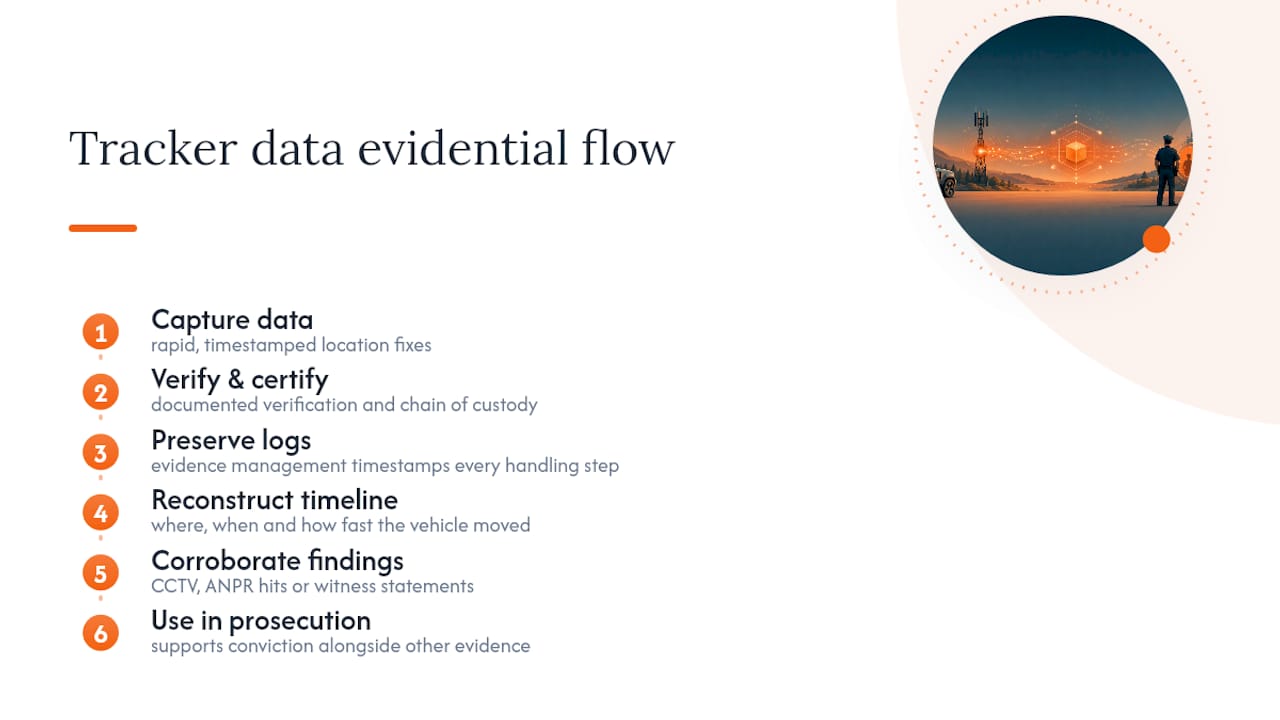
A monitored tracker needs to supply rapid, timestamped location fixes and a documented verification step that police can rely on when deciding whether a proactive response is worth allocating. Sporadic pings with poor accuracy are often not actionable, however alarming they look on an app.
That’s the practical bar. Original logs matter because a court needs to trust that the timestamps and coordinates weren’t altered after the fact. Evidence management systems record every handling step for physical and digital evidence, timestamping transfers and keeping an audit-ready record that police and prosecutors can point to when tracker logs are submitted as part of a case. Without that structure, a defence solicitor has an easy line of attack: how do we know this data wasn’t edited?
Timestamps and location history build the timeline investigators actually use, showing where a vehicle went, how fast, and when it stopped. That sequence often does more to secure a conviction than any single dramatic data point.
There are real limits, though. GPS accuracy varies with signal quality, buildings and tunnels distort fixes, and in rare cases signals can be spoofed. That’s why investigators lean on corroboration, CCTV footage, ANPR hits, or witness statements, to back up what the tracker shows rather than relying on it in isolation. A tracker log is powerful evidence, but it’s rarely the only evidence a case is built on.
Getting your preparation right before you ever need it
None of this works retroactively. The single biggest failure point isn’t the tracker technology itself, it’s owners who let a subscription lapse, forget their device ID, or never test whether their app actually logs history properly.
Keep your monitoring subscription active without gaps, and write down your device ID and installer details somewhere you can find them under stress, not just in an email you’ll struggle to search on your phone at 2am. Check that your app retains historical logs rather than just showing a live pin, and if the manufacturer offers automatic backups, switch them on.
Complementary devices strengthen your position considerably. A dashcam gives you an independent timestamp; an immobiliser buys you time before a thief even gets moving. If your tracker offers driver identification, register it, because it adds another data point that helps verify unauthorised use quickly rather than ambiguously.
Pro Tip: Save your insurer’s claims line and your tracker monitoring centre’s direct number in your phone contacts now, under names you’ll recognise instantly. The thirty seconds you save searching for a number during a genuine theft can be the difference between a live pursuit and a cold trail.
Professional installation also plays a bigger role than most owners assume, not just for reliability but for reducing the false alarms that waste everyone’s time, including yours.
A specialist installer’s view on supporting police recovery
Thatcham-approved fitting isn’t a box-ticking exercise. Placement quality directly affects whether a unit delivers the continuous, accurate fixes a monitoring centre needs to verify movement quickly. Professional installation and monitored services reduce false positives compared with a device wedged in by hand, and that reliability is what lets a SOC hand police clean, actionable data rather than a shaky signal that needs re-checking.
Certain specialist tracker providers offer UK-wide installation with 24/7 monitoring and standard escalation procedures for handing verified alerts to police where needed. If your vehicle goes missing, the fastest route is reporting the incident to Lrd-track’s monitoring team alongside your 101 call, so escalation to police happens on verified data rather than a second-hand description.
Police recovery versus private tracking firms: who does what
Police and private tracking providers aren’t in competition, they’re running parallel tracks that only work well together when the handover is clean. A private monitoring centre’s job stops at verification and evidence packaging; only police have the legal authority to pursue, intercept, or seize a vehicle, and no monitoring firm can substitute for that.
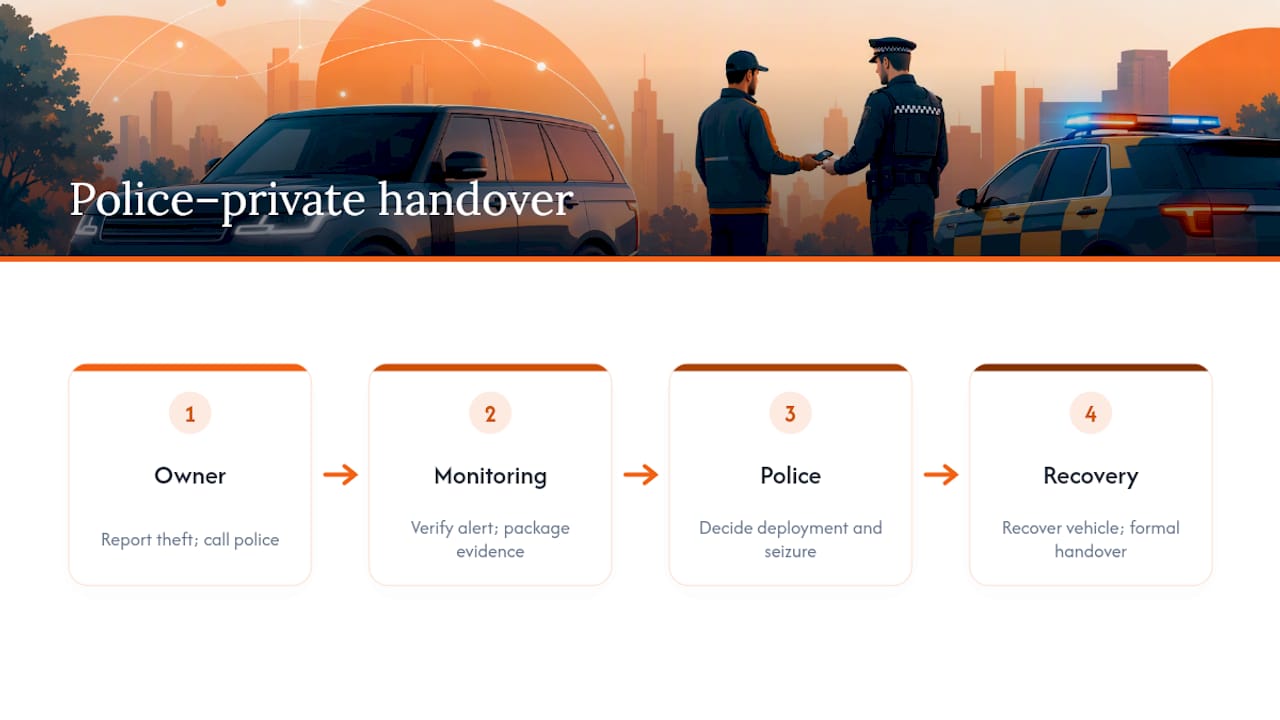
Where things go wrong is when owners assume a tracker app replaces the 999 or 101 call entirely. It doesn’t. The SOC’s evidence packet is designed to make a police response faster and better informed, not to bypass it. Forces coordinate with accredited monitoring centres because it saves them time verifying claims themselves, but the decision to deploy a patrol car or authorise a pursuit sits entirely with police command.
Private recovery firms without formal police liaison arrangements can sometimes create confusion rather than clarity, especially if they encourage an owner to approach a located vehicle independently. That’s a safety risk, not a shortcut. The providers worth trusting are the ones with documented handover procedures, because that’s the difference between data that speeds up a police response and data that just sits in an app nobody official ever sees.
Where the law limits what police can do with tracker data
Tracker data doesn’t give police unlimited licence to act. Officers still need reasonable grounds to pursue, stop, or search based on what a tracker shows, and location data on its own is a starting point for investigation rather than automatic proof of theft.
Consent matters enormously here, and it cuts both ways. If someone fits a tracker to a vehicle without the owner’s knowledge, that can amount to harassment or unlawful surveillance under UK law, and police will investigate the person who placed it, not just the person being tracked. This is worth knowing if you ever suspect a device on your own vehicle wasn’t fitted by you, your dealer, or your insurer.
For legitimate theft cases, data sharing between forces and accredited providers generally operates within data protection frameworks that require proportionate, documented use. That’s part of why chain of custody, covered earlier, carries so much weight; data obtained or handled improperly risks being challenged or excluded before it ever reaches a courtroom. Owners considering fitting a tracker to a vehicle they don’t solely own, a shared family car, a company vehicle, should check the legal position on consent before installation, not after a dispute arises.
Why some tracker alerts don’t get the response owners expect
False alarms erode trust fast, and they’re more common than most owners realise. A tracker misreading a tow to the garage as a theft, or a driver forgetting to disable an alert before a legitimate trip, generates noise that control rooms have learned to treat cautiously. That caution is rational, but it means genuinely urgent alerts can occasionally get less attention than they deserve if the reporting history looks unreliable.
Data delays are the other recurring problem. Consumer-grade devices that ping infrequently, sometimes every few minutes rather than continuously, can leave a real gap between where a vehicle actually is and where the last fix placed it. A fleet-style GPS system built for continuous tracking illustrates the contrast well: constant positional updates matter far more for a live pursuit than occasional check-ins, which is exactly why monitored vehicle trackers are built differently to item-finding tags.
Resource limitations compound both problems. Even a perfectly verified, real-time alert competes against every other live incident a force is handling that hour. There’s no way around this reality, only around minimising your own contribution to it: keep your system monitored, keep false triggers to a minimum, and make sure the data you hand over is as clean as possible.
Get proper police-recognised tracking before you need it
None of this preparation helps if the tracker fitted to your Land Rover isn’t reliable enough to give a monitoring centre a clean fix in the first place. Thatcham-approved tracking units are available for Defender, Discovery and Range Rover models, often offered with professional installation and 24/7 monitoring services.
The S5 tracker with driver identification gives you continuous monitored coverage plus a record of who’s driving, which matters both for insurance and for the kind of verified data police respond to fastest. If you want backup coverage built in, the S7 insurance-approved tracker adds that resilience. And if you’re weighing up which unit suits your vehicle, Lrd-track’s Defender tracker range covers UK-wide fitting and support from a team that understands exactly what a control room needs to see.
Editorial take: what the conventional advice gets wrong
Most guidance on tracker theft focuses on the gadget and skips the plumbing behind it. A monitored device is only as useful as the verification chain behind it, and that’s the part owners underestimate most. Buying a tracker isn’t the finish line; keeping the subscription active, knowing your device ID, and understanding that a SOC exists to translate raw GPS pings into something a control room can act on, that’s the part that actually determines whether police treat your alert as urgent or just another report in the queue.
The overrated idea is that any tracker will do. It won’t. A consumer Bluetooth tag and a monitored, Thatcham-approved unit produce fundamentally different evidence, and police response reflects that gap directly. If there’s one thing worth prioritising above everything else in this article, it’s making sure your system produces continuous, verifiable data before you ever need to dial 101. Preparation, not panic, is what actually moves a case forward.
— Will
Sources
For the legal framework behind data sharing between forces and accredited monitoring providers, GOV.UK’s coverage of European vehicle data access is the primary official source. For how evidence chains are managed once tracker logs reach an investigation, Tracker Products’ SAFE evidence management system outlines the vendor side of that process. Both sit alongside Lrd-track’s own guidance on installation practice as practical, UK-relevant reading.