
For most Land Rover owners, especially those with keyless Defenders, Discoveries or Range Rovers, an S5 Thatcham-certified tracker is the right call. It adds Automatic Driver Recognition and 24/7 monitoring on top of location tracking, which is exactly what insurers want to see against relay theft. Before you buy anything, check your policy wording or get written confirmation from your insurer that your chosen device meets their exact requirement.
TL;DR:
- Thatcham S5 trackers include Automatic Driver Recognition, immobilisation, and 24/7 monitoring, making them essential for keyless Land Rovers targeted by relay theft.
- Insurers require confirmation of device category, proper installer accreditation, and monitoring setup before offering policy discounts or waivers, so documented approval is crucial.
- Professional installation generally takes one to two hours, requires concealed wiring, and results in a Certificate of Installation, which must be stored safely for claims.
- CAN bus trackers connect directly to the vehicle’s data network, providing real-time alerts on electronic tampering and activity more effectively than GPS-only devices.
- Cost varies from around £349 for S5 models to higher for extra immobilisation features, with subscriptions like DEFEND-Plus at £10 per month, and proper fitting is key to durability and effectiveness.
Table of Contents
- What is a CAN bus safe tracker and how does Thatcham grade it?
- How do insurers use Thatcham categories in your policy?
- What happens during installation and what paperwork should you keep?
- What actually happens after a theft alert fires?
- How do you keep your tracker insurer-approved long-term?
- How does a CAN bus tracker technically interface with your Land Rover?
- CAN bus trackers versus GPS-only trackers: what’s the real trade-off?
- Which Land Rover owners benefit most from CAN bus integration?
- What privacy and security considerations come with CAN bus trackers?
- LRD Track perspective: specialist notes for Land Rover owners
- How to get an insurance-approved tracker fitted on your Land Rover
- Authoritative resources to verify certification and details
- Sources
- FAQ
What is a CAN bus safe tracker and how does Thatcham grade it?
A CAN bus safe tracker, in the context that matters to Land Rover owners, is a Thatcham-certified device that plugs into your vehicle’s electronics to provide insurance-grade theft protection. Thatcham doesn’t grade trackers by brand or marketing claims. It grades them by category, and for Land Rover owners, two categories dominate the conversation: S5 and S7.
An S5 tracker includes Automatic Driver Recognition (ADR), motion detection, remote immobilisation capability, and constant oversight from a Secure Operating Centre (SOC). An S7 tracker is location-only. It tells you and your insurer where the vehicle is, but it has no ADR tag and no immobilisation function. Thatcham’s own certification standard draws this line clearly: S5 systems carry ADR, S7 systems don’t.
Here’s why that distinction matters so much for your Land Rover specifically. Keyless entry systems on modern Defenders and Range Rovers are a known target for relay attacks, where thieves clone or amplify your key’s signal from metres away without ever touching your keys. With an S5 system, driving off without the ADR tag present triggers an alert straight to the monitoring centre, regardless of whether the thief has a working key.
- S5: ADR tag, motion sensors, remote immobilisation, SOC monitoring, backup power
- S7: GPS location reporting, no ADR, no immobilisation, lower cost
S7 can be perfectly adequate for an older, non-keyless Land Rover that insurers consider lower risk. For anything keyless, high-value, or a frequent theft target, S5 is the standard most brokers expect to see.
How do insurers use Thatcham categories in your policy?
Thatcham certification tells you the device has passed independent testing. It does not automatically tell your insurer to lower your premium or waive an excess. Certification covers the device, the installation, and the monitoring service together, but insurer acceptance is a separate conversation you need to have before you hand over any money.
This catches out more Land Rover owners than you’d think. They buy an S5 device, get it fitted, then discover their insurer wanted a specific installer accreditation or a named monitoring provider that wasn’t part of the deal. Avoid that by working through this checklist before you order anything:
- Ask your insurer exactly which Thatcham category they require: S5, S7, or either.
- Confirm whether they mandate a specific approved installer or accept any Thatcham-certified fitting network.
- Check if ADR is a stated requirement, particularly if your Land Rover has keyless entry.
- Establish what monitoring model they expect. Some policies specify SOC-monitored systems only.
- Get their answer in writing, by email or policy addendum, not a verbal assurance from a call centre.
Our insurer requirement checklist covers this in more depth if you want the exact phrasing to use.
Pro Tip: Screenshot or save your insurer’s email confirmation alongside your policy documents. If you ever need to claim after a theft, that written confirmation is your proof that the tracker met their stated requirement at the time of purchase.
What happens during installation and what paperwork should you keep?
Professional fitting for a Thatcham-approved tracker on a Land Rover typically takes one to two hours, done as a mobile appointment at your home or workplace. Concealed, hard-wired fitting matters here. A tracker bolted somewhere obvious defeats the point of hiding it from someone who already knows where to look for a factory alarm sensor.
At the end of the fit, you should receive a Certificate of Installation. This document confirms the device, the fitting standard, and the installer’s accreditation, and it’s frequently what insurers ask to see if you ever need to demonstrate compliance. Buyer guidance on Thatcham installs consistently flags this certificate as the paperwork owners forget to keep safe until it’s too late.
Keep an eye on these technical points during the fit:
- Confirm the device includes tamper detection, so removal attempts trigger an alert.
- Ask about backup battery life if the vehicle’s main power is cut.
- Check the SIM is roaming-capable, so signal isn’t lost near a network boundary.
- Store the Certificate of Installation with your insurance documents, not in a glovebox.
What actually happens after a theft alert fires?
A Secure Operating Centre doesn’t just ping your phone and leave you to it. The sequence runs: alert triggers, the SOC attempts to verify with you directly, then escalates to police liaison while sending live location updates to both you and the responding force. That’s the meaningful difference between an S5 system and an app-only GPS tracker with no monitoring behind it.
Thatcham’s S5 specification requires this 24/7 monitored service as a certification condition, alongside driver identification and motion detection. An app that shows you a dot on a map is useful. It isn’t the same as a monitoring centre already talking to police while your Land Rover is still moving.
Realistically, outcomes still depend on factors outside any tracker’s control:
- Police resourcing and priority levels vary by force and time of day.
- Underground car parks or remote areas can cause temporary signal loss.
- ADR logs and SOC alert timestamps become useful evidence for both police and insurers.
Understanding the limits matters as much as understanding the benefits. A tracker improves recovery odds. It doesn’t guarantee a particular response time.
How do you keep your tracker insurer-approved long-term?
Cover doesn’t stay valid just because you fitted a good device once. Insurers can and do query tracker status at renewal or after a claim, so a few habits keep you protected without much effort.
- Check monthly that your subscription is active and the device is reporting.
- Confirm your ADR tags are present and haven’t been left in another vehicle or bag.
- Store your Certificate of Installation and SOC contact details somewhere you can find them fast.
- At renewal, reconfirm your insurer still accepts your tracker category and update named drivers.
- If you upgrade from an older Land Rover to a newer keyless model, reassess whether S7 is still sufficient.
How does a CAN bus tracker technically interface with your Land Rover?
A CAN bus tracker connects directly into your Land Rover’s Controller Area Network, the internal data bus that lets the engine, transmission, immobiliser, and dashboard systems talk to each other. Rather than relying purely on an external GPS antenna and a standalone battery, the device reads live data straight from the vehicle’s own electronics.
This connection typically happens through the OBD port or a hardwired tap into the CAN bus wiring during professional fitting. Once connected, the tracker can read ignition status, door and bonnet sensors, and battery voltage directly from the car, rather than inferring activity from movement alone. That’s part of why concealed, professional installation matters so much for insurer-grade devices: a tracker wired into the CAN bus is far harder for a thief to locate and disable than a plug-in unit sitting under the dashboard.
For Land Rover models specifically, this integration also supports faster, more accurate tamper alerts. If a thief tries to disconnect the battery or interfere with the vehicle’s electronics to defeat a standard alarm, a CAN bus connected tracker can often detect the interruption and fire an alert before the vehicle even moves. Combined with ADR and SOC monitoring, that data feed becomes part of the layered security a certified S5 system is built around, rather than a single point of detection that a determined thief only has to bypass once.
CAN bus trackers versus GPS-only trackers: what’s the real trade-off?
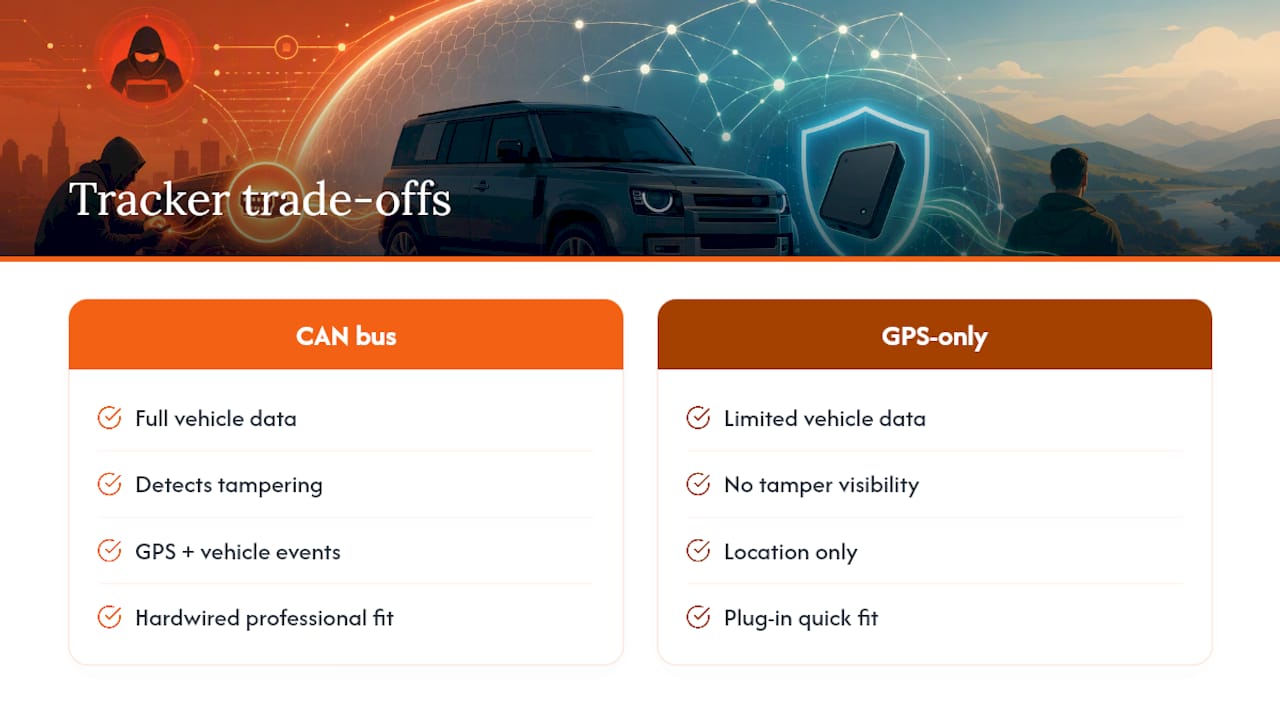
A CAN bus tracker gives you far more than a location dot on a map. Because it reads directly from the vehicle’s own systems, it can report ignition events, battery tampering, and door activity alongside GPS position, which is precisely why Thatcham’s S5 category demands this deeper level of integration rather than location tracking alone.
A GPS-only tracker, by contrast, tells you where the vehicle is and little else. It has no visibility into what’s happening inside the car electrically, so it can’t distinguish between the vehicle being driven normally and someone attempting to disable its systems. That’s a real limitation if your Land Rover is targeted by thieves who know how to isolate a battery or bypass a basic alarm quickly.
The trade-off comes down to cost and complexity. CAN bus integrated systems generally cost more upfront and require professional, often hardwired, fitting rather than a quick plug-in job. GPS-only trackers are cheaper and faster to install, which is why they’re typically priced lower than fully integrated S5 systems. For a high-value, frequently targeted vehicle like a modern Defender, that extra layer of data usually justifies the cost. For a lower-risk, older, non-keyless Land Rover, a simpler GPS-only or S7 device may genuinely be enough.
Which Land Rover owners benefit most from CAN bus integration?
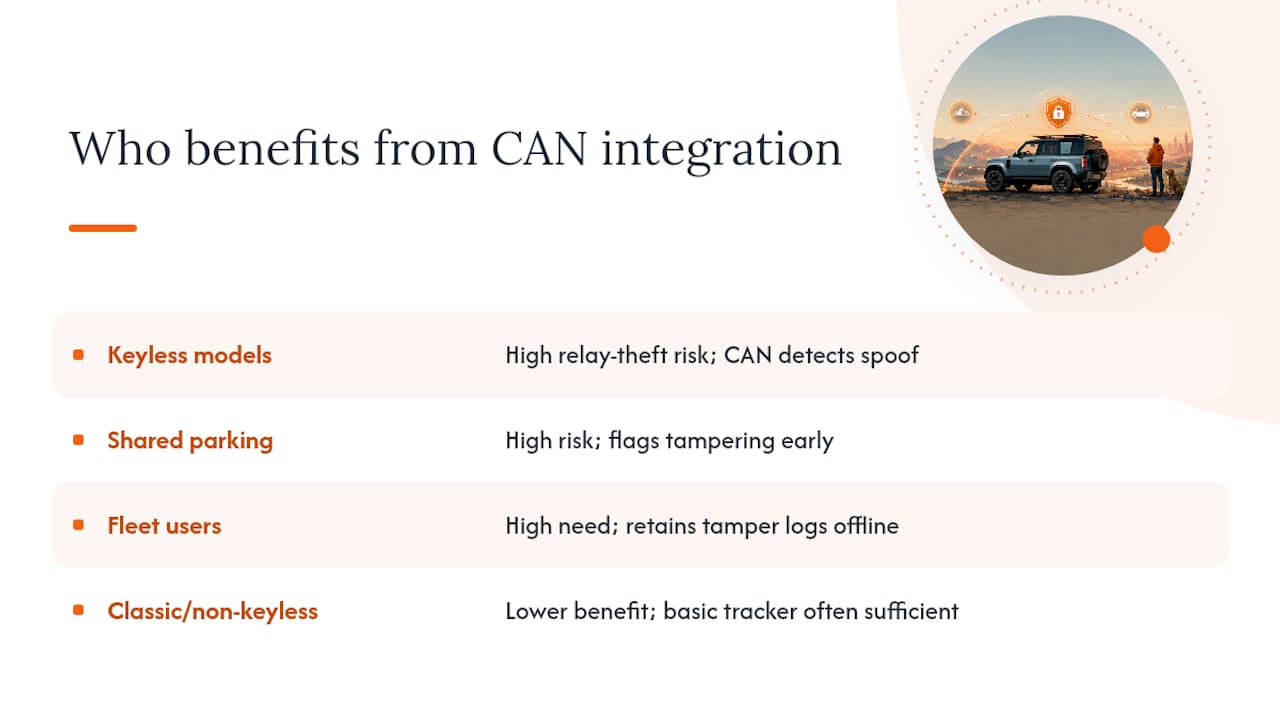
Keyless Defenders, Discoveries and Range Rovers sit at the top of the list. These models are consistently targeted by relay theft precisely because their keyless entry systems can be exploited without physical contact, and a CAN bus connected tracker gives you the ignition and immobiliser visibility a relay attack can’t spoof.
Vehicles kept in shared driveways, street parking, or commercial yards also benefit heavily, since these environments give thieves more opportunity and less scrutiny to interfere with a vehicle’s electronics undisturbed. A tracker that reads directly from the CAN bus can flag tampering attempts long before a car physically leaves the spot.
Fleet and commercial Land Rover users, such as agricultural or estate vehicles that spend long periods unattended in rural locations, see similar value. Signal and monitoring reliability matter more when a vehicle might sit for days without anyone checking on it, and integrated systems tend to hold tamper data even through brief periods of signal loss.
Owners of classic or non-keyless Land Rovers, by contrast, often see less marginal benefit from full CAN bus integration. These vehicles face different theft methods, usually physical rather than electronic, so a well-monitored S7 location tracker can meet insurer requirements without the added cost of deeper vehicle integration. Matching the tracker category to the actual theft risk for your specific model, rather than defaulting to the most advanced option, keeps cost proportionate to genuine need.
What privacy and security considerations come with CAN bus trackers?
A tracker wired into your Land Rover’s electronics has access to more data than a standalone GPS unit, and that’s worth understanding before you agree to fitting. Ignition events, door activity, and location history all pass through the monitoring provider’s systems, which means the security of that data depends heavily on how the provider stores and handles it.
Choosing a provider with a genuine 24/7 Secure Operating Centre matters here, not just for theft response but because that infrastructure typically comes with stricter data handling standards than a basic app-only service. Ask any installer directly how long location and event data is retained, who can access it, and whether it’s shared with third parties beyond your insurer and the police in a genuine theft scenario.
There’s also a physical security angle worth considering. Because a CAN bus connected device sits deep in the vehicle’s wiring, tampering with it is harder for a thief, but it also means removal or troubleshooting isn’t something you can easily do yourself. That’s a reasonable trade for the added protection, provided you’re working with an installer who fits and documents the job properly, leaving you with a clear Certificate of Installation and a direct line to their support team if anything needs checking later.
LRD Track perspective: specialist notes for Land Rover owners
Most tracker problems we see on Land Rovers aren’t about the device. They’re about where it’s fitted. Generic installers who don’t know a Defender’s wiring loom from a Discovery’s often place units somewhere accessible, which defeats the entire point of concealment. Land Rover-specific fitting knowledge, knowing which cavities and looms are genuinely hidden on each model, is what separates a tracker that survives a determined theft attempt from one that gets found and cut in minutes.
We’ve also noticed that owners underestimate how often insurers change their exact wording between renewals. A device that satisfied a policy two years ago might not satisfy the same insurer’s current terms, particularly as keyless theft methods evolve. Booking a fitting isn’t a one-off transaction. It’s the start of an ongoing relationship where your monitoring subscription, your ADR tags, and your paperwork all need to stay current together.
— Will
How to get an insurance-approved tracker fitted on your Land Rover
If your Land Rover is keyless, high-value, or simply the kind of vehicle thieves actively look for, matching the right Thatcham category to your model shouldn’t be guesswork. Lrd-track builds exclusively around Land Rover models, which means every fitting position, every ADR tag placement, and every subscription package is chosen for how Defenders, Discoveries and Range Rovers are actually built and actually targeted.
The S5 and S7 Insurance Approved Trackers range covers most standard requirements, while the S5 Plus Insurance Approved Trackers & Immobilisers line adds remote immobilisation for owners who want the strongest available layer against keyless theft. Every fitting includes a Certificate of Installation for your insurer, and monitoring runs through subscriptions like the DEFEND tracker subscription at £6 per month or DEFEND-Plus at £10 per month, depending on the package you need.
Booking is straightforward: choose your model on the product finder, confirm your insurer’s exact category requirement, and get a UK-wide professional installation scheduled around you.
Authoritative resources to verify certification and details
- Thatcham Security Certification for official category definitions
- Thatcham’s product definitions and guidelines PDF for full S5 technical requirements
- Thatcham’s certified product database to confirm a device is currently approved
- RAC’s guide to Thatcham categories for buyer-focused cost context
Sources
FAQ
What is the difference between Thatcham S5 and S7?
S5 includes Automatic Driver Recognition, motion detection, remote immobilisation, and 24/7 SOC monitoring. S7 is location tracking only, with no ADR tag and no immobilisation function.
Do insurers always require an S5 tracker?
Not always. Many insurers accept S7 for lower-risk or older, non-keyless vehicles, but high-value keyless Land Rovers are usually asked to meet the S5 standard.
How much does an S5 tracker for a Land Rover cost?
Lrd-track’s S5 Insurance Approved Tracker is £349 one-off, with the S5 Plus Insurance Approved Tracker & Immobiliser starting from £449, plus a monitoring subscription such as DEFEND-Plus at £10 per month.
How long does professional fitting take?
Most Thatcham-approved fittings on a Land Rover take one to two hours, typically done as a mobile appointment at your home or workplace.
What is a Certificate of Installation and why do I need it?
It’s the document your installer issues confirming the device, fitting standard, and accreditation, which insurers frequently request as proof your tracker meets their policy requirement.
Can a CAN bus tracker be removed or disabled easily?
Concealed, hardwired CAN bus installations are significantly harder to locate and disable than plug-in units, though no tracker eliminates theft risk entirely.