
Store your key in a signal-blocking pouch, keep it away from your front door and windows, and fit at least one visible mechanical deterrent, such as a steering wheel lock. That single combination blocks the wireless signal thieves need and forces them to spend time they don’t have.
Here’s why it works: relay theft relies on stealing a radio signal from your key fob without you knowing. Block the signal, and there’s nothing to steal.
- Buy a tested Faraday pouch and use it every single night, no exceptions.
- Check your car has actually locked (listen for the click, try the handle) before you walk away.
Key Takeaways
Effective relay attack prevention means combining behavioural changes, signal blocking, visible mechanical deterrents, and monitored tracking, because no single measure stops every attack method.
| Point | Details |
|---|---|
| Block the signal first | Store your key fob in a tested Faraday pouch every night, away from doors and windows. |
| Stack physical deterrents | Add a steering wheel lock and OBD port lock; electronics can’t bypass mechanical devices. For enhanced soundproofing and passive protection, consider the Comfort Mat Door Kit to reduce signal leakage from your car doors. |
| Attacks take under a minute | Relay theft can happen in under 60 seconds, so prevention must work before that window opens. |
| Check where possible | Some models let you disable passive keyless entry via the handbook or dealer; not all do. |
| Add monitored recovery | A Thatcham-approved tracker from Lrd-track won’t stop a theft but sharply improves recovery odds through real-time alerts and remote immobilisation. |
Table of Contents
- What is relay attack car theft?
- How do thieves actually pull off a relay attack?
- What actually stops keyless car theft?
- How do you choose a Faraday pouch that actually works?
- Which physical deterrents still stop a relay theft?
- Can trackers stop relay theft, or just help you get your car back?
- What are carmakers doing to stop relay attacks?
- How much time and money does relay attack prevention actually take?
- What should you check every day to stay protected?
- What does professional installation for trackers and deterrents involve?
- Should you disable keyless entry or rely on manual locking?
- How can Lrd-track help you defend against relay theft?
- Where can you read more about relay attack prevention?
- Frequently asked questions about relay attack prevention
- Sources
What is relay attack car theft?
A relay attack is a form of keyless car theft where criminals use two small devices to capture the signal from your key fob and “relay” it to your car, tricking it into thinking the key is right next to it. It works against passive keyless entry and start (PKES) systems, the tech that lets you unlock and start your car without pressing a button.
Here’s what that looks like in practice: one thief stands near your front door holding a signal amplifier while your key sits on the hallway table. A second thief, holding a relay device, stands next to your car on the driveway. The signal passes between the two devices, the car reads it as genuine, and the doors unlock.
A Faraday bag blocks the fob’s signal completely, which is exactly why police and Thatcham Research treat it as one of the simplest, most effective countermeasures available to ordinary drivers.
How do thieves actually pull off a relay attack?
The mechanics are simpler than most owners assume, and that’s precisely what makes them so common.
- One device, held near your home, detects and amplifies the weak signal constantly emitted by your key fob.
- That signal gets relayed wirelessly to a second device positioned next to your car.
- Your car interprets the relayed signal as the real key being present and unlocks.
- The same trick, or a physical bypass through the OBD port, can then start the engine.
Under 60 seconds. A relay attack can be executed in under a minute, and testing by ADAC found relay methods working in under 30 seconds on many models. Some crews work in pairs; others use a single operator with a modified relay box that does the job of two devices. The common thread is opportunity: keys left near doors or windows, and spare keys visible on hooks or sideboards, hand thieves an easy target.
What actually stops keyless car theft?
No single measure guarantees safety, but stacking several makes an attack take longer, cost more effort, and become far more likely to be abandoned. That’s the logic behind defence-in-depth, and it’s the approach Thatcham Research and police forces consistently recommend.
Behavioural controls cost nothing. Keep your fob away from exterior walls, front doors, and windowsills; a signal can travel through brick and glass more easily than you’d think. Warwickshire Police also flags that letterbox fishing, where thieves hook keys straight through your front door, remains a real threat that no amount of signal blocking will stop. Store keys well away from the door itself, not just in a pouch.
Signal blocking neutralises the core vulnerability. A Faraday pouch or a dedicated box in a drawer stops the fob broadcasting at all.
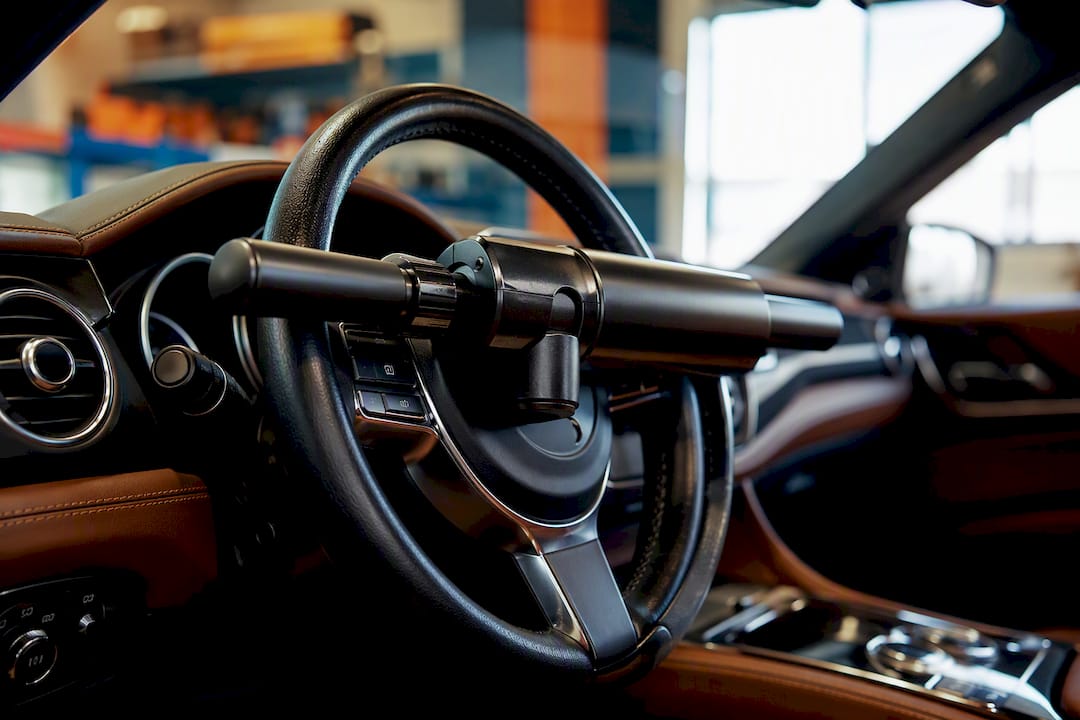
Visible mechanical deterrents work precisely because electronics can’t touch them. A steering wheel lock or crook lock is dumb, cheap, and utterly immune to relay technology.
Electronic hardening closes secondary routes. An OBD port lock stops thieves plugging into your car’s diagnostic port to programme a blank key, a technique increasingly used once relay methods are blocked.
Recovery and monitoring catch what prevention misses. A Thatcham-approved tracker doesn’t stop a fast theft, but it dramatically improves recovery odds if one succeeds.
Police guidance frames the goal simply: every extra layer increases the time and effort a thief must invest, and most give up long before they’d need to.
Your daily checklist:
- Keep your key fob in a signal-blocking pouch overnight, every night.
- Store spare keys in the same pouch, not on a hook by the door.
- Manually check your doors are locked, don’t just trust the beep.
- If you notice anyone loitering near your driveway or car, treat it as suspicious and report it.
Pro Tip: Test your Faraday pouch every couple of months by trying to unlock your car with the fob inside it, from a few feet away. If it still unlocks, the pouch has degraded and needs replacing.
How do you choose a Faraday pouch that actually works?
Not every pouch on sale does the job properly, so testing matters more than the price tag.
Effective pouches use layered metallic fabric, often a combination of nickel, copper, and silver-coated materials, that block radio frequencies your fob transmits on. Cheap single-layer designs degrade fast and can develop gaps at the seams.
Test yours at home: place the fob inside, close the pouch fully, and try your key’s unlock button from a metre away. Try again from right next to the car. If it unlocks either time, the pouch isn’t working.
- Expect to pay roughly £10 to £25 for a genuinely reliable double-layer pouch.
- Look for stitched, not glued, seams, since glue lines are the first place shielding fails.
- Replace pouches showing wear, fraying, or after roughly a year of daily folding.
West Yorkshire Police recommend checking pouches periodically rather than assuming one purchase lasts forever.
Which physical deterrents still stop a relay theft?
Mechanical devices are refreshingly immune to hacking, which is exactly why they remain central to any serious prevention plan.
- A steering wheel lock or crook lock physically prevents the wheel turning, regardless of how the doors were opened.
- A wheel clamp adds a second, highly visible obstacle that takes tools and time to remove.
- A steering column lock protector shields the column itself from being drilled or forced.
- An OBD port lock stops thieves accessing the diagnostic port to programme a replacement key once inside the cabin.
Expect to pay roughly £20 to £60 for a decent steering lock, and £30 to £80 for a quality OBD lock. Most of these fit in minutes with no tools beyond what’s in the box, though a locksmith or specialist installer can fit column protectors and deadlocks if you’d rather leave it to someone else.
Can trackers stop relay theft, or just help you get your car back?
Trackers rarely stop a fast relay theft in progress. What they do is transform what happens next, alerting you the moment your car moves without authorisation and giving recovery teams a live location to work with.
Look for these features when comparing systems:
- Thatcham Research approval, the industry benchmark insurers recognise.
- Real-time alerts sent straight to your phone the second unusual movement is detected.
- Integration with a remote immobiliser, so the vehicle can be stopped even after it’s been driven off.
- Genuine 24/7 professional monitoring, not just an app you have to check yourself.
Pro Tip: Park facing outward on your driveway where possible. It sounds trivial, but it makes number plates and unusual activity easier for neighbours and cameras to spot, which adds friction thieves would rather avoid.
What are carmakers doing to stop relay attacks?
Manufacturers are moving towards Ultra-Wideband (UWB) ranging, which checks how far away a key genuinely is rather than simply whether its signal is present. This closes the core loophole that makes relay attacks possible.
Prototype UWB systems such as PURE demonstrate sub-metre relay protection with minimal added latency, showing the technical fix works. The catch is deployment: distance-bounding protocols have existed in academic research for years without reaching most consumer vehicles yet.
Don’t wait for a firmware update to arrive. ADAC’s testing shows only around 15% of vehicles are currently well protected against relay methods.
How much time and money does relay attack prevention actually take?
Thieves need under 60 seconds to relay a signal and open your car, so your defences need to work before that window opens, not after.
- A Faraday pouch: roughly £10 to £25, one-off.
- A steering wheel lock: roughly £20 to £60, one-off.
- An OBD port lock: roughly £30 to £80, one-off.
- A professionally installed, monitored tracker: a one-off installation fee plus an ongoing subscription.
Several insurers offer premium reductions for Thatcham-approved trackers, particularly on higher-value vehicles where insurers already flag elevated theft risk. Weigh that against the cost of an uninsured excess or a written-off claim, and the layered approach earns its keep quickly.
What should you check every day to stay protected?
- Store your key fob in its Faraday pouch the moment you’re indoors, not just at bedtime.
- Keep spare keys in the same pouch, never on a hook near the front door or hallway table.
- Lock your car and manually verify it, checking the handle or listening for the lock click.
- Fit your steering wheel lock overnight, especially if your car is parked on the street.
- Glance over your car and driveway before bed for anything out of place.
Once a month, test your pouch by trying to unlock the car with the fob sealed inside, and check your tracker app is still receiving live location updates. Both take under two minutes and catch failures before they matter.
What does professional installation for trackers and deterrents involve?
Fitting a tracker or a serious mechanical deterrent isn’t always a job for a Sunday afternoon in the garage, and for high-value vehicles, that’s a good thing.
Professional tracker installation typically involves an engineer visiting your home or a garage, wiring the unit into the vehicle’s systems (including immobiliser integration where offered), and testing signal strength and app connectivity before they leave. Expect the visit to take a couple of hours. This matters because a poorly wired tracker can fail silently, giving you false confidence exactly when you need it most.
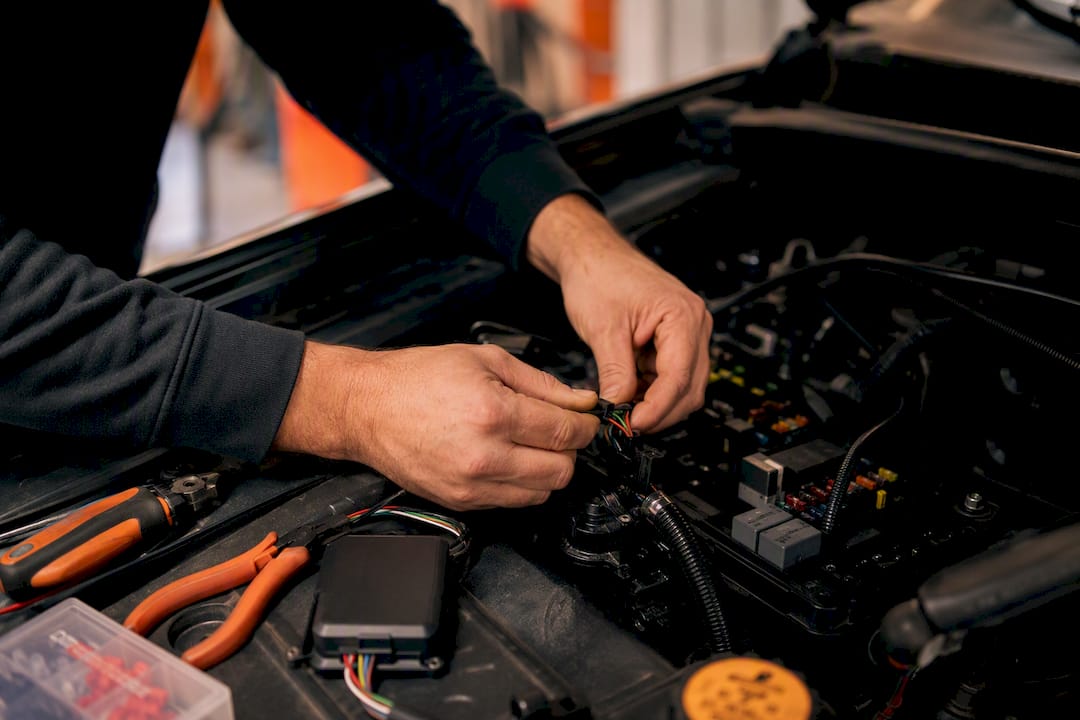
Deadlocks and OBD port locks sit somewhere in between. Many owners fit basic steering locks themselves in minutes, but security deadlocks designed for specific models, particularly Land Rover Defenders, benefit from professional fitting to ensure they don’t interfere with existing locking mechanisms or void any warranty terms.
Reliability comes down to who fits the device. A tracker installed by a specialist familiar with your exact model tends to outperform a generic unit self-fitted with a wiring diagram and good intentions. Ask any installer whether they specialise in your vehicle type, whether the tracker carries current Thatcham approval, and what ongoing support looks like if the unit ever needs recalibrating or the SIM connection drops.
For high-value vehicles particularly, professional installation isn’t overkill. It’s the difference between a tracker that works when it matters and one that quietly stopped reporting months ago.
Should you disable keyless entry or rely on manual locking?
Disabling your key fob’s wireless signal is one of the most effective countermeasures available, but it isn’t universal. Whether it’s possible depends entirely on your specific model, so check your handbook or ask your dealer rather than assuming the option exists.
Where it is possible, some vehicles let you put the fob into a “sleep” mode through a button combination, or your dealer can adjust settings via diagnostic software. This stops the fob broadcasting constantly, removing the signal there is to relay in the first place. It’s a genuinely strong step for models such as certain Land Rover Discovery and Defender variants, where owners have successfully disabled passive entry without losing manual key functionality.
If your model doesn’t support this, manual locking habits matter more. Always press the lock button on your fob directly at the car rather than relying on walk-away locking, and get into the routine of physically checking the door handle. This single habit change costs nothing and closes the gap left by any car that can’t have its keyless function switched off.
Combine whichever option applies to you with a Faraday pouch for genuine belt-and-braces protection. Neither measure alone is bulletproof, but together they remove almost every easy opportunity a relay thief relies on.
Lrd-track’s perspective on layered security for high-value vehicles
We build trackers and installation services specifically for Land Rover models because generic security doesn’t cut it for vehicles this targeted. Thatcham approval, professional fitting, and 24/7 monitoring don’t replace your Faraday pouch and steering lock; they back them up when everything else fails.
How can Lrd-track help you defend against relay theft?
A pouch and a steering lock buy you time. What happens if a thief still gets through is where Lrd-track comes in. We build Thatcham-approved trackers specifically for Land Rover models, Defender, Discovery, Range Rover, and Grenadier, with professional installation and genuine 24/7 monitoring, not an app you have to remember to check.
Our S5 Plus tracker and immobiliser adds a second authentication layer that a relayed signal can’t fake: even if a thief gets your car moving, remote immobilisation and real-time alerts mean you and our monitoring team know immediately. Pair that with the mechanical deterrents covered above, and you’ve got the defence-in-depth stack that actually works, not just the one that sounds good on paper.
Not sure which model fits your vehicle? Use our product finder to compare trackers and installation options and get a professional fitted within days.
Where can you read more about relay attack prevention?
- The Metropolitan Police vehicle safety pages detail manual lock checks and signal jamming risks.
- Help Net Security’s coverage of ADAC testing explains the scale of vehicle vulnerability across the market.
- The AP News report on Thatcham Research advice sets out expert-backed first lines of defence.
- The USENIX paper on PURE details how UWB-based relay protection works at a technical level.
Check your own vehicle’s handbook or contact your manufacturer to confirm which of these features, particularly disabling passive keyless entry, apply to your specific model.
Frequently asked questions about relay attack prevention
How quickly can a relay attack happen? Most attacks take under 60 seconds from signal capture to unlocking the car, with some ADAC-tested methods working in under 30 seconds.
Does a Faraday pouch really work? Yes, when it’s genuinely shielded and undamaged. Test yours regularly by trying to unlock your car with the key sealed inside; if it still works, the pouch has failed.
Can thieves steal my car if my key is in a Faraday pouch? Blocking the signal removes the main relay method, but physical theft of the key itself, through letterbox fishing or burglary, remains possible, so secure key storage matters just as much as signal blocking.
Is a steering wheel lock worth it if I already have a tracker? Yes. A tracker helps you recover a stolen car; a steering lock helps stop the theft happening in the first place. They solve different problems.
Will insurance premiums drop if I fit a Thatcham-approved tracker? Many insurers offer reduced premiums for Thatcham-approved devices, particularly on higher-risk, higher-value vehicles, though the exact discount depends on your insurer and vehicle.
Sources
- How to protect your car from the growing risk of keyless vehicle thefts | AP News
- PURE: Practical UWB relay protection integrated into EMV by Coppola et al. (USENIX)