
The best defence after a car theft is a Thatcham-approved, professionally fitted tracker with backup power and 24/7 monitoring. The moment you suspect your car is gone, call the police, open the tracker app, and share the live tracking link with the control room. Live monitoring paired with direct police liaison is what actually gets cars back. A tracker sitting quietly on a shelf app does nothing. One that’s already talking to a monitored operating centre changes everything.
TL;DR:
- Devices must include backup power and tamper alerts to maintain transmission after main power loss and to alert owners of unauthorized access attempts.
- Live monitoring and instant police sharing are critical for recovery, with Thatcham-approved, professionally installed trackers offering the best protection.
- Thatcham approval ensures devices meet key standards for backup power, tamper detection, and build quality necessary for effective recovery.
- Hardwired, concealed installation significantly outperforms plug-in units in resisting theft removal within the first 48 to 72 hours.
- Prioritize monitoring services and professional installation over marketing features to increase the chances of vehicle recovery after theft.
Table of Contents
- First hour, first 72 hours: what to actually do after a car theft
- Which tracker features actually help you find a stolen car?
- How do you choose a tracker that actually helps you get your car back?
- LRD Track: a fitted, monitored option built specifically for Land Rovers
- Why the standard advice on car tracking gets this half-right
- Get a Thatcham-approved tracker fitted before you need one
- Where this article’s guidance comes from
- Sources
- FAQ
First hour, first 72 hours: what to actually do after a car theft
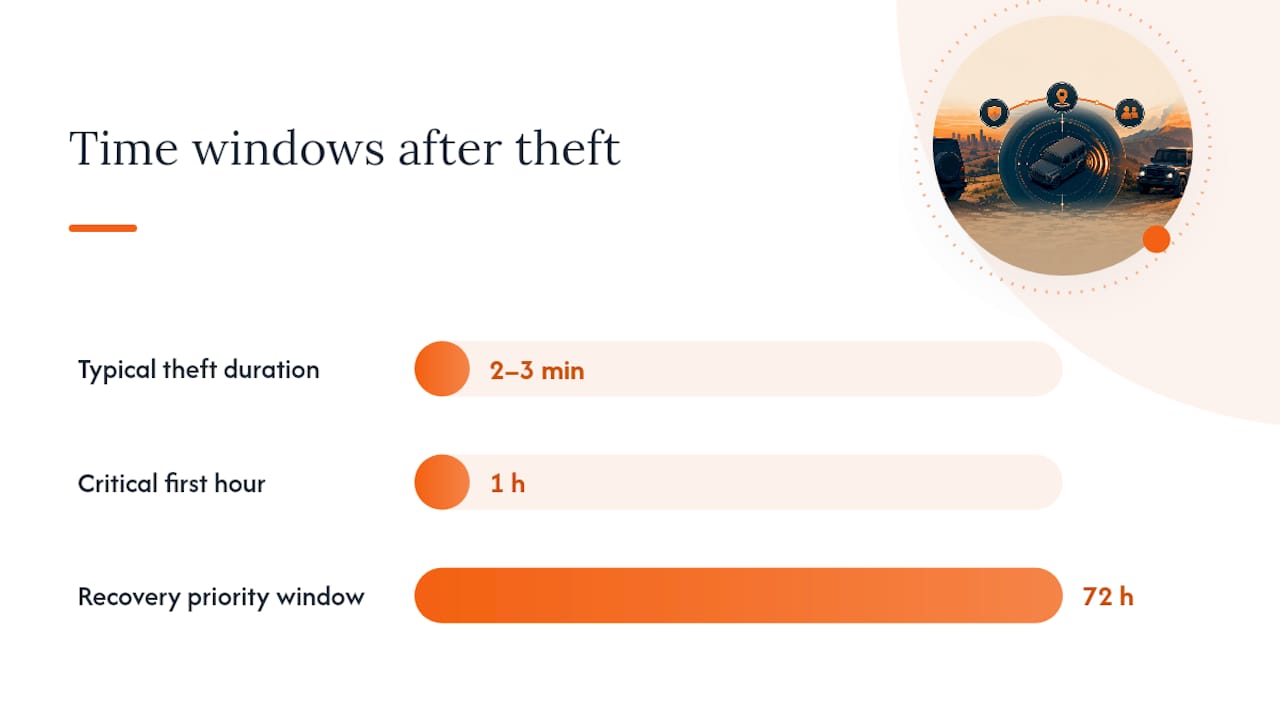
The first hour decides more than most owners realise. Get this sequence right and you give the police what they need to act fast.
- Confirm it’s actually stolen. Check with family members, ring anyone who might have borrowed it, and rule out a legitimate tow (councils and private firms remove vehicles for parking breaches more often than owners expect).
- Call the police immediately on 101, or 999 if the theft is in progress. Give your registration, VIN, make and model, and the postcode where it was last seen.
- Open your tracker app and share the live link with the call handler. A live tracking link turns a vague “somewhere in the area” report into a moving grid reference officers can watch in real time, and that link is what raises the case’s priority.
- Pull any footage you have. Dashcam clips, doorbell cameras, neighbours’ CCTV. Note exact timestamps, because thefts often happen in a tight two or three minute window during the night.
- Notify your insurer as soon as possible. Keep your policy number, the crime reference number the police give you, and any tracker activity logs to hand. Most insurers want a claim opened early even if the car turns up later.
Do not go looking for the car yourself. It feels instinctive, but chasing a location pin puts you face to face with people who have just committed a crime, and it can also compromise how the police handle the vehicle once it’s found.
Pro Tip: Send the police your tracker’s raw share link rather than screenshots or a running commentary. A live, unedited feed is something officers can act on immediately; a series of texted updates just slows everyone down.
Which tracker features actually help you find a stolen car?
Not every tracker earns the name. Some just report a location every few hours, which is fine for fleet management and useless for a live theft in progress.
- Reporting frequency that changes under threat. The most effective systems switch from a low-frequency sleep mode to live, high-frequency reporting the instant unexpected movement is detected, which is the single biggest technical factor in whether police can intercept a moving vehicle.
- Backup power independent of the car battery. Thatcham-approved devices must include backup power so the tracker keeps transmitting even after thieves cut the main battery, which is one of the first things a professional thief tries.
- Tamper and vibration alerts. A sensor that flags unauthorised movement or an attempt to disconnect the unit triggers that faster reporting mode before you’ve even noticed the car is missing.
- Hidden, hardwired installation. A unit bolted into a visible OBD port is found and pulled in minutes. A hardwired tracker fitted in a non-obvious location by a professional survives far longer.
- A monitored Secure Operating Centre. This is the piece most owners overlook. A 24/7 centre validates the alert, contacts you to confirm it’s genuine, and liaises directly with police, rather than leaving you to manage everything from your phone.
A real-time GPS feed shared with police significantly improves recovery odds because officers can watch the vehicle move rather than chase a stale last-known position.
Coverage has limits worth knowing. Cellular trackers can struggle in genuinely remote areas, and determined thieves sometimes use signal jammers, which is exactly why tamper alerts and backup batteries matter so much. Satellite units solve the coverage gap but usually report less often and cost more to run.
How do you choose a tracker that actually helps you get your car back?
Buying a tracker for theft recovery is a different decision from buying one for fleet mileage logs. Get the wrong device and you’ll only discover it the day you need it most.
Insist on Thatcham approval. It’s the UK’s recognised security testing standard, and it’s what most insurers check before they’ll accept a device against your policy or offer a premium discount. A device without it might still work, but you can’t be sure it meets the backup power, tamper detection, and build standards insurers rely on.
Choose monitored over app-only. An app-only tracker relies entirely on you noticing an alert, understanding it, and knowing what to do next, often at 3am. A monitored system has trained staff validating the alert and calling police before you’ve even finished reading the notification.
Professional, hidden fitting beats plug-in convenience. OBD plug-in trackers are quick to install and just as quick for a thief to spot and remove. A hardwired unit fitted by a technician in a concealed position is a different proposition entirely.
Check reporting intervals and geofencing before you sign anything. Ask the installer directly how often the device reports at rest, how fast it switches to live mode, and whether you can generate a shareable police link on demand.
Weigh cellular against satellite. Cellular units are cheaper and report more often; satellite makes sense mainly if you regularly park somewhere with poor signal.
Before booking, ask the installer:
- What’s the exact police reporting procedure if the tracker fires an alert?
- How does the tamper alert work, and what triggers it?
- What’s the battery life on backup power, and how is the subscription structured?
- What warranty covers the hardware and the fitting itself?
Pro Tip: Ask for the installer’s Thatcham certificate reference number, not just a verbal assurance. Insurers sometimes ask for it directly when you make a claim, and having it on file saves a frantic phone call later.
LRD Track: a fitted, monitored option built specifically for Land Rovers
LRD Track fits Thatcham-approved trackers built specifically around Land Rover models, including the Defender, Discovery, and Range Rover. The range includes the S5 insurance-approved car tracker with driver ID and the S7 Classic, alongside nationwide professional installation, app-based real-time alerts, and 24/7 monitoring.
Land Rovers sit high on theft lists precisely because they’re valuable and, in some cases, easier to strip for parts. That’s why installation quality matters as much as the device itself. Thieves who steal a Land Rover often know to search for a tracker within the first 48 to 72 hours, and professional hardwired fitting is specifically designed to resist that removal window. This contrasts with an exposed plug-in unit a thief can spot from the driver’s seat.
Once a tracker is active, here’s what changes for you:
- Live monitoring runs continuously through the operating centre, not just when you happen to check the app.
- If the vehicle moves without authorisation, you and the monitoring centre are alerted, and a shareable police link is ready immediately.
- The installer coordinates directly with insurers where needed, since many require proof of an approved device before or after a claim.
Before your fitting, have your V5C logbook and insurance details ready. Installers can usually provide fitting certification and Thatcham reference documentation your insurer may ask for later, so keep both somewhere you can find them in a hurry.
Why the standard advice on car tracking gets this half-right
Most advice on this topic treats tracking as a technology choice. Buy a good enough device, the thinking goes, and the app will do the rest. That’s backwards. The device is only half the system. The other half is whether anyone is watching it at 3am and whether the police get a live link fast enough to act.
Owners consistently overestimate cheap, off-the-shelf trackers and underestimate the value of monitoring. A £30 plug-in unit that pings every ten minutes will not help you against a thief who’s already found and removed it inside the hour. The systems that actually produce recoveries combine three things: a device that survives tampering, a backup battery that keeps transmitting after the main power is cut, and a human operating centre that talks to police while you’re still finding your keys.
If you take one thing from this, prioritise the monitoring and the fitting over the marketing spec sheet. That’s where recoveries actually happen, not in a feature list.
— Will
Get a Thatcham-approved tracker fitted before you need one
Waiting until after a theft to think about tracking is the single most common mistake Land Rover owners make. Specialist services fit Thatcham-approved trackers designed for Land Rover models like Defender, Discovery, and Range Rover, offered with professional installation and continuous monitoring from the start.
Choose between the S5 insurance-approved tracker with driver ID or the S7 Classic, depending on the level of coverage your insurer requires. Every fitting is carried out by a trained technician who hides and hardwires the unit rather than leaving it exposed on an OBD port, and every device comes with the paperwork your insurer will likely ask to see. The subscription covers ongoing monitoring and support, so you’re never relying on an app notification alone.
If your Defender, Discovery, or Range Rover isn’t fitted yet, book your Land Rover Defender tracker with nationwide installation and get a fitting date confirmed before your car becomes a statistic rather than a recovery story.
Where this article’s guidance comes from
The steps and technical claims here draw on the following sources, worth checking directly if you’re preparing a police report or an insurance claim.
- Thatcham security certification — the UK’s insurance-recognised testing standard for approved trackers.
- Vehicle theft recovery: critical steps in the first 72 hours — on reporting frequency and the theft recovery timeline.
- How to find a stolen car using GPS — on sharing live tracker links with police.
Sources
- Thatcham security certification
- Vehicle theft recovery: critical steps in the first 72 hours
- How to find a stolen car using GPS
FAQ
What is the best anti-theft car tracker in the UK?
The most effective option is a Thatcham-approved, professionally fitted tracker with backup power and 24/7 monitoring, such as LRD Track’s S5 or S7 Classic devices for Land Rover models. App-only or plug-in trackers without monitoring or backup power offer far weaker protection.
What happens when your car is stolen then found in the UK?
Police will usually ask you to attend the recovery site or a garage to confirm ownership, and you’ll need your V5C and insurance details. If the tracker was active, the retrieval log can also support any related insurance claim.
Can I sue someone for putting a tracker on my car in the UK?
Yes, covertly fitting a tracker on someone else’s vehicle without consent can amount to harassment or a data protection breach, and the vehicle’s registered owner may have grounds for civil action. This is separate from an owner fitting their own tracker for security, which is entirely lawful.
Is it illegal to put a tracker on a car in the UK?
No, it’s legal to fit a tracker on a vehicle you own or have explicit authority to fit one to, such as a company car with employee consent. It becomes a legal problem only when a tracker is fitted covertly on someone else’s vehicle without their knowledge or consent.