
If your policy makes theft cover conditional on a tracker, it almost certainly means a Thatcham-approved S5 or S7 system, fitted by an accredited installer and kept on an active monitoring subscription. Miss any of those three, and your insurer has solid ground to decline a theft claim. This isn’t rare small print. Financial Ombudsman decisions have upheld refusals on exactly these grounds.
TL;DR:
- Insurers require Thatcham-approved S5 or S7 trackers that are actively monitored, fitted by accredited installers, and include a certificate of installation.
- A tracker that only logs locations without real-time monitoring or with lapsed subscriptions does not meet theft cover conditions.
- Thatcham certifies the entire system—device, monitoring centre, and installer—meaning improper installation or monitoring disqualifies your tracker’s validity.
- Claim refusals have been upheld by the Financial Ombudsman when trackers are inactive or subscriptions lapse at the time of theft.
- Regularly checking your policy endorsements, subscription status, and keeping the certificate handy are essential to ensure your tracker complies with insurance requirements.
Table of Contents
- What insurers typically require: S5, S7, and real‑time tracking
- Does Thatcham certification cover the device or the whole system?
- Can an insurer really refuse a theft claim over a tracker?
- Who controls your tracker data, and what are your GDPR rights?
- How do you check your policy meets tracker requirements now?
- Publisher perspective: how does Lrd-track fit these requirements?
- What actually matters most in all this?
- Getting a compliant tracker fitted on your Land Rover
- Sources
What insurers typically require: S5, S7, and real‑time tracking
Insurers don’t ask for “a tracker.” They ask for a specific, certified system that meets Thatcham’s S5 or S7 category and stays switched on. That distinction catches out more owners than you’d expect.
Thatcham S5 includes Automatic Driver Recognition (ADR), which flags when the vehicle moves without the registered driver’s tag or fob nearby. Insurers often insist on S5 for keyless-entry, high-value vehicles because ADR closes the exact gap that relay theft exploits. Thatcham S7 covers standard tracking without ADR and suits lower-risk, non-keyless vehicles.
Neither category is a one-off purchase. Both depend on a live connection to a 24/7 Secure Operating Centre (SOC) that can locate the vehicle and alert police the moment it moves without authorisation. That’s the part a lot of owners miss:
- A device that only logs location for you to check later doesn’t meet theft-cover conditions.
- Consumer gadgets such as Apple AirTags or Tile trackers rely on nearby phones picking up a Bluetooth signal, not dedicated network monitoring, so insurers don’t recognise them.
- A lapsed subscription, even for a few days, can mean the tracker was technically “not in operation” when the vehicle was stolen.
- Rising vehicle theft, tracked in the ONS crime bulletin, is precisely why insurers have tightened these conditions on higher-value models.
If your Defender, Discovery, or Range Rover sits in a keyless-theft hotspot, classic car certification guidance on tracker requirements can help you understand why only Thatcham-approved systems built to S5 standard satisfy insurance conditions and are worth checking against your policy wording before you assume a cheaper device will do.
Does Thatcham certification cover the device or the whole system?
Thatcham certifies the entire setup, not just the black box under your seat. That means the device, the SOC monitoring it, and the installer fitting it all have to meet the standard together. A brilliant tracker fitted badly, or monitored by an uncertified centre, still fails the requirement.
What that looks like in practice:
- Accredited installer fits the unit. A Thatcham-registered engineer connects the tracker correctly, often hard-wired into the vehicle’s electrics rather than plugged in.
- The installer issues a Certificate of Installation. This document is your proof the fitting meets Thatcham’s rules, and insurers will ask for it if you ever claim.
- You check the certificate details. Confirm it states the correct category (S5 or S7), the installation date, and the installer’s accreditation number.
A compliant installation should also include a backup battery (so the tracker keeps working if the main power is cut) and tamper protection that alerts the SOC if someone tries to disable it. Automatic Driver Recognition (ADR), where fitted, should also be confirmed on the paperwork.
Pro Tip: Keep your Certificate of Installation somewhere you’d actually find it in a hurry, not buried in an inbox. If your Land Rover is stolen, you’ll need to hand it to your insurer within days, not weeks.
Owners with older pre-2019 systems needn’t panic. Thatcham’s guidance confirms Cat 5 and Cat 6 devices remain valid as long as monitoring stays active, since those older labels simply map onto today’s S5 and S7 categories.
Can an insurer really refuse a theft claim over a tracker?
Yes, and the Financial Ombudsman Service has confirmed it more than once. In Decision Reference DRN-3620345, the Ombudsman backed an insurer’s refusal where the policy required a fitted, active tracker and the device wasn’t in operation at the time of theft. A second case, Decision Reference DRN-4141058, reached the same conclusion after the policyholder let their subscription lapse.
The Ombudsman’s reasoning in both cases turns on one thing: were the tracker conditions stated clearly in the policy documents, and had the insurer proven the tracker wasn’t active when the car was taken? Where the answer to both is yes, the refusal stands.
The obligation itself usually sits in your Insurance Product Information Document (IPID) or as a named endorsement on your policy schedule, not buried in general terms. If you ever need to challenge a decision or support a claim, keep this evidence ready:
- Your Certificate of Installation
- Subscription payment records or receipts
- App screenshots showing the tracker’s active status
Who controls your tracker data, and what are your GDPR rights?
Your tracker provider, usually through its Secure Operating Centre, holds and processes your vehicle’s location data, and that makes it a data controller under UK GDPR. The lawful basis is typically either your contract with them or a legitimate security interest, both of which should be spelled out in the provider’s privacy policy.
Reasonable data practice means keeping location data only as long as needed for monitoring and claims purposes, not indefinitely. A few things worth doing yourself:
- Read the provider’s privacy policy before you sign up, not after.
- Tell any named or regular drivers that the vehicle is tracked and why.
- Contact the provider directly if you want to see, correct, or delete your stored data.
If tracking touches on employees or a shared family vehicle, it’s worth understanding the legal side of car tracker use before assuming consent isn’t needed.
How do you check your policy meets tracker requirements now?
Most owners only discover a gap in their cover after something’s gone wrong. Fixing that takes twenty minutes, not a lawyer.
- Read your endorsements, IPID, and policy schedule. Look specifically for the words “tracker,” “S5,” “S7,” or “immobiliser device.”
- Ask your insurer directly if anything’s ambiguous. Get the answer in writing, ideally by email, so you have a record of what they actually told you.
- Confirm the paperwork with your installer or provider. Ask for the Thatcham category, the SOC’s contact details, and your Certificate of Installation.
- Keep your subscription receipts. File them alongside your policy documents, not in a separate app you’ll forget about.
- Screenshot your tracker app periodically. A dated image showing “active” status is small proof that carries real weight at claim time.
Pro Tip: Set a calendar reminder every three months to check your tracker’s subscription status. It takes thirty seconds and closes off the single most common reason theft claims get challenged.
If your Defender is on finance, it’s worth checking whether your finance company has its own tracker requirement separate from your insurer’s, since the two conditions don’t always match.
Publisher perspective: how does Lrd-track fit these requirements?
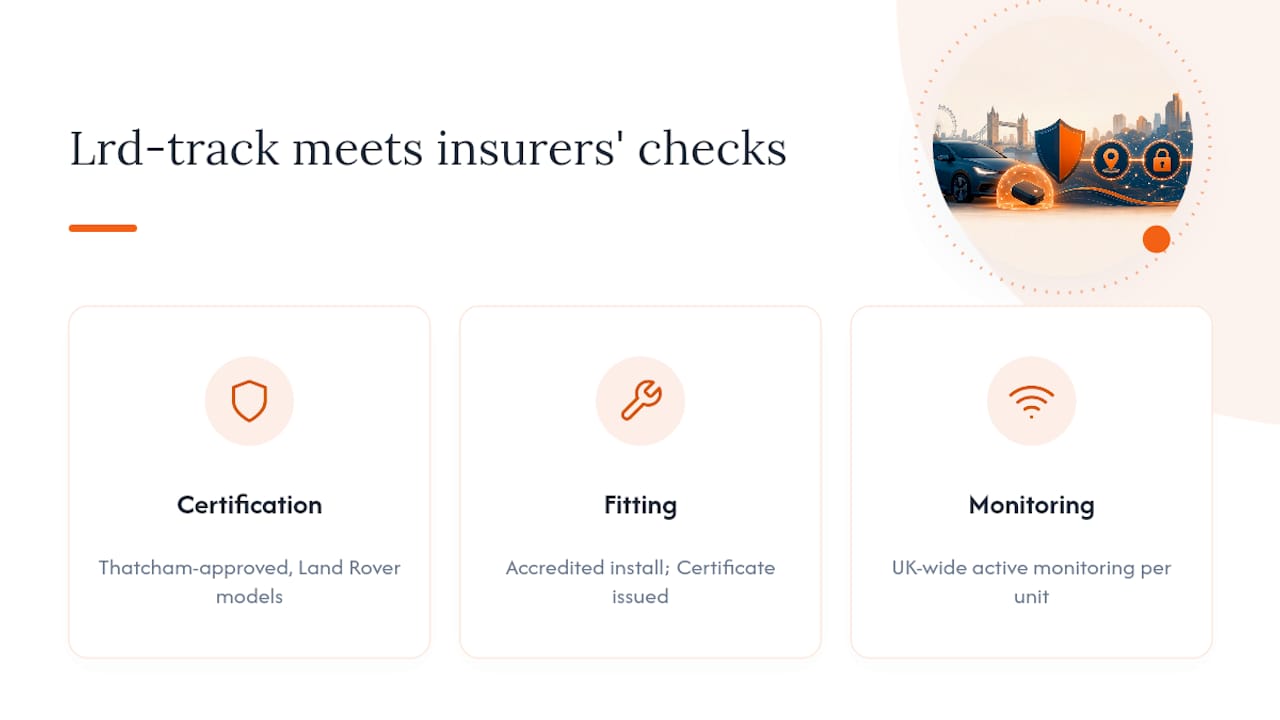
Some tracker providers offer Thatcham-approved systems designed for Land Rover models, with accredited installation, a Certificate of Installation, and UK-wide monitoring behind each unit. That covers the three checkpoints insurers actually look for: certified category, professional fitting, and active oversight.
What actually matters most in all this?
Most guidance on this topic gets the emphasis wrong. Owners fixate on buying the “best” tracker, when the far more common failure point is the subscription lapsing quietly six months after installation, long after the excitement of fitting it has worn off.
The Ombudsman decisions cited above didn’t hinge on bad hardware. They hinged on a device going quiet and nobody noticing until it mattered. That’s a behavioural problem, not a technical one, and no amount of extra sensors or app features fixes it if you don’t check the thing is still switched on.
If you take one thing from this, take this: get your Certificate of Installation into a folder with your policy documents today, and put a reminder in your calendar to check the subscription every few months. The paperwork is genuinely as important as the hardware. Insurers don’t decline claims because a tracker was bad. They decline them because nobody could prove it was working.
— Will
Getting a compliant tracker fitted on your Land Rover
Certain companies build tracking systems specifically around Land Rover models, including Defender, Discovery, and Range Rover, avoiding the need to adapt generic trackers for unusual vehicle layouts. Installations may be carried out by accredited fitters, backed by 24/7 monitoring, and come with a Certificate of Installation.
For Defender owners specifically, the Land Rover Defender tracker range covers UK-wide installation and ongoing support in one package. If you’re weighing up categories, the S7 tracker page sets out what a standard, non-ADR installation includes. Either way, the next step is the same: book your fitting date and get the certificate your insurer will actually ask for.