
The fastest, most reliable route to genuine real-time protection is a hard-wired, insurance-approved S5 or S7 tracker backed by 24/7 monitored support. That combination beats every phone app and battery-powered gadget when it matters most: the minutes after your Land Rover disappears.
Lrd-track builds exactly this for Defender, Discovery, and Range Rover owners, with professional installation, driver ID, immobiliser options where fitted, and a monitored control centre that liaises directly with police.
Here’s the trade-off you’re weighing up:
- Faster refresh rates (5 to 10 seconds) mean near-instant location updates, but they drain battery and data quicker on non-wired units.
- Hard-wired systems sidestep that problem entirely because they draw power from the vehicle itself.
- Monitored recovery consistently outperforms self-monitored apps because a control centre can act the second an alert fires, not whenever you happen to check your phone.
Key Takeaways
Insurance-approved, hard-wired S5 or S7 trackers with 24/7 monitored support recover stolen vehicles faster than any self-monitored app or Bluetooth tag.
| Point | Details |
|---|---|
| Refresh rate defines real-time | Premium systems update every 5 to 10 seconds; anything measured in minutes is periodic logging, not live tracking |
| Monitoring beats device specs | A 24/7 control centre liaising with police outperforms self-monitored apps regardless of refresh rate |
| Match tracker type to purpose | Hard-wired for permanent security, battery/magnetic only as a secondary or intermittent option |
| Budget the full subscription | Compare annual totals including monitoring fees, not just hardware price, before choosing a provider |
| Lrd-track fits high-value Land Rovers | S5, S5 Plus, and S7 systems combine Thatcham approval, driver ID, and monitored recovery for Defender, Discovery, and Range Rover models |
Table of Contents
- What does “real-time” actually mean for a car tracker?
- Which type of car tracker suits your Land Rover?
- Which features actually improve recovery odds?
- What does real-time tracking cost, and how quickly can it be installed?
- How do you choose the right tracker and installer?
- Why Lrd-track fits high-value Land Rovers specifically
- Can a car tracker connect to fleet management or telematics software?
- Is vehicle tracking legal, and what about driver consent?
- What the tracking industry gets wrong about “real-time”
- Protect your Land Rover with a monitored, insurance-approved tracker
- Sources
What does “real-time” actually mean for a car tracker?
“Real-time” gets used loosely across the tracking industry, and that vagueness costs owners money and false confidence. A device pinging its location every five minutes is not giving you real-time tracking. It’s giving you a breadcrumb trail with big gaps in it, and a thief only needs a fraction of that time to disappear.
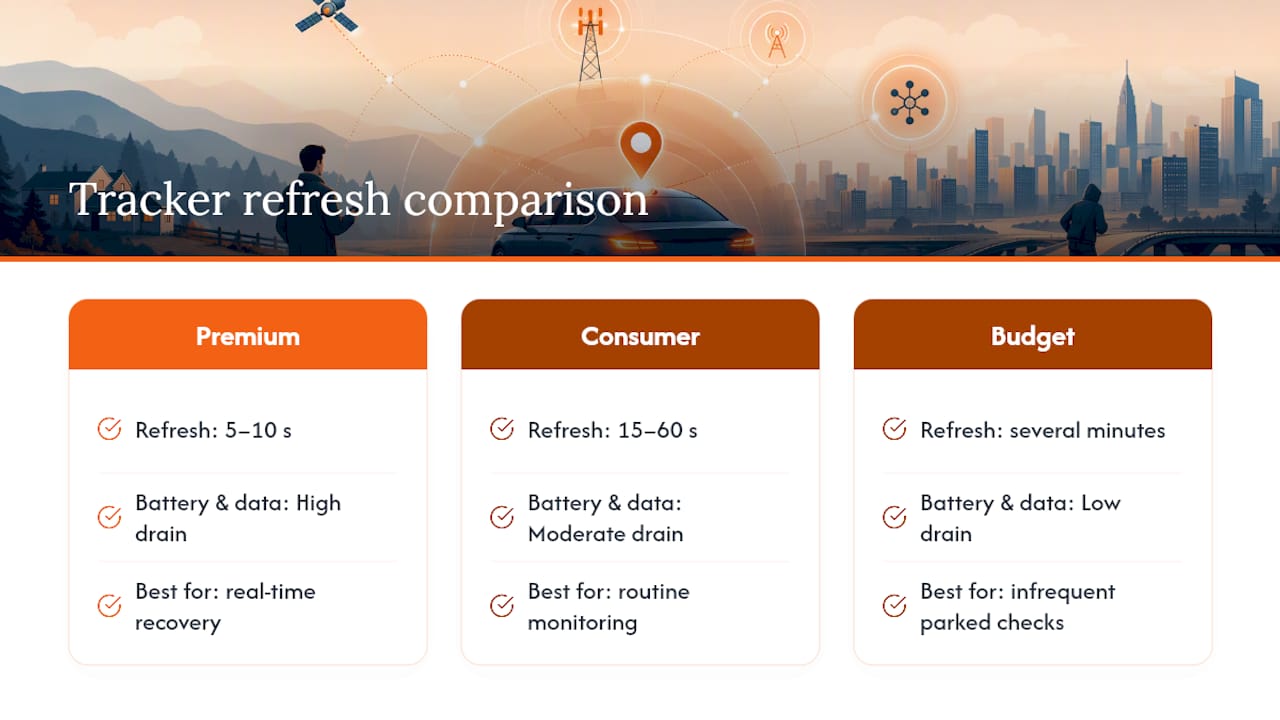
Refresh rate is the technical term that actually matters. Premium hard-wired systems typically update every 5 to 10 seconds, while common consumer-grade units settle for 15 to 60 seconds, and budget or low-power devices can stretch to several minutes between pings. Faster refresh rates give near-immediate live tracking but increase battery drain and cellular data usage, which is why many devices throttle updates when the vehicle is stationary and reserve the fastest tier for a higher subscription.
Pro Tip: Ask any supplier for the exact refresh rate in seconds, not a vague “real-time” claim. If they can’t give you a number, assume it’s slower than you’d like.
Accuracy depends on more than refresh speed. Open sky gives multi-constellation GNSS receivers a clean fix within a few metres. Urban canyons, multi-storey car parks, and dense tree cover all degrade that signal, sometimes badly enough to place a vehicle on the wrong street. Cellular latency adds another layer: some devices store location data and forward it in batches rather than streaming continuously, which can make a tracker feel laggy even when its GPS fix is accurate.
Where this genuinely matters is active recovery, when you or the police are trying to follow a moving vehicle in real time. For routine monitoring, checking where the car’s parked overnight, confirming a family member’s journey, a slower refresh rate is perfectly adequate and saves battery. Confusing the two use cases is where most owners end up disappointed with a tracker that technically works exactly as advertised.
Which type of car tracker suits your Land Rover?
Not every tracker is built for the same job, and picking the wrong category is the single most common mistake owners make when buying on price alone.
- Hard-wired, insurance-approved trackers. Wired into the vehicle’s electrics, these units never run out of power, support immobiliser integration, and qualify for Thatcham approval. For theft recovery on a high-value Land Rover, this is the category to be in.
- OBD-II plug-in trackers. These clip into the diagnostic port and draw power whenever the ignition is on. Quick to fit yourself, but just as quick for a thief to spot and pull, and they typically lack the tamper protection a hard-wired unit has.
- Battery and magnetic trackers. Genuinely covert and easy to reposition, but battery life is the constraint. Battery-powered magnetic trackers can last days at high update frequency and weeks at low frequency, which makes them a reasonable secondary device rather than a primary line of defence.
- Bluetooth tags like AirTag or Tile. Useful for finding a car in a car park, hopeless for theft recovery. These devices rely on crowdsourced Bluetooth networks rather than continuous GPS and offer no direct police liaison, so a thief driving your vehicle out of range of other Bluetooth devices effectively vanishes.
Whichever category you choose, tamper resistance is what separates a tracker that survives an actual theft attempt from one that gets found and binned in the first ten minutes. Look for backup batteries that keep transmitting if the main power is cut, and concealment away from obvious access points like the OBD port or fuse box.
Which features actually improve recovery odds?
A tracker’s marketing copy will list dozens of features. Only a handful of them change what happens when your car is actually stolen.
- Geofencing with instant alerts flags an unauthorised start or a vehicle leaving a set zone the moment it happens, not after the fact.
- Tamper and unplugging alerts, paired with a backup battery, keep the device transmitting even if a thief finds and disconnects the main power feed.
- Driver ID fobs and immobiliser integration stop a started engine from being driven away, which is a direct defence against relay attacks on keyless entry systems.
- A 24/7 monitored control centre that can liaise with police is the feature that decides outcomes, not the one that sells the headline.
- Trip history, speed logs, and access controls matter less for recovery but add real day-to-day value for fleet oversight.
Monitoring centres that actively liaise with police forces are treated as the gold standard for recovery, a point repeated consistently across independent testing and recovery expertise.
Driver ID and immobiliser integration deserve particular attention on modern Land Rovers. Combining driver ID fobs with an immobiliser defends against relay attacks that exploit keyless entry, and when that system is tied to a monitored tracker, a vehicle that gets started illegitimately still can’t be driven away.
What does real-time tracking cost, and how quickly can it be installed?
Total cost of ownership matters more than the sticker price on the box. A cheap unit with an expensive monthly subscription can cost more over three years than a pricier hardware purchase with a modest ongoing fee.
| Cost component | Typical range and notes |
|---|---|
| Hardware (hard-wired, Thatcham-approved) | Higher upfront cost than plug-in units, reflecting the installation work and insurance-grade components |
| Hardware (OBD-II or battery/magnetic) | Lower upfront cost, but often paired with a shorter device lifespan or weaker tamper protection |
| Monitoring subscription | Varies by refresh-rate tier and monitoring level; faster updates and 24/7 police-liaison monitoring sit at the top of the range |
| Professional installation | A scheduled fit, typically completed within a working day |
| Plug-and-play installation | Can be done in minutes without booking an appointment |
Subscription costs vary widely depending on update frequency and feature set, so budget for the monthly fee alongside the one-off hardware and installation cost when working out your annual total, not just the headline device price.
Confirm Thatcham approval status directly with your insurer before you buy. Some insurers offer a premium reduction for S5 or S7 systems on high-value vehicles, but only if the specific product and installer are recognised. A tracker that isn’t formally approved won’t help your premium even if it performs identically to one that is.
How do you choose the right tracker and installer?
Work through this checklist before you commit to any supplier, and don’t be talked out of asking every question on it.
- Confirm the power source. Hard-wired for permanent monitoring, or battery for a secondary, removable device.
- Ask for the exact refresh rate in seconds, and whether it changes when the vehicle is stationary or moving.
- Check the monitoring arrangement. Is it a 24/7 staffed control centre, or an app that relies on you noticing an alert?
- Ask directly whether the centre liaises with police, and what that process looks like once a theft alert triggers.
- Confirm SIM and network coverage for the areas you actually drive in, including rural routes with patchy signal.
- Ask about data retention and access controls, particularly if you’re managing more than one vehicle.
- Check warranty length and whether the tracker transfers if you sell the vehicle.
- Verify Thatcham approval in writing, and confirm the specific model number your insurer recognises.
Pro Tip: If a supplier hesitates or gives a vague answer to “does your control centre liaise with police,” treat that as your answer. A genuine monitored service will explain the process in one sentence.
Walk away from any quote with hidden installation fees, no option for a professional fit, or a refusal to put the Thatcham approval in writing. Those are the three most common corners cut by suppliers competing purely on headline price.
Why Lrd-track fits high-value Land Rovers specifically
Lrd-track’s S5 and S7-class systems are built around the Thatcham criteria that matter for recovery: driver ID, immobiliser integration on relevant models, and 24/7 monitoring with police liaison built into the workflow rather than bolted on.
- The S7 tracker covers the core monitored, insurance-approved requirement for Defender and Series models.
- The S5 tracker with driver ID adds identity verification to reduce unauthorised starts.
- The S5 Plus with immobiliser combines both for the highest level of protection currently offered.
Every unit is professionally installed rather than left to a DIY fit, and the monitoring workflow follows the same sequence that separates managed services from self-monitored apps: an alert triggers, the control centre verifies movement, continuous location pinging activates, and police liaison begins with a live feed already running.
| Point | Details |
|---|---|
| S5 vs S7 | S7 covers core monitored tracking; S5 adds driver ID and, in some builds, immobiliser control |
| Installation | Professional fit rather than self-install, matching Thatcham’s approval requirements |
| Recovery workflow | Alert, verification, continuous pinging, and police liaison run as one connected process |
Compare the full range through the Lrd-track product finder to match a system to your specific model.
Can a car tracker connect to fleet management or telematics software?
Fleet managers running more than a handful of vehicles rarely want a tracker that lives in isolation. The practical question is whether trip history, driver ID logs, and alert data can flow into whatever telematics or fleet platform already runs your operation.
Most monitored tracking platforms expose this through an API or a data export, letting geofence breaches, speed logs, and driver identification events feed into a central dashboard alongside fuel, maintenance, and route data. Configurable alerts, driver ID, and trip history are where fleet operators get most of their operational value, often more than from chasing the fastest possible refresh rate.
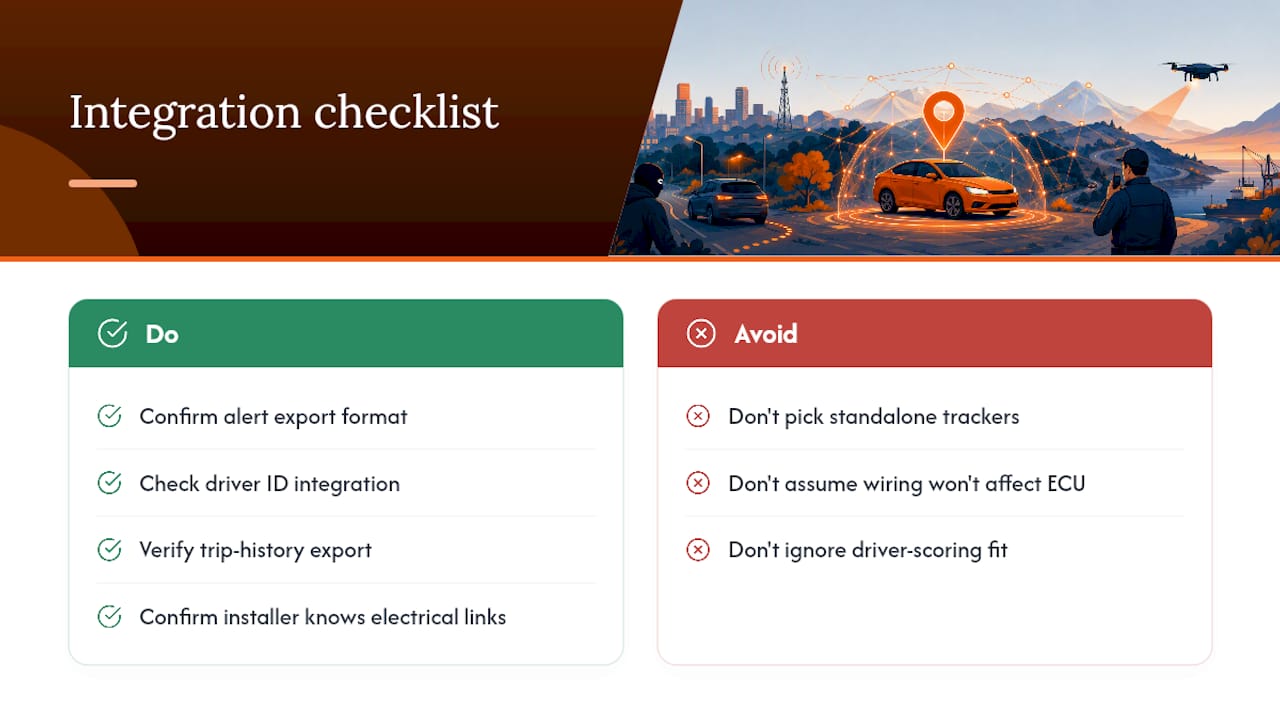
Before signing up a fleet to any tracking provider, ask specifically whether alert data can export in a format your existing system accepts, and whether driver ID records integrate cleanly with driver behaviour scoring you might already run. A tracker that works brilliantly as a standalone device but can’t talk to the rest of your fleet stack creates a second dashboard nobody has time to check. For vehicles with additional security modifications, such as deadlocks or isolator switches, it’s also worth confirming the installer understands how those systems interact electrically with the tracker’s wiring before any work begins. If you’re weighing up installation logistics on a modified vehicle, a specialist in vehicle electronics such as Airbag Reset UK can advise on how ECU and airbag systems interact with aftermarket wiring, which is worth understanding before any tracker installation on a heavily modified Defender.
Is vehicle tracking legal, and what about driver consent?
Fitting a tracker to a vehicle you own outright is legal in the UK. The complications arise around data use, consent, and who else drives the car.
If you’re a fleet manager tracking vehicles driven by employees, UK data protection law requires you to be transparent about what’s being tracked and why, and to have a lawful basis for processing that location data under the UK GDPR framework. That generally means informing drivers in writing, limiting data use to legitimate purposes like security and fleet management, and setting a defined retention period rather than keeping location history indefinitely. Covertly tracking an employee without any disclosure is a compliance risk regardless of how good your intentions are.
For personal Land Rover owners, consent is simpler because you’re tracking your own asset, but the same principle applies if you occasionally lend the vehicle to family members or share driving duties. It’s worth mentioning the tracker exists rather than letting someone discover it by accident. Data retention also matters commercially: check how long your provider stores trip history and location logs, and whether that data could ever be requested by a third party such as an insurer investigating a claim. None of this should put you off fitting a tracker. It just means reading the privacy terms as carefully as you’d read the warranty.
What the tracking industry gets wrong about “real-time”
Most buying guides treat refresh rate as the headline spec, as if shaving a device’s ping interval from 30 seconds to 10 is the decision that matters most. It rarely is. What decides whether you get your car back is whether a human being is watching the alert and can act on it immediately, not how many times a minute the GPS chip reports its position.
The conventional advice tells owners to chase the fastest possible update rate. The more useful question is who’s on the other end of that alert at 3am. A tracker pinging every five seconds into an app nobody’s checking overnight is functionally slower than a monitored system pinging every thirty seconds into a control centre that calls the police the instant something moves.
If you own a Land Rover, the model that gets targeted specifically because of its resale value and parts demand, the priority order should be monitoring quality first, Thatcham approval second, and refresh rate a distant third. Get those first two right and the technical specs mostly take care of themselves.
— Will
Protect your Land Rover with a monitored, insurance-approved tracker
If you’ve made it this far, you already know the difference between a tracker that pings a phone app and one that gets a stolen vehicle back. Lrd-track builds specifically for Land Rover owners who need the second kind, and that focus means every unit, harness, and installation is engineered around Defender, Discovery, and Range Rover electrics rather than adapted from a generic fleet product.
What you get is straightforward: a hard-wired, Thatcham-approved S5 or S7 system, professional installation, and a 24/7 monitored control centre that liaises with police the moment your vehicle moves without authorisation. Driver ID and immobiliser options add another layer against relay attacks on keyless models. Start by comparing your options on the Lrd-track product finder, where you can match your exact model to the right system and get a quote before booking installation.
Sources
Sources referenced above cover Thatcham S5/S7 standards, tested refresh-rate trade-offs, and independent tracker testing on monitoring and tamper features.
- Best GPS car trackers
- Best GPS trackers, tested
- Best Car GPS Trackers for 2026, Tested
- Car tracker (Flotilla IoT)