
Export theft tracking for your Land Rover means one thing in practice: a Thatcham‑approved GPS tracker, fitted by an accredited engineer, backed by 24/7 monitoring. Most insurers will accept S7 as a baseline. High‑value or keyless models often need S5 for driver recognition, or S5+ for remote immobilisation. Specialist providers supply and fit both categories with professional installation services.
TL;DR:
- An insurance-approved tracker must be fitted by an accredited engineer and include a Thatcham certificate to ensure coverage validity.
- For high-value Land Rovers, especially keyless models, S5 or S5 Plus trackers with driver recognition and immobilisation features are recommended.
- Speed is critical in the first hour after theft; contact police, your monitoring centre, and insurer immediately to optimize recovery chances and claim outcomes.
- A monitored tracker with a roaming SIM, backup locating methods, and tamper detection is essential for effective theft recovery and insurer compliance.
- Proper documentation, including installation and Thatcham certificates, must be provided upfront to prevent claim or cover issues later.
Table of Contents
- What’s the difference between Thatcham S7 and S5 trackers?
- What features must an insurance‑approved tracker have?
- What should you do in the first hour after theft?
- What paperwork should your installer give you?
- Which protection level and subscription actually suits your Land Rover?
- Why trackers are recovery tools, not guarantees
- Get your Land Rover fitted with a Thatcham‑approved tracker
- Sources
- FAQ
What’s the difference between Thatcham S7 and S5 trackers?
Thatcham runs two tracker categories that matter to your policy: S7 and S5. Understanding which one your insurer actually wants is the difference between a smooth claim and a disputed one.
S7 is the reactive baseline. It gives you a 24/7 monitored Secure Operating Centre, GPS location, and a direct line to police once you report a theft. It works well for a stationary theft or a vehicle lifted from a compound overnight, because the tracker starts reporting position the moment someone reports it missing and the monitoring centre liaises with the police on your behalf.
S5 builds on all of that and adds Automatic Driver Recognition, known as ADR. A small tag inside the car tells the system who’s driving. If the Land Rover moves without that tag present, the system triggers a silent alert immediately, rather than waiting for you to notice the car has gone. That matters enormously against relay attacks, where thieves clone your key signal from metres away without ever touching your Defender or Discovery.
S5 Plus goes one step further and adds remote immobilisation, letting the monitoring centre stop the engine once police confirm it’s safe to do so.
Which category applies depends on your insurer and your vehicle’s value:
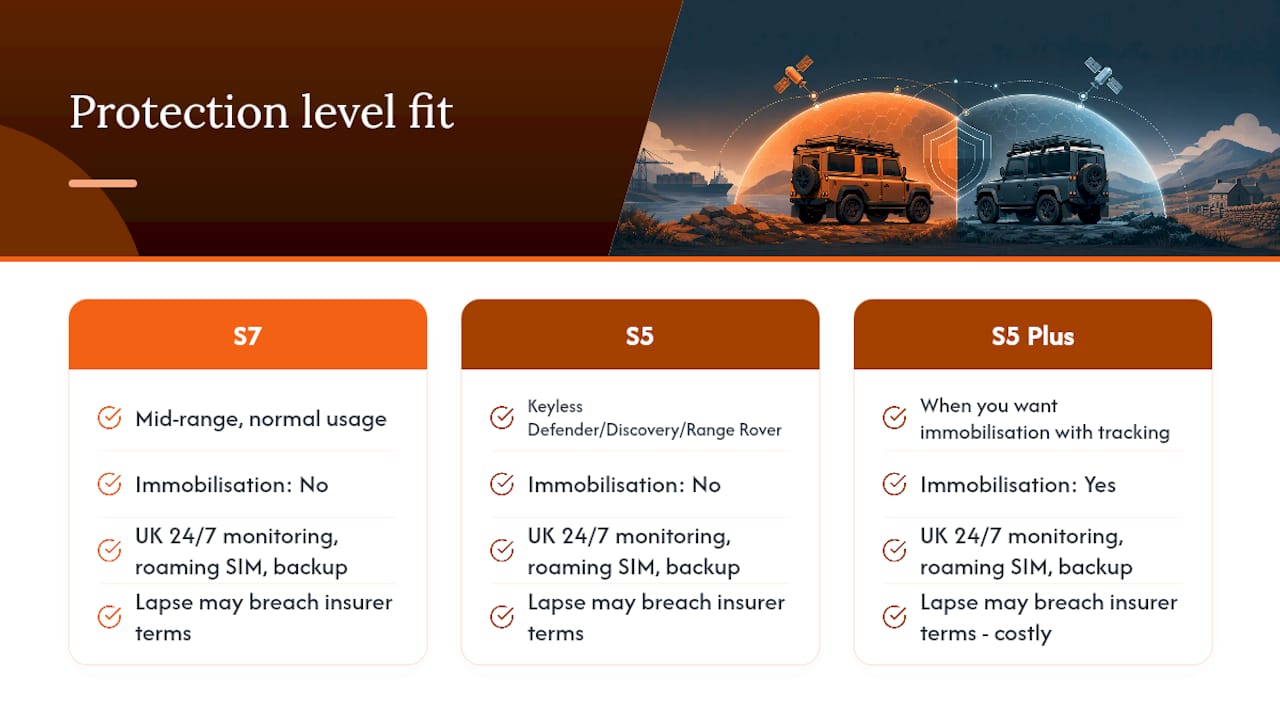
- S7 typically suits standard cover requirements on mid‑range models.
- S5 is commonly specified for higher‑value Land Rovers, especially keyless models, where proactive alerting justifies the extra cost.
- S5 Plus suits owners who want immobilisation on top of tracking, often specified for flagship Range Rover or Defender models.
Our Thatcham S7 tracker guide for Land Rover owners breaks down which models it fits best.
What features must an insurance‑approved tracker have?
Not every “tracker” on the market qualifies for insurance purposes, and the gap between a consumer GPS tag and a genuinely Thatcham‑approved system is bigger than most owners expect. Before you hand over payment, confirm the device covers every point below.
- A 24/7 Secure Operating Centre. The monitoring team must be staffed around the clock, not routed through a call centre that closes overnight.
- A roaming SIM. This lets the tracker switch networks automatically if one signal drops, which matters in rural areas or underground car parks.
- GPS plus a backup locating method, such as VHF. GPS alone can be jammed or blocked, so a secondary method materially improves recovery odds.
- Tamper detection and battery backup, so the unit keeps reporting even if power is cut.
- Minimum resistance to attack, per Thatcham’s own product definitions.
- A driver ID tag (ADR) for S5 systems, which triggers an alert the instant the vehicle moves without it present.
Ask for the paperwork before you sign anything: the Thatcham certificate number for the exact device, an installation certificate with the fitter’s accreditation, and the monitoring centre’s direct contact and escalation policy. Our insurer requirement checklist covers exactly what UK insurers ask for at renewal.
Pro Tip: Never fit a tracker yourself if your insurer specifies Thatcham certification. A self‑fit device, however good the hardware, won’t carry an installation certificate, and that gap alone can void your cover at claim stage.
What should you do in the first hour after theft?
Speed decides almost everything here. The order you make calls in genuinely changes your recovery odds and your claim outcome.
- Call the police first, on 101, or 999 if the theft is happening right now. You need a crime reference number, and no insurer will process a claim without one.
- Call your tracker’s monitoring centre immediately, ideally within the same hour. Many recoveries succeed because the provider starts feeding live position data to police before the trail goes cold.
- Notify your insurer straight away, not after the vehicle turns up or fails to. Insurers manage recovery and storage costs, and involving them late can leave you exposed to charges you shouldn’t have to pay.
Once the vehicle is located, police recovery operators arrange collection and storage, and those charges can start accruing quickly. Storage and removal fees typically begin the day after police notification, and insurer involvement early on often determines whether those costs are recoverable at all. If the vehicle is locked with no key available, a locksmith may be needed, adding further delay.
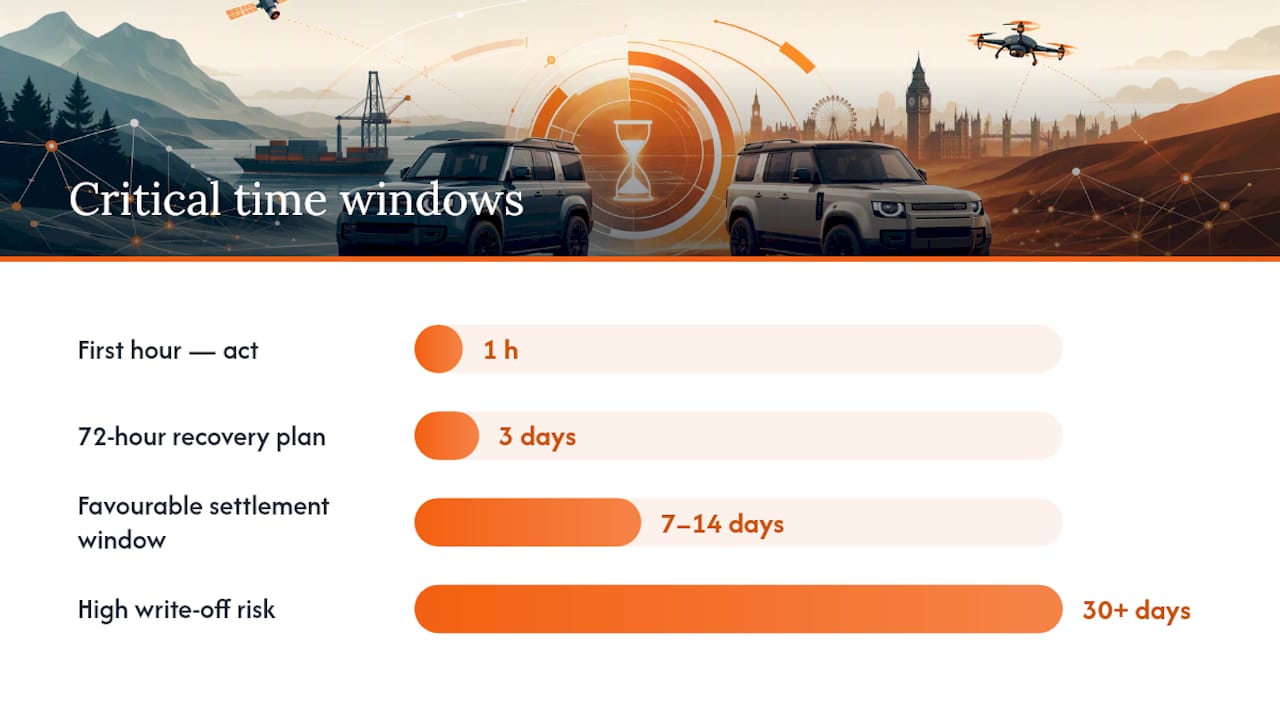
Timing genuinely affects your settlement. Vehicles recovered within 7 to 14 days tend to settle faster and more favourably than those still missing after 30 days, at which point insurers frequently write them off. Our 72‑hour recovery plan for Land Rover owners walks through what those first three days should look like.
What paperwork should your installer give you?
Only a Thatcham‑accredited engineer can issue documents your insurer will actually accept, so treat this as non‑negotiable at point of purchase.
- Ask for the installation certificate on the day of fitting, not “sent later.” It should name the engineer’s accreditation and the exact date of fitting.
- Confirm the device’s Thatcham certificate number matches what’s listed on Thatcham’s own register.
- Verify the monitoring centre’s compliance, ideally against BS 8591, and confirm they have a Level 1 police response arrangement.
- Check how the subscription activates, and what happens if monitoring lapses. A lapsed subscription can mean an unmonitored tracker at exactly the moment you need it working.
- Understand immobilisation authorisation. If you’ve chosen S5 Plus, ask what proof police need before the monitoring centre will remotely stop the engine.
Owners with classic or long‑stored Land Rovers should also look at dedicated classic vehicle location and recovery services, which complement a fitted tracker when a car sits unused for extended periods.
Which protection level and subscription actually suits your Land Rover?
S7 is usually enough for standard cover on mid‑range models with normal usage patterns. Once you’re insuring a keyless Defender, Discovery, or Range Rover above typical thresholds, S5 becomes the sensible baseline, and S5 Plus is worth the extra outlay if you want immobilisation alongside tracking.
Whichever category you choose, prioritise a subscription that includes UK‑based 24/7 monitoring, a roaming SIM, and backup tracking technology rather than GPS alone. A suspended or lapsed subscription doesn’t just leave your car unmonitored. It can breach the terms your insurer set when they agreed cover, which matters far more than the modest saving from letting a payment slip.
Device and subscription choice can influence your premium too. Insurers price risk partly on what protection is fitted, so a properly certified S5 system on a high‑value model can work in your favour at renewal, not just at claim time.
Why trackers are recovery tools, not guarantees
No tracker prevents theft outright. What a Thatcham‑certified S5 or S5 Plus system does is shorten the window between theft and recovery, and that window is everything. ADR‑equipped trackers catch relay attacks that a reactive S7 system would only spot after the car has already gone. Pair either with basic physical deterrents, a steering lock, a signal‑blocking pouch for your key, and you’ve closed most of the gaps thieves exploit.
The first hour matters more than any spec sheet. Call your monitoring centre alongside the police and your insurer, not after. That single habit, more than any feature on the device itself, decides whether your Land Rover comes home.
— Will
Get your Land Rover fitted with a Thatcham‑approved tracker
Some companies focus on Land Rover-specific Thatcham-approved tracking, fitted by experienced professionals. Available devices include options across the S7 and S5 ranges, S5 Plus with immobilisation, standalone immobilisers, and driver recognition tags, with nationwide installation services.
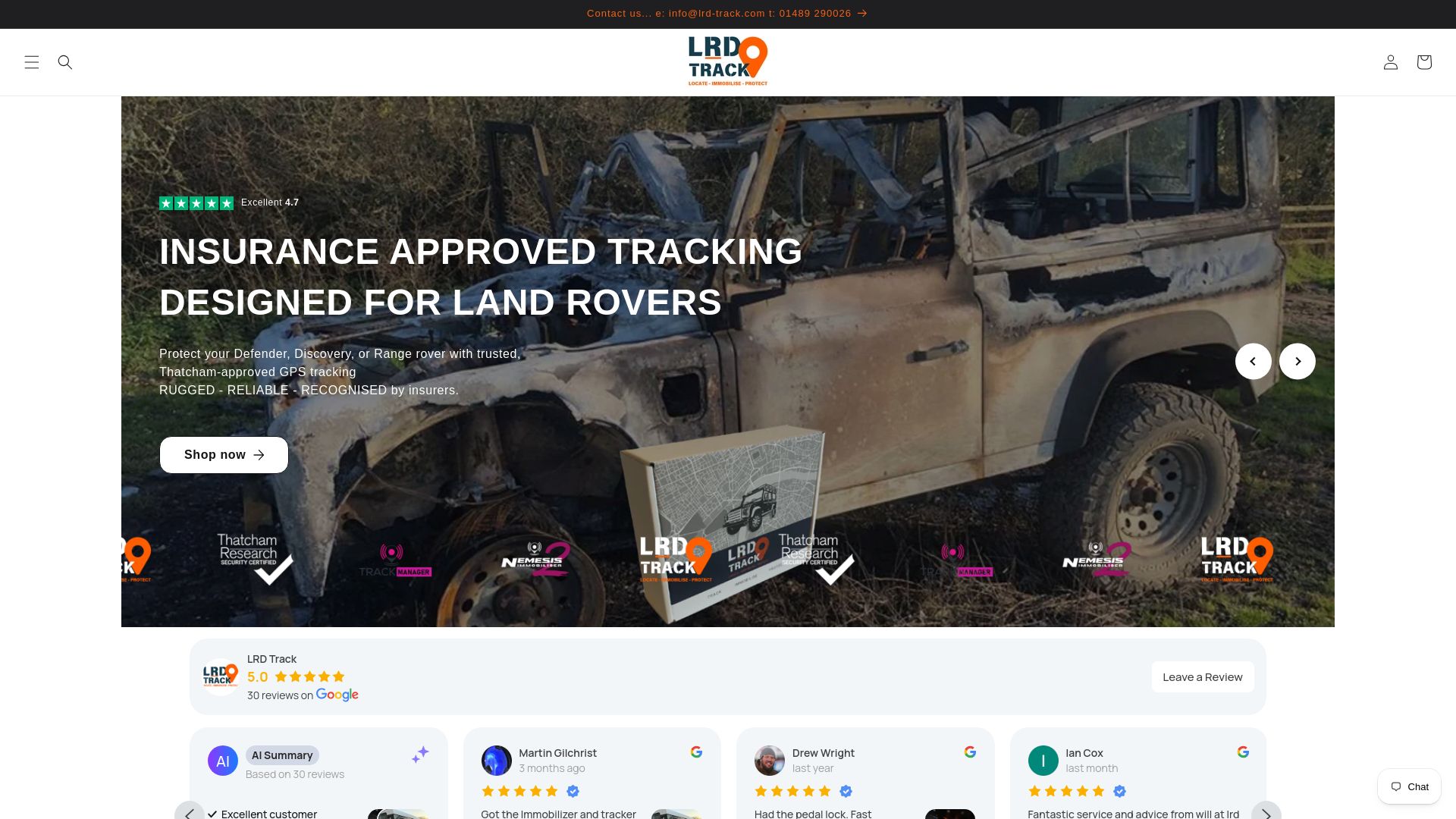
Buying is straightforward. Browse the Thatcham and insurance‑approved tracker range or the Land Rover‑specific tracking collection, choose the category your insurer specifies, and book professional fitting. Every installation comes with a Thatcham certificate number and an installation certificate, the exact paperwork your insurer will ask for at renewal or claim stage. Prices and subscription fees vary; please refer to the provider’s website for the most current pricing details.
If you’re still deciding which category fits your model, start with the S5 tracker with driver ID and get a fitting date confirmed this week.
Sources
- Gov
- Thatcham Security Certification - Thatcham Research
- Car theft insurance: what to do if your vehicle is stolen | RAC Drive
- Insurance-approved vehicle tracker: what one is and how it affects insurance | Insurd
FAQ
Do I need S5 or S7 for my Land Rover?
It depends on your insurer’s requirement and your vehicle’s value. Many mid‑range models are covered with S7, while high‑value or keyless Defenders, Discoveries, and Range Rovers often need S5 for its driver recognition feature.
Can I fit a Thatcham tracker myself?
No. Insurers requiring Thatcham certification need an installation certificate from an accredited engineer, so a self‑fit device won’t satisfy that condition even if the hardware itself is Thatcham‑approved.
What do I do in the first hour after my Land Rover is stolen?
Call the police on 101 (or 999 if the theft is in progress) to get a crime reference number, then contact your tracker’s monitoring centre and your insurer without delay. All three calls should happen within the first hour.
Who pays recovery and storage fees after a stolen Land Rover is found?
Recovery operators arrange collection and storage once police locate the vehicle, and these charges begin accruing quickly. Contacting your insurer early is what usually determines whether those costs are covered.
How much does an insurance‑approved tracker from Lrd-track cost?
Lrd-track’s S7 tracker starts at £179 one off, the S5 tracker at £349, and the S5 Plus with immobiliser from £449, all listed on the tracker collection page. Monitoring subscriptions start from £6 a month for standard tracking.