
Prevent tow-truck theft by combining physical delay, immediate movement or tow alerts, and a rehearsed response plan. No single lock, tracker, or camera stops a determined thief on its own. What works is layering barriers that cost thieves time with electronic detection that fires the moment your truck moves, backed by a team that knows exactly what to do when the alert lands.
TL;DR:
- Physical security measures like controlled gates, robust fencing, and lockable toolboxes slow thieves but rarely stop professional crews entirely.
- Ignition-independent trackers with tow and inclination alerts, dual-path communication, and geofencing are essential for quick suspect detection and accurate locating.
- Staff must regularly test alert systems and develop clear response plans, including when and how to notify police and insurers during theft events.
- Securing tools, equipment, and removable assets with tagging, lockable cages, and serial logs prevents secondary theft and facilitates faster recovery.
- Immediate actions after an alert include confirming the vehicle, preserving evidence, and strictly involving police without risking confrontation.
Table of Contents
- What is tow truck theft prevention and why layered security matters
- Immediate checklist to reduce risk in the near term
- Physical security: hardening trucks and yards against theft
- Electronic detection: tracker features you must insist on
- Making the technology reliable through rehearsed response
- Securing tools, recovery equipment, and removable assets
- What to do when an unauthorised movement alert arrives
- LRD Track practitioner notes: what we build into high-value recovery
- Prevention is discipline, not a single gadget
- Get your fleet properly covered with Lrd-track
- Sources
- FAQ
What is tow truck theft prevention and why layered security matters
Tow truck theft prevention means stacking physical, electronic, and procedural controls so that no single failure leaves your vehicle exposed. A wheel clamp buys you minutes. A tow alert buys you a location before the truck reaches a lock-up. A trained dispatcher who knows to call police first, not confront anyone, buys you a recovery instead of a write-off.
Secured by Design’s guidance on vehicle crime makes the same point for high-value vehicles generally: deterrence improves when physical delay and technical detection are combined, because visible, time-consuming barriers push criminals toward easier targets. A tow truck sitting in a dark yard with nothing but an ignition immobiliser is exactly the easy target thieves look for, since most tow-based theft doesn’t touch the ignition at all. It happens by lifting the vehicle onto another recovery truck.
Immediate checklist to reduce risk in the near term
Some risks can be closed this week, not next quarter. Start here:
- Lock down keys. No spare keys stay in the cab, glovebox, or magnetic box under the chassis.
- Park deliberately. High-risk trucks go in a locked compound or under direct lighting and camera coverage, never on an unlit side street overnight.
- Test your tracker’s alert routing. Confirm notifications reach at least two people, not just one manager’s phone.
- Prepare an incident pack now, before you need it (see the step-by-step section below).
- Mark your tools and photograph serial numbers on winches, chains, and dollies.
- If an alert fires, do not approach the vehicle or any suspect. Call the police, and preserve every timestamp and CCTV clip you can.
Physical security: hardening trucks and yards against theft
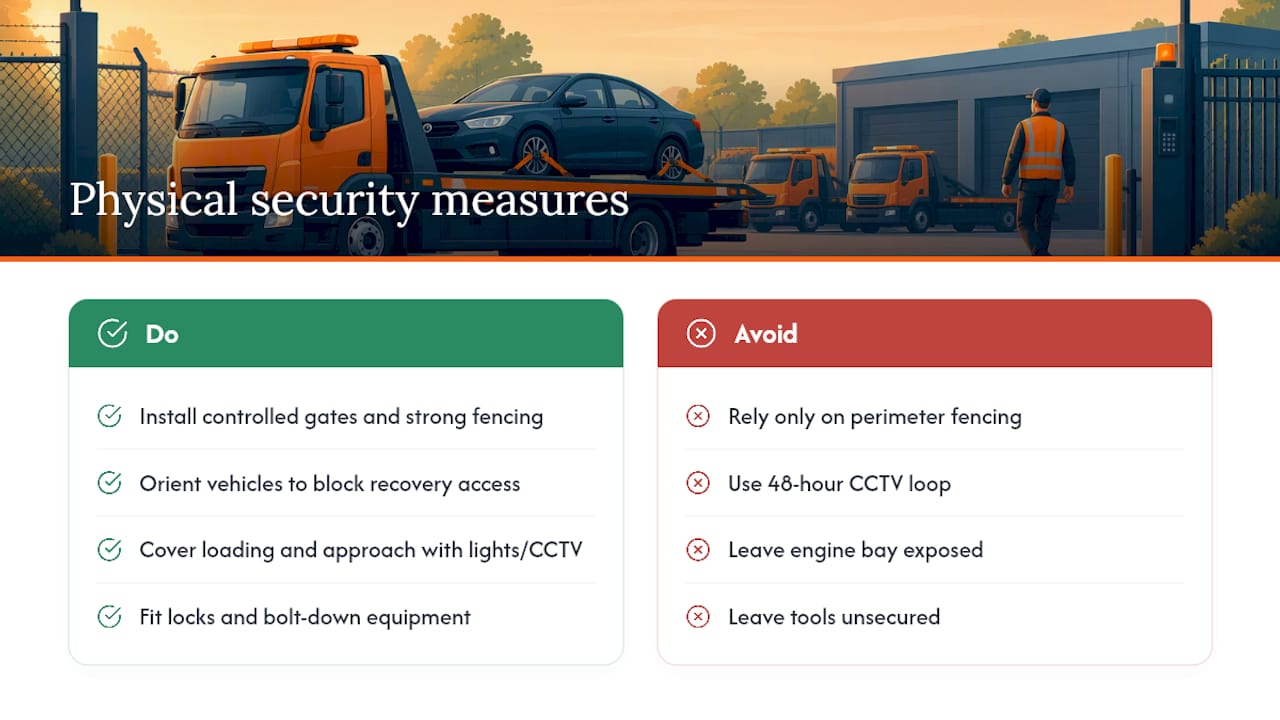
Physical barriers don’t stop a professional crew, but they slow one down, and time is what pushes thieves toward a softer target. Compound security starts with controlled gates and fencing robust enough to resist a vehicle-assisted breach, plus vehicle orientation that blocks easy access to recovery equipment parked nearby.
Lighting and CCTV need to actually cover the loading area and approach paths, not just the compound entrance. Police guidance on commercial-vehicle security recommends controlled access, adequate lighting, and camera retention that lasts long enough to support an investigation, not just a 48-hour loop that overwrites itself before you’ve noticed anything is wrong.
Inside the cab, steering locks, gear locks, and wheel clamps add friction that a tow-away crew has to work around in full view of any camera. Bonnet and door locks matter too, since a truck with an exposed engine bay is one with an easily disabled tracker. Overnight, lockable toolboxes and bolt-down cages for winches, chains, and dollies stop the secondary theft that often accompanies the primary one: thieves who can’t move the truck may still strip it for parts and equipment.
Electronic detection: tracker features you must insist on
A tracker that only reports when the ignition is on is close to useless against tow-based theft, because the whole point of towing a vehicle away is that the ignition never turns on. Stolen-vehicle recovery standards are specific on this: an effective system needs ignition-independent movement detection and inclination or tow alerts that fire the instant the vehicle tilts or shifts, sending push notifications and SMS to multiple contacts at once, not one person who might be asleep or off-shift.
Geofencing adds a second layer of protection: if the truck leaves an approved yard or job-site boundary, the system flags it immediately and hands you a live location you can pass straight to police. Backup communications matter as much as the primary signal. A tracker relying on one path can be jammed or blocked, so dual-path reporting (typically GPS plus a secondary network) resists tampering far better than a single-channel unit.
Remote immobilisation sounds like the obvious next step, but stolen-vehicle recovery guidance is clear that it should only be triggered in coordination with police, given the road-safety risk of stopping a vehicle mid-tow or mid-transit. Finally, keep your installation paperwork in order. Thatcham’s vehicle security listings cover immobilisers, alarms, and inclination sensors, and insurers routinely ask for proof of approved installation before they’ll process a claim.
Making the technology reliable through rehearsed response
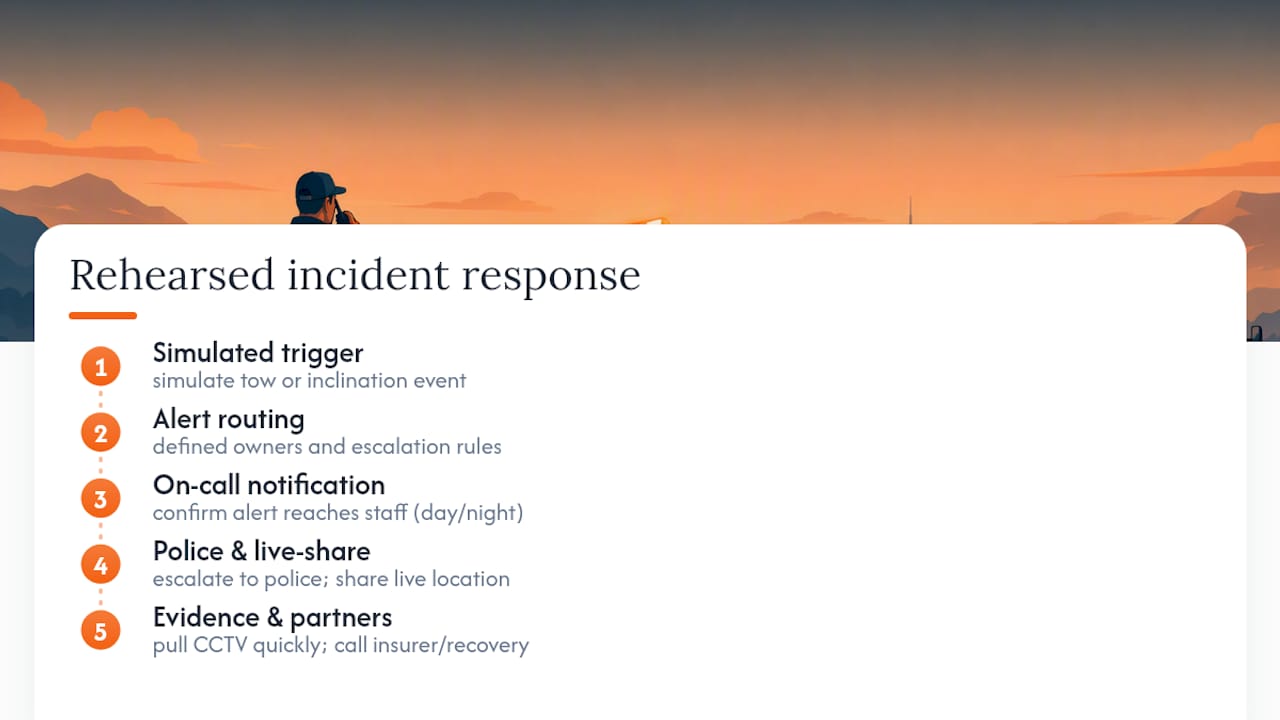
A tracker that has never been tested is a tracker you’re guessing about. Define who owns alerts out of hours, who escalates to police, and who calls the insurer and recovery partner, before an incident forces you to work it out live.
Build an incident pack now: VINs, device serial numbers, installer receipts, recent tracker history, and any CCTV footage that shows the yard. Schedule a genuine end-to-end test on a regular basis, simulating a tow or inclination event to confirm the alert reaches on-call staff, that live location sharing with police actually works, and that CCTV clips can be pulled in minutes rather than hours.
Pro Tip: Run your “simulated tow” test at a different time each quarter, once during the day and once overnight. Notification routing that works fine at 2pm often fails silently at 2am when the on-call phone is on silent.
Train every driver and yard worker on the same rule: never approach a suspect, ever. Their job is to preserve evidence and protect key custody, not play security guard.
Securing tools, recovery equipment, and removable assets
Tools and recovery gear get stolen more often than the trucks themselves, largely because they’re easier to move and easier to sell. A photographed inventory, updated whenever kit changes, gives you and your insurer something concrete to work from after a loss.
- Mark or forensic-tag winches, chains, dollies, and other high-value items.
- Fit lockable compartments and bolt-down cages for anything that can’t come inside overnight.
- Remove portable electronics (radios, tablets, diagnostic tools) at the end of every shift.
- Keep serial-number logs alongside your tracker and installation records to speed up both recovery and insurer claims.
What to do when an unauthorised movement alert arrives
- Confirm the vehicle and its location through the tracker app, and copy the timestamp and live location link before anything else.
- Preserve every log and CCTV clip immediately. Do not wait until morning; footage retention windows are shorter than most operators assume.
- Call police straight away with the live location, VIN, and registration. Never approach the truck or any suspect yourself.
- Notify your insurer and any monitored recovery provider. Remote immobilisation should only be triggered on their guidance, in coordination with police.
- Log the full timeline of alerts, calls, and actions taken. This record is what supports both the police investigation and your insurance claim.
LRD Track practitioner notes: what we build into high-value recovery
The company supplies Thatcham-approved trackers, professional installation, and 24/7 monitoring designed to address the issues covered in this article: ignition-independent movement detection, tow and inclination alerts, and multi-contact notification routing. Operators using tracked vehicles should test their alert chain regularly, keep installer receipts and photographs of fitted units on file, and make sure subscription and device serial records stay current. When a monitored alert fires, having live location, device serial, and operator contact details ready for police speeds up handover considerably, turning a vague theft report into an actionable trace.
Prevention is discipline, not a single gadget
Routine testing and staff habits cost almost nothing and stop more theft than any single device. Fixing key custody, parking orientation, and incident-pack readiness gives outsized protection for the effort involved.
— Will
Get your fleet properly covered with Lrd-track
This service offers an alternative to piecing together generic aftermarket trackers for Land Rover recovery vehicles, providing Thatcham approval, ignition-independent movement detection, and tow or inclination alerts built around the failure points covered in this article.
If you’re running Defender, Discovery, or Range Rover-based recovery trucks, the priority list is the same one this article walked through: insist on ignition-independent movement detection, inclination and tow alerts, and 24/7 monitoring that routes to more than one contact. These Thatcham and insurance-approved trackers are built to satisfy insurer evidence requirements from the moment of installation, with documented fitting records available to support claims. Fleet managers running mixed recovery operations can also see how managed telematics supports safe recovery coordination when immobilisation needs to be handled alongside police.
For operators who want the full DEFEND-Plus range with immobilisation built in, the Lrd-track product collection covers everything from entry-level tracking to backup-secured units. Request your installation evidence pack when you book fitting, and get professional installation booked before your next high-value recovery job goes out.
Sources
- Secured by Design — Caravan, motorhome & campervan security
- Thatcham vehicle security national listing (OE) — February 2024
- National Business Crime Centre — Commercial vehicle security guidance
- Stolen Vehicle Recovery | EU-ICIP / MobilityITS
FAQ
What is the best theft deterrent for trucks?
No single deterrent works alone; the strongest approach combines a physical barrier (steering lock, wheel clamp, or secure compound) with a tracker that detects movement independent of the ignition. Trucks with both take far longer to steal and are far easier to recover if they do go missing.
Does putting car keys in a tin block the signal?
A sealed metal tin can block the signal from a keyless entry fob, which is why some owners use it against relay theft. It does nothing against tow-based theft, though, since that method lifts the vehicle without ever needing the key or its signal.
What truck gets stolen the most?
Theft patterns vary heavily by region and vehicle value, and no single reliable nationwide figure identifies one model as the most targeted. High-value 4x4s and recovery vehicles with valuable towing equipment attached are consistently attractive targets regardless of make.
How do I make my truck theft proof?
No vehicle is fully theft proof, but you get close by layering a physical lock, an ignition-independent tracker with tow and inclination alerts, secure overnight parking, and a tested incident response plan. Regularly rehearsing the alert-to-police handover is what actually separates a recovered truck from a total loss.