
Choose a Thatcham-category S5 tracker with a roaming, multi-network SIM, professionally installed and monitored around the clock, then confirm that exact combination with your insurer before you rely on it. Some providers build Land Rover systems to this specification with UK-wide fitting and 24/7 monitoring. Your next move is simple: call your insurer, check the category they require, then book a Thatcham-approved installation.
TL;DR:
- A roaming, multi-network SIM is essential for reliable tracking across rural, motorway, and urban locations, especially for high-value Land Rover models.
- Verify with your insurer that the chosen Thatcham S5 tracker and monitoring standard meet their specific category and partner requirements before installation.
- Thatcham certification confirms product quality but does not guarantee insurer acceptance, which must be negotiated separately and documented properly.
- Professional installation is crucial, as a properly wired and hidden S5 unit with driver ID and resistance testing ensures maximum effectiveness and approval.
- Expect the total cost to include a high-end device, professional fitting, and ongoing monitoring, with the last often representing the most significant expense over three years.
Table of Contents
- What Do Thatcham S5 and S7 Actually Require?
- Why Does a Roaming SIM Matter for Tracking a Vehicle?
- How Do You Get an Insurer to Accept Your Tracker?
- Which Thatcham-Approved Trackers Suit a Land Rover?
- What Does This Cost, All In?
- How Long Does Installation and Insurer Sign-Off Take?
- Ready to Fit a Thatcham-Approved Tracker to Your Land Rover?
- An Editorial View on Choosing an Insurance‑Approved Tracker
- Where to Verify the Details
- Sources
- FAQ
What Do Thatcham S5 and S7 Actually Require?
Thatcham splits vehicle trackers into categories, and S5 is the one insurers lean on most for high-value vehicles like a Defender or Range Rover. The category isn’t a vague quality badge. It’s a technical checklist, and every item on it exists because thieves have found ways round a lesser system.
Thatcham’s own product definitions guidelines set out what an S5 system must include:
- A roaming (multi-network) SIM, not a single-carrier one
- GPS positioning with regular health checks
- A 24/7 monitored service meeting BS 8591 Category 1
- Driver identification where the specification calls for it
- Bi-directional communications between vehicle and monitoring centre
- Battery backup that keeps working if the main power is cut
- Resistance-to-attack testing, so the unit can’t simply be located and ripped out
Pro Tip: Don’t take a seller’s word for certification. Thatcham runs a biennial certification programme, and its database is the only definitive way to check a specific product still holds current approval.
For Land Rovers specifically, insurers often set S5 (or the immobilisation variant, S5 iMOB) as a policy condition on models that sit high on theft league tables. S7 systems, by contrast, are asset trackers without the alarm and immobilisation layer, sometimes accepted for finance agreements rather than comprehensive cover. Getting the category wrong means paying for a tracker that still leaves your policy unfulfilled.
Why Does a Roaming SIM Matter for Tracking a Vehicle?
A single-network SIM only works where that one carrier has signal. A multi-network SIM connects to whichever network is strongest in that location, and switches automatically as the vehicle moves. For a car that never leaves a city postcode, that difference barely registers. For a Land Rover that goes from a rural yard to a motorway to a supermarket car park in one day, it can be the entire difference between a live signal and a dead one.
Think through three ordinary situations:
- Rural parking overnight. A single carrier might have patchy coverage at a farm or estate; a roaming SIM finds whichever signal is available.
- Motorway recovery. Signal drops are common in cuttings and tunnels; automatic network switching cuts the window where the vehicle goes dark.
- Yard theft. Once a vehicle is moving fast toward a port or lock-up, every minute of lost signal is a minute the recovery team loses ground.
Pro Tip: Ask what the roaming SIM adds to your monthly monitoring fee before you buy. It’s usually a small premium, and a multi-network versus single-network comparison shows it typically pays for itself the first time it prevents a coverage blackout at the exact moment recovery teams need live data.
How Do You Get an Insurer to Accept Your Tracker?
Thatcham certification proves a product works and survives attack. It doesn’t automatically mean your insurer will accept it, because insurer recognition is negotiated separately between manufacturers and insurance companies. Follow this order and you avoid paying for a system your insurer later rejects.
- Call your insurer first. Ask which Thatcham category they require (S5, S5 iMOB, or S7) and whether they need a specific manufacturer or partner agreement, not just any certified device.
- Verify certification yourself. Search the product on Thatcham’s own database and note the exact product reference for your insurance paperwork. Don’t rely on a brochure claim.
- Check the monitoring centre standard. It needs to meet BS 8591 Category 1, or whatever standard your insurer specifies in writing.
- Question the installer directly. Ask about the roaming SIM, GPS jamming detection, driver ID, and the resistance-to-attack rating. A Thatcham-approved S5 tracker for Land Rover owners should answer every one of these without hesitation.
- Book professional installation and keep every document. Certificate, installer receipt, product code. File them with your policy, not in a drawer.
Pro Tip: If an installer offers a DIY fit, can’t name the monitoring centre standard, or has no certificate to hand over, walk away. Those are the three clearest red flags that the tracker won’t stand up when your insurer actually checks.
Which Thatcham-Approved Trackers Suit a Land Rover?
Not every S5 device on the market is built with a Defender’s chassis, a Discovery’s electronics, or a Range Rover’s known theft profile in mind. Land Rovers appear disproportionately on theft target lists, which is why insurers scrutinise the category and fit quality more closely on these models than on a mainstream hatchback.
LRD Track’s S5 tracker with driver ID covers the roaming SIM, GPS, and monitored-service requirements in one fitted unit, aimed specifically at Defender, Discovery, and Range Rover models. For owners whose insurer or finance agreement calls for the immobilisation variant, similar specifications extend to S5 iMOB fitting. Where a policy or lender only requires asset-location tracking rather than the full alarm and immobilisation package, the S7 tracker meets that lower bar at a lower cost.
Beyond the tracker itself, layered security matters. Physical deterrents like security deadlocks and identification systems such as Datatag don’t replace a tracker, but they slow a thief down long enough for the tracking and monitoring layer to do its job. Before buying anything, check the Thatcham and insurance-approved tracker collection against the exact category your insurer named on the phone.
What Does This Cost, All In?
Three separate costs make up the total: the hardware, the installation, and the ongoing monitoring subscription. A consumer guide from RAC Drive confirms that Thatcham-approved trackers vary in price and that active, monitored systems cost more than passive ones, reflecting the 24/7 monitoring centre behind them.
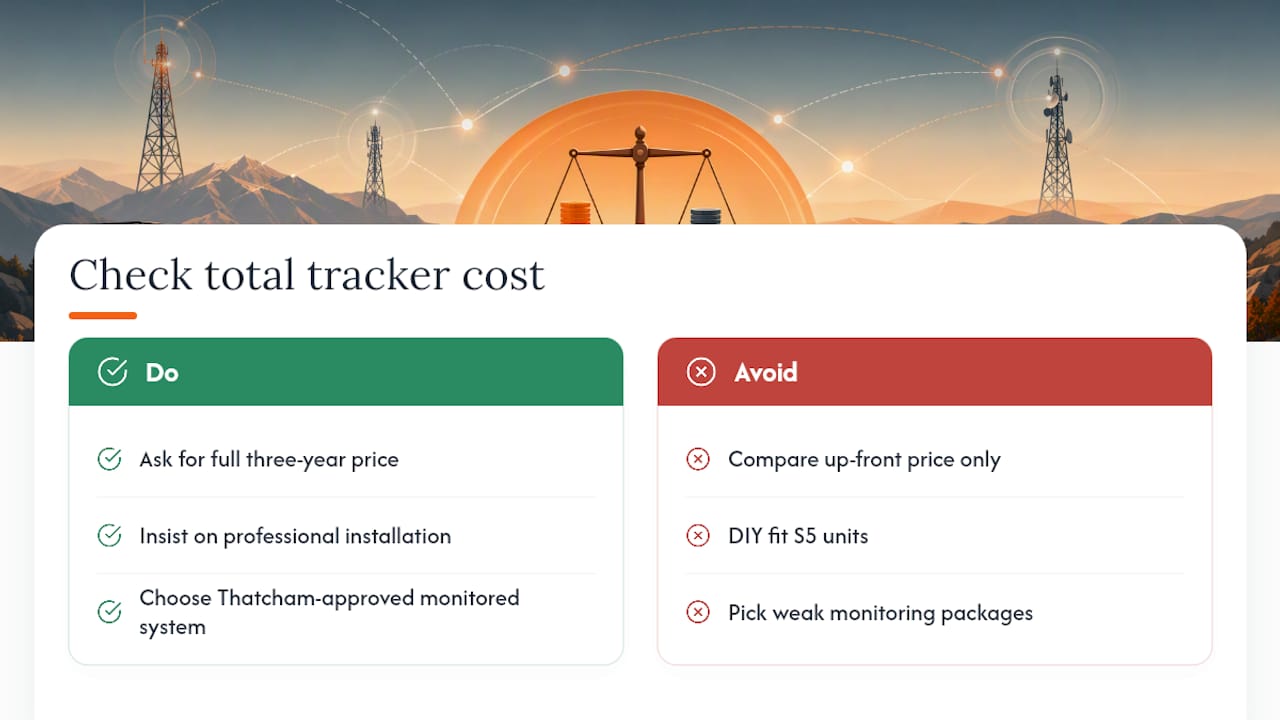
Expect the tracker unit itself to sit at the higher end of the market compared with a basic plug-in device, because it’s carrying GPS, roaming SIM hardware, battery backup, and attack-resistance engineering rather than a simple location chip. Professional installation is a separate line item, and it should be, since a correctly hidden, correctly wired S5 unit is part of what earns the resistance-to-attack rating in the first place. A DIY fit voids that assurance even if the hardware itself is certified.
The recurring cost is the monitoring subscription, which covers the BS 8591 Category 1 monitoring centre, the roaming SIM’s data allowance, and ongoing health checks on the unit. This is the fee that sometimes gets overlooked when owners compare sticker prices. A cheaper tracker with a weaker monitoring package can end up costing more over three years than a pricier unit with a leaner subscription. Ask for the full three-year figure, not just the up-front price, before you decide.
How Long Does Installation and Insurer Sign-Off Take?
The path from deciding to buy to having a fully insurer-recognised tracker usually runs in four stages, and none of them should be rushed.
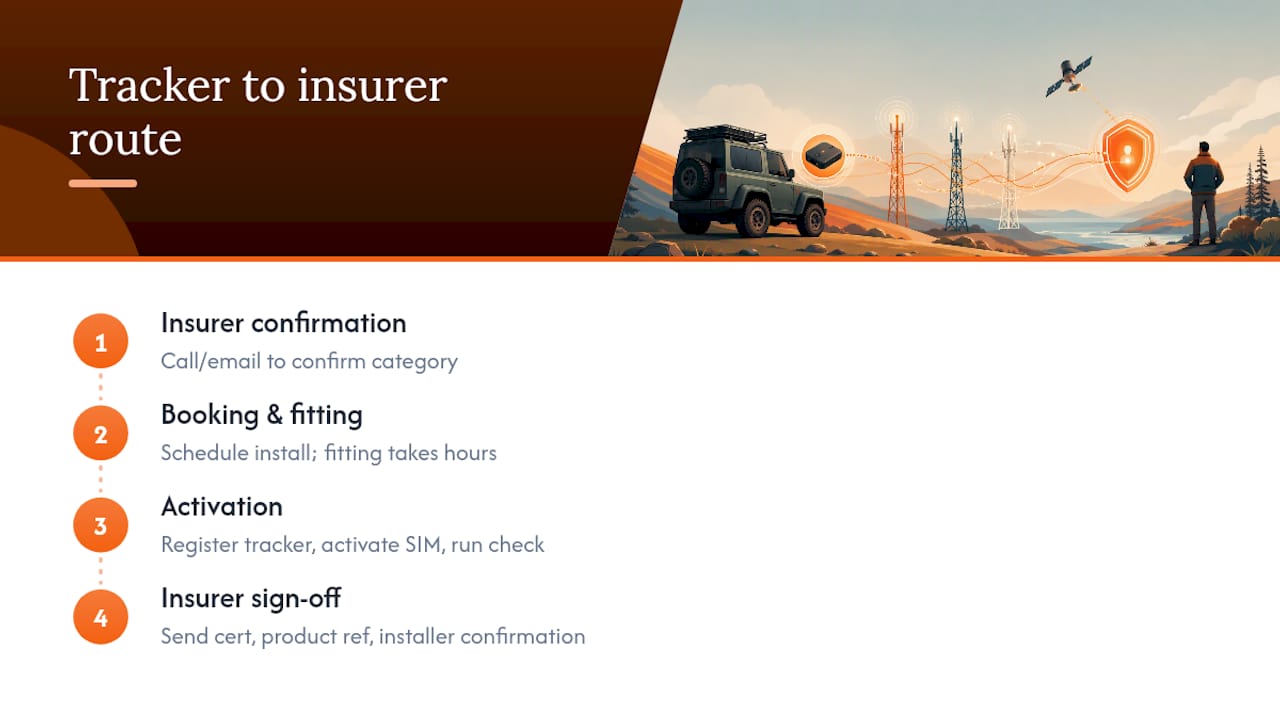
Stage one: insurer confirmation. A phone call or email to your insurer, ideally same day, confirming the category and any partner agreement they need. This is the step owners skip most often, and the one that causes the most trouble later.
Stage two: booking and fitting. Once you’ve chosen a certified product, professional installation is typically scheduled within a matter of days, depending on installer availability across the UK. The fitting itself, for a properly wired S5 unit with driver ID, typically takes several hours.
Stage three: activation. After fitting, the tracker gets registered with the monitoring centre, the roaming SIM is activated, and the installer runs a health check to confirm GPS and communications are working.
Stage four: insurer paperwork. You send your insurer the certificate, product reference, and installer confirmation. Some insurers acknowledge this within days; others fold it into your next renewal. Either way, don’t consider the job done until you have written confirmation the tracker has been logged against your policy.
Ready to Fit a Thatcham-Approved Tracker to Your Land Rover?
Everything in the checklist above, roaming SIM, S5 or S7 category, BS 8591 monitoring, driver ID, resistance-to-attack testing, is typically included in specialist Land Rover tracking systems.
Some companies offer Thatcham-approved S5 and S7 trackers for Defender, Discovery, and Range Rover models, with UK-wide professional installation rather than a DIY kit. Units typically run on a monitored 24/7 service, connect through a roaming multi-network SIM, and include GPS jamming detection alongside app-based tracking so you can check your vehicle’s location without waiting on a call centre.
After installation, customers typically receive product references, installer certificates, and fitting documentation needed to satisfy insurer paperwork requirements, which serve as the proof insurers ask for rather than a verbal assurance. If your Defender needs the full S5 iMOB specification, start with the Land Rover Defender tracker collection and book installation once your insurer has confirmed the category they require.
An Editorial View on Choosing an Insurance‑Approved Tracker
The mistake most Land Rover owners make isn’t choosing a bad tracker. It’s assuming Thatcham approval and insurer approval are the same thing. They’re not, and that gap has caught out owners who bought a genuinely certified S5 unit, then found their insurer wanted a specific partner agreement they never had.
Roaming SIMs are the part people underrate most. A tracker that goes silent for twenty minutes on a motorway or at a rural yard has failed at the exact moment it mattered, and a multi-network SIM is a cheap insurance policy against that particular failure. The real cost trade-off isn’t tracker versus no tracker. It’s a slightly higher monthly monitoring fee versus the risk of a recovery window closing while your device hunts for signal.
Keep every certificate and every email your insurer sends confirming acceptance. Paperwork is dull until the day you need it.
— Will
Where to Verify the Details
Confirm any product against Thatcham’s own certification database and product definitions guidelines, and read a broader guide to GPS tracking connectivity if you want the mechanics behind roaming networks. Save your product reference and every insurer email together.
Sources
- Vehicle security product definitions guidelines — Thatcham Research
- Multi-network vs single-network guide — M2M SIMs
FAQ
What Is a Thatcham S5 Tracker?
It’s a Thatcham-certified vehicle tracking system that combines a roaming SIM, GPS, 24/7 monitoring meeting BS 8591 Category 1, driver identification, and resistance-to-attack testing, the category most insurers require for high-value vehicles.
Does Thatcham Approval Guarantee My Insurer Will Accept It?
No. Thatcham certification confirms the product meets its technical specification, but insurer acceptance is a separate arrangement you need to confirm directly with your insurance provider.
Why Do I Need a Multi-Network SIM Instead of a Standard One?
A multi-network SIM automatically switches to the strongest available signal across carriers, which matters for a Land Rover that moves between rural, motorway, and urban coverage in a single journey.
Is S5 or S7 Right for My Land Rover?
S5 includes alarm and immobilisation features alongside tracking, which most comprehensive insurance policies require; S7 is asset-location tracking only, sometimes accepted for finance agreements rather than full cover.
How Do I Check If My Tracker Is Still Certified?
Search the product directly on Thatcham’s certification database, since certification runs on a biennial cycle and a product’s status can change between renewals.