
“No Tag No Start” means your vehicle’s starter motor stays inhibited until a registered driver tag, whether a fob, card, or your phone, confirms who’s behind the wheel. For Land Rover owners, the strongest route is a Thatcham-capable S5 or S7 system fitted by a specialist installer, such as LRD Track’s S5 Plus or S7 Classic range. The trade-off: you’ll need to carry a tag, pay for professional fitment, and usually run a monitoring subscription.
TL;DR:
- Professional installation by approved specialists ensures compliance with Thatcham categories and provides model-specific wiring for reliable operation.
- Keys and physical tags are dependable but carry risks if lost, while phone-based systems enable rapid revocation with some trade-offs in battery life.
- Subscription costs for GPS tracking and remote immobilisation often surpass hardware expenses, with multi-year plans potentially reducing long-term costs.
- Signal interference, dead batteries, or app permission issues can disrupt system functionality, but quick support and revocation procedures mitigate risks.
- Tag-based immobilisation is most effective for high-value, theft-prone vehicles when combined with GPS recovery and physical deterrents.
Table of Contents
- What does ‘no tag no start’ actually compare against?
- How does tag-based immobilisation actually stop the car starting?
- Why does professional installation and Thatcham approval matter?
- Fob, card, or phone: which tag should you actually carry?
- What does a ‘No Tag No Start’ system actually cost you?
- What goes wrong with ‘no tag no start’ systems, and how is it fixed?
- When is tag-based immobilisation actually the right call?
- Get a Thatcham-capable fitment sorted for your Land Rover
- Sources
What does ‘no tag no start’ actually compare against?
Every “No Tag No Start” system does the same basic job: it refuses to let the engine run unless it recognises an authorised tag nearby. Where they differ is in the depth of features behind that promise, and that’s where Land Rover owners need to look closely before choosing.
LRD Track’s S5 Plus sits at the top of that range. It’s built around a Thatcham-capable specification with remote immobilisation, tags supplied as standard, and professional installation carried out by fitters who know Defender, Discovery, and Range Rover wiring inside out. If your insurer wants proof of an approved category and you want recovery capability layered on top of the immobiliser, consider products built specifically to meet those requirements.
LRD Track’s S7 Classic takes a leaner approach. It skips some of the S5 Plus’s extras but keeps the reliability that classic Defender owners need, particularly where original wiring looms demand a specialist touch rather than a generic aftermarket box wedged under the dash. The S7 Classic Defender Tracker is the sensible pick when you want proven immobilisation without paying for features you won’t use.
Beyond LRD Track’s own range, the market includes several comparable products worth knowing by name: SmarTrack S5+ iMOB, Lock & Track’s No Tag No Start Immobiliser (TagLock GPS Tracker), Vodafone Protect & Connect S5 Plus, Meta’s No Tag No Start / BLE42 Bluetooth immobiliser, Tracker S5 Plus, ScorpionTrack Driver S5-Plus With Immobilisation, and the Meta Trak S5 Deadlock and Deadlock PRO variants. Most of these sit in the same S5-class bracket: Bluetooth or RFID tag detection, a monitoring subscription, and installer-fitted immobilisation relays. Where they tend to differ is installer network reach and how quickly a lost tag gets deprovisioned from the system, details worth asking about directly rather than assuming.
A few things stand out once you line the category up like this:
- Every credible option in this space requires professional fitment. DIY immobiliser kits simply don’t carry the approval status insurers ask for.
- Tags are supplied as part of the package across the board. The differentiator is how many you get and how easily you can add spares.
- Subscription costs apply almost universally where live GPS monitoring or remote immobilisation is part of the deal.
- Vehicle-specific installation, particularly starter inhibit looms for Defender models, is where specialists genuinely separate themselves from generic fitters.
How does tag-based immobilisation actually stop the car starting?
Underneath the marketing, it’s a control loop. A receiver wired into the starter circuit constantly scans for a paired tag using Bluetooth Low Energy or RFID. No valid signal, no permission sent to the starter relay, and the engine simply won’t crank, regardless of whether someone’s got the correct key in the ignition.
Encryption matters more than most buyers realise. A cheap, unencrypted tag signal can theoretically be recorded and replayed, so decent systems rotate codes or use challenge-response pairing to prevent cloning. This is also why deprovisioning speed counts as a real security feature, not a nice-to-have. Mobile credentials can typically be revoked within seconds of being reported lost, while a physical fob usually needs manual removal from the system, leaving a window where a lost tag still works.
A few practical failure points worth knowing:
- A dead tag battery leaves you stranded unless the system has a PIN override.
- Signal-blocking pouches (the Faraday-style bags used against relay attacks) can also block your own legitimate tag if stored incorrectly.
- Phone-as-tag setups depend on the phone having power and Bluetooth enabled.
Pro Tip: Keep a spare physical tag in the glovebox even if you mainly drive with your phone. Phones die, apps crash, and you don’t want your only access method to be a battery percentage away from failure.
Why does professional installation and Thatcham approval matter?
Thatcham categories exist because insurers need a consistent standard for what counts as genuine theft protection, rather than taking a manufacturer’s word for it. S5 covers tracking with remote immobilisation; S7 covers tracking without the immobilisation layer. Vendor pages routinely tout “Thatcham-approved” as a headline claim, so it’s worth verifying rather than assuming.
Before booking, run through this:
- Ask the installer to show their Thatcham approval documentation, not just quote the category number.
- Confirm the fitter has direct experience with your specific model, especially older Defenders with non-standard wiring.
- Request a live demonstration of tag pairing and, just as importantly, tag deprovisioning.
- Check what happens to your data and monitoring if you switch insurers.
Nationwide installation for a Land Rover-specific system typically runs to a half-day fitting, with activation and app pairing completed the same visit in most cases.
Fob, card, or phone: which tag should you actually carry?
Physical fobs and cards are dependable because they don’t rely on a charged battery or an app update. Their weakness is exactly the flip side: if you lose one, someone still has physical possession of a working credential until the system operator revokes it.
Phone-as-tag setups solve that problem neatly. Mobile credential revocation is close to immediate, compared with the manual process a lost fob often demands. The catch is battery drain and permissions. Driving apps that rely on continuous GPS and Bluetooth can noticeably shorten your phone’s battery life, so if you’re doing long rural drives, don’t assume your phone will always be the reliable option.
- Order at least one spare tag per additional driver in the household.
- Report a lost tag immediately. Remote revocation closes the gap fast; a PIN override buys you time if the system supports it.
- Keep physical tags away from other RFID cards to avoid signal interference.
What does a ‘No Tag No Start’ system actually cost you?
Hardware and installation for a Thatcham-capable S5 system generally come as a single upfront package, varying by your model and wiring needs. The ongoing cost mainly comes from the subscription, which covers live GPS tracking, 24/7 monitoring, and remote immobilisation services.
Buyers often fixate on the hardware price and miss the subscription line entirely, which is exactly how renewal bills become an unwelcome surprise.
A simple way to check total cost: add the device and installation price to twelve months of subscription. That’s your genuine first-year cost. Every year after that, only the subscription applies, so a system that looks pricier upfront can still work out cheaper over three years than a lower-cost device with a steeper monthly fee.
- Ask whether the subscription is monthly or annual, and whether multi-year discounts exist.
- Check if remote immobilisation is bundled or sold as an add-on.
- Confirm what happens to pricing if you sell the vehicle mid-contract.
What goes wrong with ‘no tag no start’ systems, and how is it fixed?
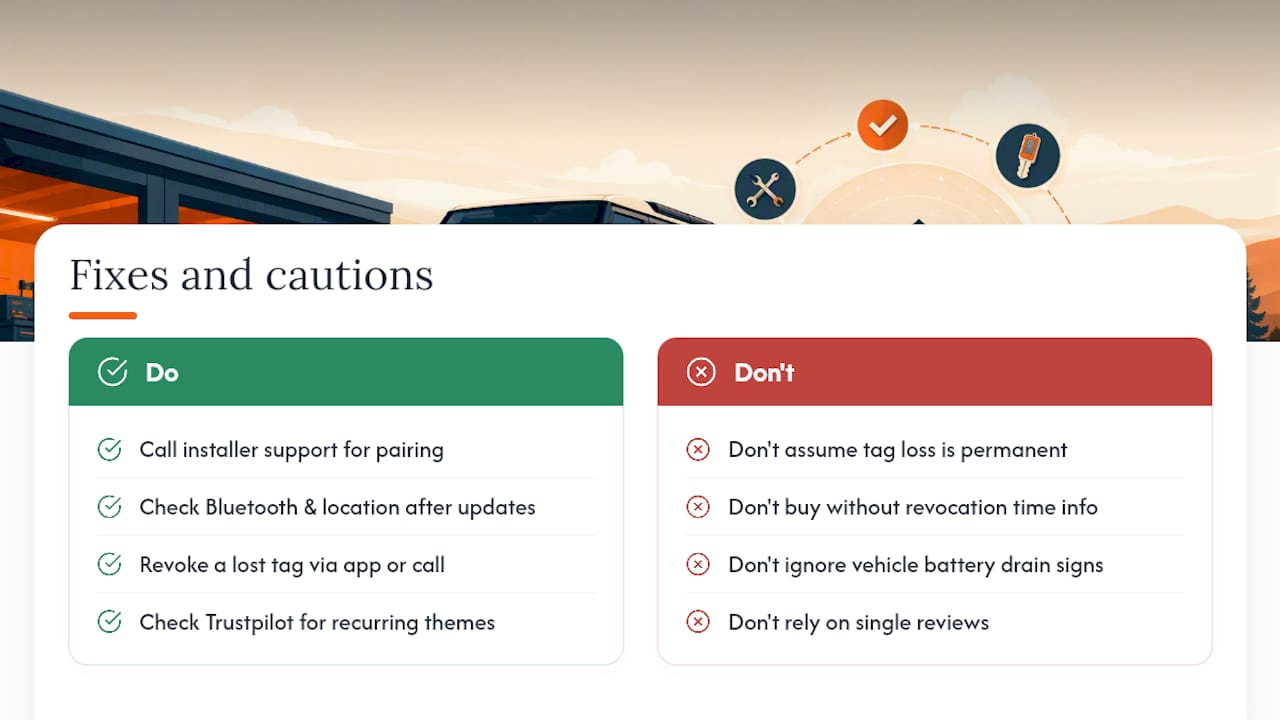
Most reported issues fall into a handful of predictable categories. A tag that stops pairing is usually a flat battery or a Bluetooth connection that’s dropped, both fixed in minutes by a reputable installer’s support line rather than a full workshop visit. Phone-as-tag users occasionally lose connection after an app or operating system update changes permission settings, so it’s worth checking Bluetooth and location access whenever your phone updates itself.
Lost tags are the issue owners worry about most, and rightly so. A properly run system lets you revoke a specific tag from an app or by calling support, disabling it without touching anyone else’s access. If your provider can’t explain how quickly that revocation takes effect, that’s a fair reason to ask more questions before buying.
Independent review sites can be genuinely useful here. Checking platforms like Trustpilot for recurring themes, rather than a single five-star or one-star review, tends to reveal whether a provider’s installation quality and support response times hold up in practice.
Battery drain in the vehicle itself is another common query, particularly on older Defenders left unused for weeks. A well-fitted system draws minimal standby current, but ask your installer for the expected draw figure so you know what’s normal.
For support, most reputable providers offer a phone line alongside app-based diagnostics, letting you check tag status remotely before assuming a fault exists at all.
When is tag-based immobilisation actually the right call?
Tag-based immobilisation earns its keep on high-value, theft-prone vehicles, Defenders and Discoverys especially, where thieves increasingly target keyless entry systems. It’s rarely the only layer worth having. Pairing it with GPS recovery tracking and basic physical deterrents, like understanding how thieves actually attempt to bypass immobilisers, gives a more realistic picture of what stops a theft versus what merely slows one down. Review your tag list and subscription status every few months. Systems only protect you if the pairing details actually match who’s driving.
— Will
Get a Thatcham-capable fitment sorted for your Land Rover
If your Defender, Discovery, or Range Rover needs genuine insurance-grade protection rather than a generic aftermarket box, LRD Track’s S5 and S7 ranges are built specifically around your model, not adapted from a one-size-fits-all kit.
The S5 Plus suits owners who want remote immobilisation and recovery tracking bundled together, while the S7 Classic fits Defender owners who want reliable, vehicle-specific installation without paying for features they’ll never use. Every fitment uses model-specific components, including specialist starter inhibit looms where the wiring demands it, carried out by installers who work UK-wide.
Check compatibility with your model and request a quote through the Defender tracker collection, where approval documentation, installer accreditation, and warranty details are all laid out before you book.
Sources
- Mobile credentials vs key fobs: which access credential to pick | Tec-Tel
- Mobile Credentials vs Key Fobs for Access Control in NJ, PA & DE | Systems Integrations