
A Thatcham-approved tracker with accredited installation and an active monitoring subscription is what most UK insurers require before they’ll adjust your premium or cover a high-value vehicle at all. The certificate alone doesn’t satisfy the insurer; the combination does. Your next move is simple: call your insurer today, ask whether they want an S5 or S7 system, and get their answer in writing. Specialist providers offer Thatcham-approved trackers, professional installation and certificates needed to satisfy insurers.
TL;DR:
- Most UK insurers require an active, monitored Thatcham-approved tracker with accredited installation to qualify for premium discounts or coverage of high-value vehicles.
- The certificate is only valid if issued by a Thatcham-accredited engineer and includes details like vehicle info, category, installer credentials, and installation date; self-installation voids it.
- An active subscription to the secure operating center must be maintained, as lapses can lead to canceled benefits, premium increases, or claim disputes.
- Insurance discounts for trackers typically range from 5% to 15%, with higher savings for high-value vehicles or those at greater theft risk, especially when combined with features like Automatic Driver Recognition.
- Specialist installation tailored to Land Rovers ensures proper concealment and driver recognition, which are critical for compliance and effective theft recovery.
Table of Contents
- What “Thatcham-approved” actually means for tracker certificate insurance
- Do insurers require a tracker certificate for your policy?
- What makes a tracker certificate valid (and what voids it)
- Costs, typical discounts, and a payback example
- Step-by-step: getting a tracker certificate your insurer will accept
- How long does a tracker certificate stay valid?
- What happens if your tracker certificate lapses or goes missing
- Why specialist installation matters more for Land Rovers
- Get your Land Rover certified and insured with LRD Track
- Sources
What “Thatcham-approved” actually means for tracker certificate insurance
Thatcham Research is the UK body that tests and certifies vehicle security equipment, and it’s the name insurers actually mean when their policy documents say “approved tracker.” Two categories exist now: S5 and S7. Older paperwork sometimes still refers to Cat 5 and Cat 6, but those labels were retired back in 2019 and now map directly onto S5 and S7. If your insurer’s letter mentions “Cat 5,” they mean S5.
S7 is the entry point. It gives you real-time location tracking, a link to a 24/7 Secure Operating Centre (SOC), tamper alerts if someone tries to disconnect the unit, and battery backup so a thief can’t simply cut the power and vanish off the map. S5 does everything S7 does, then adds Automatic Driver Recognition (ADR), which flags unrecognised drivers attempting to move the vehicle. That extra layer is why S5 tends to carry more weight with insurers on higher-value cars.
What matters for your certificate is that Thatcham’s approval covers the whole system, not just the box bolted under your seat:
- The hardware itself, tested to S5 or S7 standard
- Installation by a Thatcham-accredited engineer
- An active subscription to a monitored SOC
Miss any one of those three and the “approved” status stops applying, whatever the sticker on the device says.
Do insurers require a tracker certificate for your policy?
Not every policy demands one, but several situations make it close to mandatory. High-value vehicles, anything with keyless entry, and cars registered in postcodes with elevated theft rates are the three most common triggers. For Land Rover Defenders and Range Rovers specifically, insurers often push for an S5 tracker on vehicles above roughly £30,000 to £50,000, or wherever ADR is specifically requested. Below that threshold, S7 is usually accepted for standard cover.
The only way to know for certain is to ask, and ask precisely. When you call:
- Request the exact Thatcham category they require: S5 or S7, not the legacy “Cat” label.
- Ask whether they mandate professional installation, or whether they’ll accept a self-fit unit (they won’t, but confirm it anyway).
- Confirm what monitoring evidence they need to see, and how often.
- Ask whether the tracker’s approval transfers if you sell the car or change insurer.
Get the answer emailed or posted, then file it with your policy documents. A verbal assurance from a call centre agent means nothing if a claim goes wrong six months later.
What makes a tracker certificate valid (and what voids it)
A Certificate of Installation only counts if a Thatcham-accredited engineer fitted the device. Self-installation voids the certification outright, because the fitting itself, not just the hardware, forms part of the approval. Insurers know this, which is why they ask for the certificate rather than a receipt for the tracker.
The certificate should state:
- The vehicle registration and VIN
- The exact Thatcham category (S5 or S7)
- The installer’s accreditation details
- The date of fitting and confirmation the unit passed its post-install check
Submit a copy to your insurer directly after fitting rather than waiting for renewal. Most insurers file it against your policy so there’s no dispute later if you need to make a claim.
The part owners overlook most often is monitoring continuity. A lapsed SOC subscription quietly cancels the insurance benefit even though the hardware is still physically installed in the car, because an unmonitored tracker isn’t tracking anything.
Pro Tip: Set a calendar reminder a month before your subscription renewal date. An expired SOC link is invisible until the moment you actually need it, which is exactly the wrong time to discover it.
Costs, typical discounts, and a payback example
Hardware, fitting and subscription costs vary by category, but rough UK bands hold fairly steady. S7 subscriptions typically run around £130 to £170 a year, while S5 subscriptions sit somewhat higher annually, reflecting the added ADR functionality and the higher-value vehicles it’s usually fitted to.
Insurers commonly reward an S5 tracker with the largest premium reduction, while S7 still delivers a smaller but real discount. Discounts generally fall between 5% and 15%, with the higher end reserved for high-value or high-theft-risk vehicles where a monitored tracker meaningfully improves recovery odds.
Run the numbers on your own policy before assuming it’s worthwhile. Say your Land Rover premium is £1,200 a year and your insurer offers a 10% discount for fitting an S5 tracker with an annual subscription cost. That’s a £120 saving against a £180 cost, a net £60 outlay in year one. On a higher premium at a similar discount rate, the saving covers the subscription outright with £20 to spare. The maths shifts fast once your premium climbs, which is exactly why high-value Land Rovers see the strongest case for going S5.
Step-by-step: getting a tracker certificate your insurer will accept
Getting this right in the right order saves you a second phone call to your insurer and a second visit from an installer.
- Call your insurer first. Ask which Thatcham category (S5 or S7) they want, whether they insist on accredited installation, and what monitoring proof they expect. Get it in writing.
- Choose an approved device and a recognised installer. Confirm the S7 tracker or S5 unit is fitted by an accredited engineer who issues a proper Certificate of Installation.
- Submit the certificate to your insurer as soon as fitting is complete, rather than waiting until your next renewal date.
- Keep the subscription active and store certificates, receipts, and correspondence together somewhere you can find them fast.
- Check at renewal that the discount actually applied. Insurers occasionally miss it if the certificate wasn’t logged correctly on their system.
Two habits make this whole process far less painful:
- Keep a single folder (digital or paper) for every tracker-related document tied to the vehicle.
- Re-confirm your insurer’s requirement annually, since insurer policy on tracker categories does shift over time.
How long does a tracker certificate stay valid?
A Thatcham Certificate of Installation itself doesn’t expire in the way an MOT does; it documents a one-off event, the professional fitting of a specific device to a specific vehicle. What does have a shelf life is the monitoring subscription that keeps the tracker “active” in the eyes of your insurer, and that’s the piece owners tend to let slide.
Most SOC subscriptions run on a rolling annual basis. Renewal usually means a straightforward payment to keep the monitoring link live, not a re-inspection of the hardware. If you change vehicle, sell the car, or swap insurer, the certificate itself may not automatically transfer. Some installers can reissue documentation for a change of ownership, but that’s worth confirming directly with whoever fitted the unit.
Treat renewal season as a natural checkpoint. When your car insurance comes up for renewal each year, that’s the moment to verify your subscription is still active, your installer’s contact details are current, and your insurer’s file still shows the tracker discount applied. It’s a five-minute check that avoids a much longer conversation later if you ever need to make a claim.
What happens if your tracker certificate lapses or goes missing
An insurer that discovers your tracker certificate is missing, expired, or simply never submitted has real grounds to challenge a theft claim. If the policy was priced on the assumption of an active, monitored tracker and that condition wasn’t met, the insurer can argue the risk they quoted for was never actually in place.
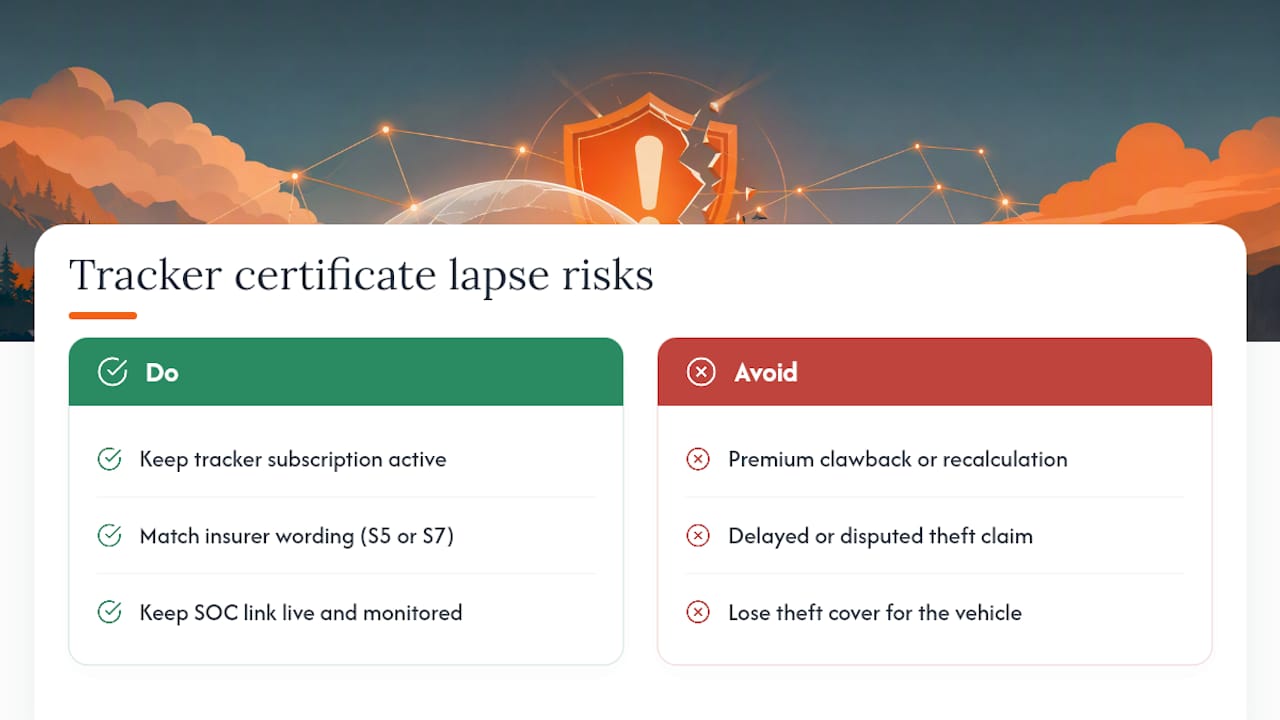
The practical fallout tends to show up in three ways. First, a discount that was applied at inception can be clawed back or the premium recalculated at renewal once the insurer notices the subscription lapsed. Second, a stolen-vehicle claim can be delayed or disputed while the insurer investigates whether the tracker was genuinely operational at the time of theft, which is a slow, stressful process at exactly the wrong moment. Third, for vehicles where the tracker was a condition of cover rather than just a discount, particularly high-value Land Rovers with keyless entry, a lapsed system can put your entire theft cover at risk, not just the discount portion.
None of this requires dishonesty on your part, just an unmonitored subscription you forgot to renew. That’s precisely why matching your insurer’s exact wording, S5 or S7, and keeping the SOC link live matters more than the certificate document itself.
Why specialist installation matters more for Land Rovers
Generic tracker fitting doesn’t always translate cleanly to a Defender or a Range Rover. These are vehicles insurers already flag as higher-risk targets, and a tracker concealed the way it would be on a standard hatchback can end up in a spot that’s easy to find or disable on a Land Rover’s specific chassis and wiring layout. Specialist companies provide Thatcham-approved GPS trackers designed for Land Rover models and have them installed by accredited engineers, which is the detail insurers verify during a claim.
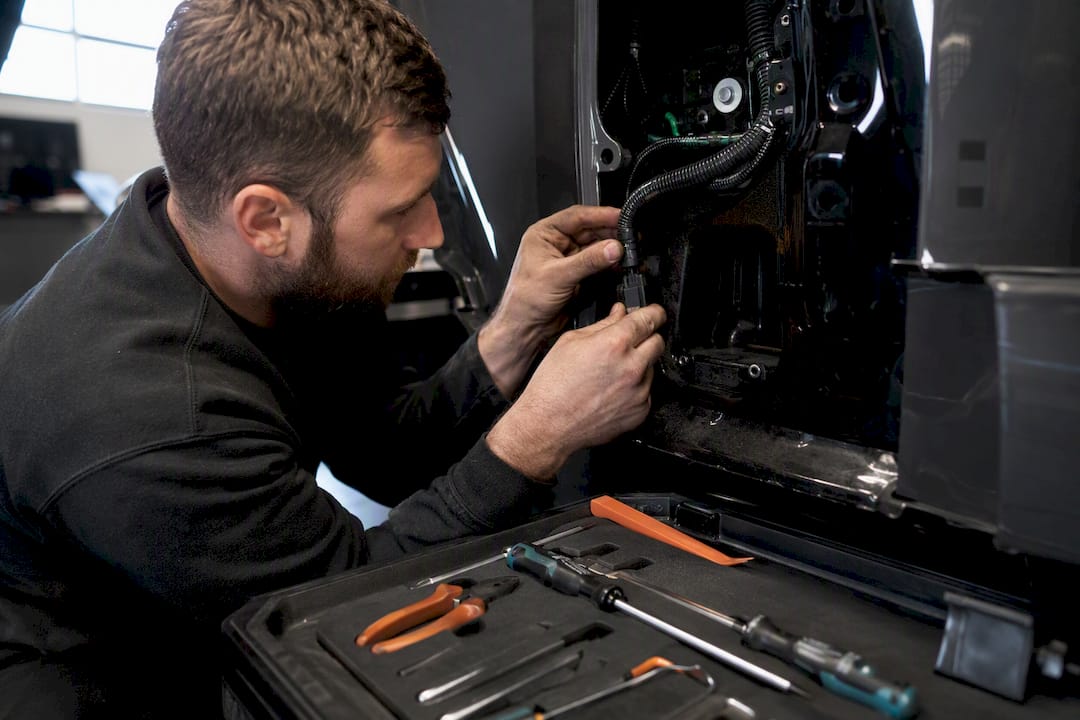
Automatic Driver Recognition earns its place here specifically because Land Rovers are disproportionately targeted by keyless theft. Vehicle-specific concealment, done properly, keeps ADR and the tracking hardware working as intended rather than as a box a thief spots and rips out in under a minute.
None of this is guesswork dressed up as expertise. The pattern across insurer requirements is consistent: they reward systems fitted by people who understand the specific vehicle, not generic installers working from a universal template.
— Will
Get your Land Rover certified and insured with LRD Track
Specialist providers offer insurance-accepted tracker certificates for Land Rover owners, using Thatcham-approved devices fitted by accredited installers familiar with various Land Rover models, and supply Certificates of Installation that are accepted by insurers.
Choosing a specialist installer cuts the risk of an insurer querying your paperwork later, and it speeds up recovery and claims handling if your vehicle is ever stolen, because the monitoring link and driver recognition data are already in place and correctly configured for your exact model. Well-fitted, well-documented systems also tend to support faster claims processing once an insurer is notified, since there’s no ambiguity over what was installed or when.
If you’re ready to act, view the Defender tracker and installation page or check nationwide installation availability to book a fitting and get your certificate sorted before your next renewal date.
Sources
- Thatcham trackers explained and what your insurer wants
- 5 car modifications that can lower insurance
- 5 ways an insurance approved tracker reduce car insurance UK