
If the police tell you your stolen car has been found, do not collect it until you have a police release. Confirm the recovery reference first, ask whether a forensic hold applies, and call your insurer straight away. That order matters: rushing to the pound before you’ve done the groundwork can mean turning up to a locked gate, or unknowingly disturbing evidence.
Here’s the checklist to work through in the first hour:
- Verify the caller – ring your local police force back on their published number and get the recovery reference.
- Ask about location and holds – find out exactly where the car is and whether a forensic examination is still underway.
- Don’t collect yet – wait for police authorisation to release the vehicle, and get a name and number for the investigating officer.
- Gather your documents – photo ID, V5C, crime reference number, and the VIN. Tell the officer if any of these were stolen with the car.
- Call your insurer – report the recovery immediately and ask whether they’ve already taken ownership under a theft settlement.
Key Takeaways
Recovering a stolen car safely means waiting for police release, documenting condition thoroughly, and notifying your insurer and DVLA at the right moments.
| Point | Details |
|---|---|
| Don’t self-collect | Wait for a formal police release before going anywhere near the pound. |
| Expect a statutory fee | Removal for a standard car found upright is £192, plus daily storage charges. |
| Photograph everything | Panels, interior, boot, and odometer, all timestamped, before you drive the car anywhere. |
| Ownership can shift | If your insurer already paid out, they may legally own the car until a buy-back is agreed. |
| Keep the case active | Log the investigating officer’s details and check in periodically to avoid PNC weeding. |
Table of Contents
- What happens when a stolen car is recovered: police, PNC and DVLA
- How to collect your recovered vehicle from police custody
- What are the statutory removal and storage charges?
- Does your car belong to you if the insurer already paid out?
- Assessing the vehicle: damage, evidence and safety
- Common pitfalls that delay or complicate recovery
- How a Thatcham-approved tracker improves recovery outcomes
- Why most advice on recovered cars misses the point
- Sources
What happens when a stolen car is recovered: police, PNC and DVLA
Recovery, arrest, and a forensic hold are three separate things, and confusing them causes most of the frustration owners report. A car can be recovered with nobody caught, or recovered as part of an active investigation that keeps it off-limits for days.
- Police log the recovery and update the Police National Computer (PNC) “lost or stolen” marker, but that entry can stay flagged as unconfirmed.
- Unconfirmed PNC entries carry roughly a six-week shelf-life before they’re weeded off if nobody confirms the theft is genuine.
- The force notifies DVLA when your vehicle has been stolen and when it is later found. You only need to contact DVLA yourself if your insurer pays a theft settlement.
- Because these systems don’t always talk to each other instantly, a car can technically be “found” on police books while still showing as stolen elsewhere, which affects resale checks and insurer decisions.
Understanding this flow explains why patience in the first 24 hours pays off. Chase too hard, too early, and you’ll often be told the same thing twice by two different departments.
How to collect your recovered vehicle from police custody
Once the force confirms release, the process is straightforward if you come prepared.
- Get the release form – this names who authorised release and confirms any forensic hold has been lifted.
- Bring your paperwork – photo ID, V5C, the crime reference, and the VIN. If your registration document was stolen with the car, say so on arrival; the officer can usually work around it.
- Walk the car before you touch anything else – check every panel, the interior, boot, odometer reading, and all keys you’re handed back. Take timestamped photographs of everything, and keep copies somewhere safe.
- Arrange transport if needed – if the car isn’t driveable, book a tow and check with your insurer first about whether they’ll authorise or reimburse the cost.
Pro Tip: Photograph the odometer even if the mileage looks unchanged. Thieves sometimes clock vehicles during the time they’re missing, and a timestamped photo is the only proof you’ll have of the true reading on the day you got the car back.
The Metropolitan Police’s own guidance on lost or stolen vehicles recommends having the car inspected by a garage before you drive it anywhere, regardless of how it looks on the surface.
What are the statutory removal and storage charges?
Recovering a stolen car from a police-appointed pound almost always comes with a bill, and it’s a legal one, not a negotiable fee.
- The Removal, Storage and Disposal of Motor Vehicles (Amendment) Regulations 2023 set the statutory framework for what can be charged.
- Under the accompanying 2023 circular, a standard private car found upright on the road carries a removal charge that is set by statute.
- Vehicles that are substantially damaged attract a higher removal fee, and every day the car sits in storage adds a separate daily charge on top.
Fees are usually payable by card or bank transfer at the pound before release, so bring a payment method that works. If you believe your insurer should cover the charge, ask them directly. Many policies do reimburse recovery fees as part of a theft claim, but you’ll typically need to pay first and claim back.
Does your car belong to you if the insurer already paid out?
Ownership can shift the moment your insurer settles a claim, and that catches a lot of owners off guard when the car turns up weeks later.
- If your insurer has already paid a theft settlement, they usually become the legal owner of the vehicle, and you must notify DVLA that you’re no longer the registered keeper, giving the insurer’s name and the date you were paid.
- If the car is recovered before any settlement, your insurer decides whether to repair it or write it off. A theft marker stays on the vehicle’s history even after repair.
- If the insurer now owns the car and you want it back, ask about a buy-back or salvage arrangement. This has to be coordinated between you, the insurer, and DVLA before any paperwork changes hands.
- Outstanding finance changes where settlement money goes; the finance company is often paid first. GAP insurance, if you hold it, can cover the shortfall between what the motor insurer pays and what you still owe.
Assessing the vehicle: damage, evidence and safety
Assume the car has been driven hard, tampered with, or partially stripped until a proper inspection proves otherwise. Recovered vehicles are frequently found damaged or missing parts, even when they look intact from a distance.
- Photograph every panel, the interior, boot space, and the odometer before you drive anywhere.
- Ask the investigating officer for their notes so you can compare your own findings against the police record.
- If the car isn’t safe to drive, arrange a tow rather than risk it. Confirm with your insurer in advance who arranges this and who ultimately pays.
- Don’t sign any disposal or release paperwork that waives your right to challenge damage findings later.
- If the car’s history involves suspected use in another crime, or ownership is disputed, get legal advice before agreeing to anything final.
Pro Tip: Ask for the officer’s notes in writing, even a short email. A verbal description of “some scuffing” is worthless in an insurance dispute; a dated written record from the investigating officer carries real weight.
Common pitfalls that delay or complicate recovery
Two timing issues catch out more owners than anything else, and both are avoidable with a bit of persistence.
- The six-week PNC window is the big one. If your theft report isn’t confirmed within that period, the record can be weeded off, meaning a later recovery might not surface on standard police checks at all.
- A forensic hold can keep your car in police custody for days if officers believe it’s connected to further offences, so ask early and ask often about timescales.
- Keep a written log of the investigating officer’s name, phone number, and email, and make contact periodically. Regular contact keeps the case active and helps prevent it slipping into the weeded category.
- Tell your insurer the moment you hear the car has been found, even before you’ve seen it. Waiting periods and claim timelines often run in parallel with police procedure, and delays on your side can hold up settlement or buy-back decisions.
How a Thatcham-approved tracker improves recovery outcomes
A Thatcham-approved tracker with professional installation and 24/7 monitoring gives investigators usable location data fast, which is why insurers favour them for high-value vehicles like the Defender, Discovery, and Range Rover.
- Real-time GPS and tow-away alerts flag movement the moment it happens, often before you’ve even noticed the car is gone.
- Remote immobilisation and driver ID help police narrow down who’s driving and where, cutting the guesswork out of early-stage investigations.
- Keep your subscription active and share tracker data with police the moment they ask; a dormant account is no use to anyone.
| Point | Details |
|---|---|
| Tracker data speeds up police work | Real-time GPS location cuts the time officers spend searching, but you still follow every police and insurer step in full. |
| Trackers don’t replace procedure | Thatcham approval and monitoring support recovery, they don’t skip forensic holds, releases, or DVLA notification. |
Why most advice on recovered cars misses the point
Most guidance on this topic stops at “contact the police and your insurer,” which is technically correct and practically useless. The real risk isn’t the recovery itself, it’s the gap between recovery and confirmation. A six-week PNC window that quietly closes if nobody chases it is the kind of detail that decides whether your claim goes smoothly or drags into months of disputed paperwork.
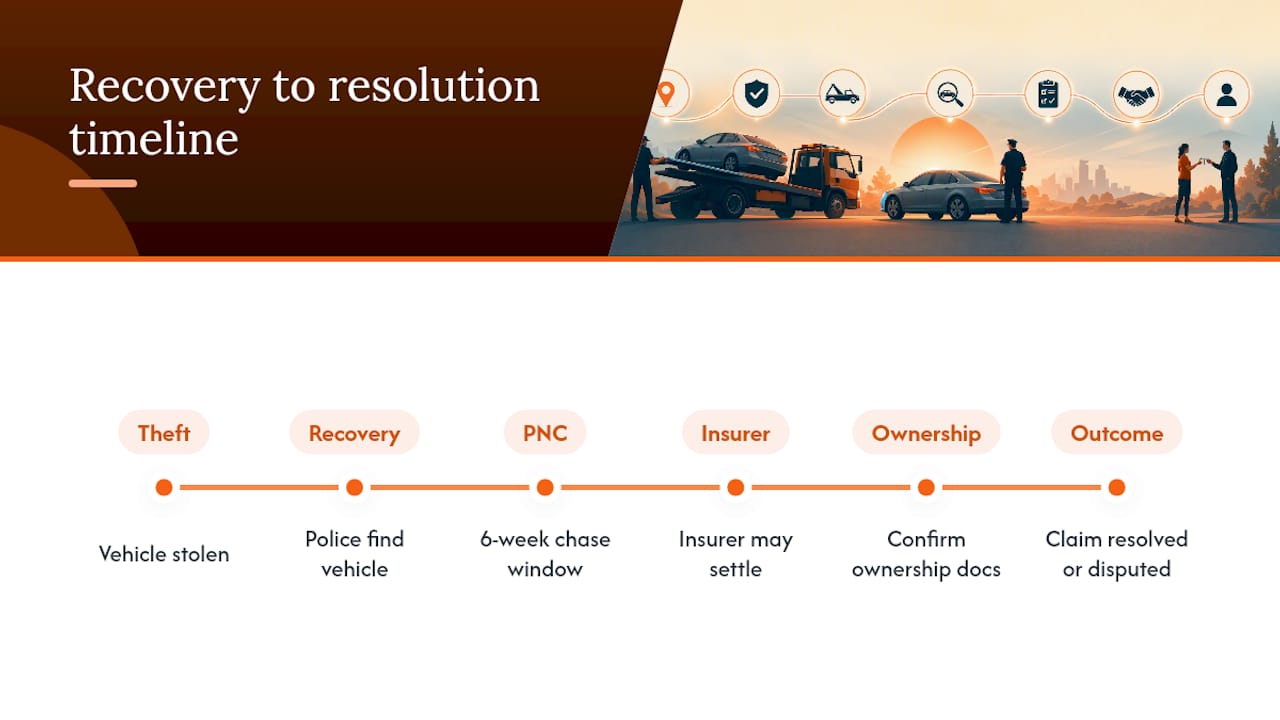
The conventional advice also underplays ownership. Owners assume the car is theirs again simply because it’s been found, but if your insurer settled first, that assumption can be wrong, and acting on it can create real legal mess.
If there’s one thing to prioritise, it’s persistence with the paper trail: officer contact details, photographs, timestamps, and insurer confirmation, in that order. Technology like a Thatcham-approved tracker shortens the front end of this process by getting police to the right location faster, but it doesn’t remove the need for you to manage the back end properly once the car is found.
— Will
Sources
- What to do if your vehicle has been stolen
- Circular 003/2023: charges for vehicle recovery
- Lost or stolen vehicles
- Removal, Storage and Disposal of Motor Vehicles (Amendment) Regulations 2023