
Yes, modern GPS trackers work on hybrid and electric cars, and Thatcham-approved units work on the vast majority of models on UK roads today. The two things that trip owners up are deep-sleep power modes and high-voltage charging interference, both of which can knock a poorly installed tracker offline for hours at a time.
- Watch for: deep-sleep accessory shutdown and charging-related signal drops.
- Best move: go hardwired, insurance-approved, and professionally fitted.
If you’re insuring a high-value hybrid, prioritise Thatcham S5 or S7 class devices from the outset. Anything less risks a rejected claim.
Pro Tip: Ask your installer to demonstrate the tracker working through a full charge cycle before you sign off the fit. If it survives that, it’ll survive most things.
Key Takeaways
Thatcham-approved hardwired trackers, professionally fitted with hybrid-aware firmware and correct antenna placement, are the most reliable route to compatibility on hybrid and electric vehicles.
| Point | Details |
|---|---|
| Deep-sleep is the main risk | Hybrids shed accessory power to protect range, which can cut power to poorly wired trackers. |
| Charging causes interference | High-voltage charging sessions can temporarily disrupt GPS and cellular signal reception. |
| Antenna placement is critical | Metallic battery enclosures create Faraday-like shielding; clear sky-view or external paths avoid dead zones. |
| Hardwired beats battery-only | Hardwired Thatcham S5/S7 units survive deep-sleep power cuts better than standalone battery trackers. |
| Lrd-track fits hybrid-specific quirks | S5 Plus and S7 Classic units are professionally installed and tested through a charge cycle before handover. |
Table of Contents
- What makes hybrids and EVs different for tracker compatibility
- Which tracker types actually work on hybrid vehicles?
- How does antenna placement affect hybrid tracker reliability?
- Do insurers require Thatcham approval for hybrid trackers?
- How do you check if your hybrid already has a tracker fitted?
- What does a hybrid car tracker cost in total?
- Why choose a specialist installer for hybrid tracker fitting?
- Compatibility differences between hybrid models and tracker brands
- Troubleshooting hybrid vehicle tracker installation issues
- How firmware updates affect tracker performance on hybrids
- Is it legal to fit a GPS tracker on your hybrid car?
- Get a Thatcham-approved fit that’s built for your hybrid
- Frequently asked questions
- Sources
What makes hybrids and EVs different for tracker compatibility
Petrol cars keep a small trickle of power running to accessories almost permanently. Hybrids and EVs don’t. To protect the 12V battery and preserve range, many hybrid platforms shed accessory power aggressively once the car is parked, dropping into what’s often called a deep-sleep state. An always-on tracker built for a diesel estate can simply lose its power feed and go dark.
Charging adds a second layer of complication. High-voltage battery packs and onboard chargers generate electromagnetic noise, and that noise can interfere with GPS reception or cellular handshakes during a charge session. A practical guide to fitting trackers on electric vehicles flags charging behaviour and power management as the two things installers need to plan around, not afterthoughts to fix later.
Then there’s the physical build. Hybrids often route high-voltage cabling and battery packs through the chassis in ways that create dense metal shielding around likely mounting points. Combine that with a tucked-away frunk or a battery pack under the boot floor, and you’ve got the makings of a signal dead zone.
Three warning signs point to a hybrid-specific fault rather than a faulty unit:
- Pings arrive in short bursts, then vanish for hours at a stretch.
- The device consistently goes quiet whenever the car is on charge.
- Last-known location sits somewhere the car clearly never was.
Pro Tip: If your tracker only misbehaves while plugged in, that’s charging interference, not a broken device. Tell your installer exactly when it happens.
Which tracker types actually work on hybrid vehicles?
Not every tracker architecture handles hybrid electronics equally well, and the differences matter more here than they do on a conventional petrol car.
Hardwired Thatcham S5/S7 units tap directly into the vehicle’s wiring, giving continuous power and the deepest integration with ignition and immobiliser systems. For insured, high-value hybrids, hardwiring remains the standard insurers recognise and the option that survives deep-sleep power cuts, because a good installer wires it past the accessory circuit that shuts down.
Battery-powered asset trackers run independently of the car’s electrics, which sounds like an advantage until you consider placement sensitivity and limited battery life flagged in user feedback on battery-powered retrieve units. They’re a reasonable stopgap for a low-value runaround, less so for a hybrid you’re insuring at real replacement value.
Combined dual-network units, hardwired with a backup battery and both GPS and cellular connectivity, are what specialists recommend for higher-value vehicles, since manufacturer guidance on EV-suitable trackers points to this layered setup as the way to maintain coverage if the main power is cut or tampered with.
- Hardwired: best power resilience, needs proper installation.
- Battery-only: flexible, weaker on deep-sleep survival.
- Combined backup: strongest against tampering and power loss.
How does antenna placement affect hybrid tracker reliability?
Getting the device right is only half the job. Where it sits inside the car decides whether it can actually see a satellite or reach a mast in the first place.
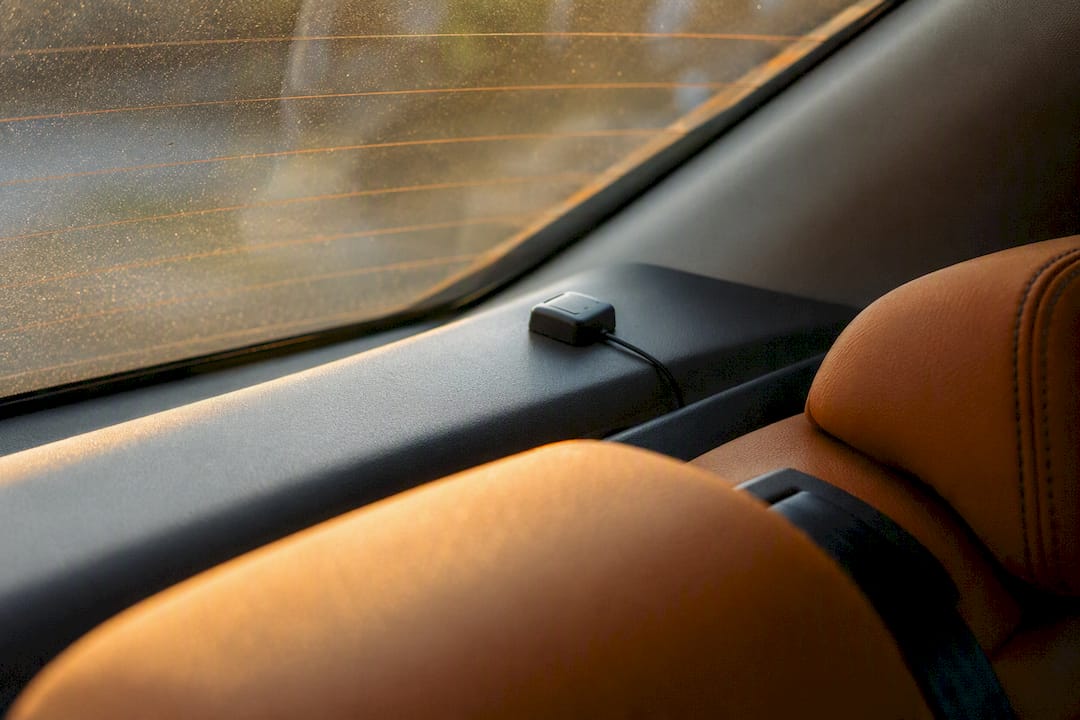
Antennas need a reasonably clear line of sight upward and outward. Hybrid platforms often place high-voltage battery packs and structural steel exactly where an installer would otherwise tuck a tracker away, under the boot floor or behind a metal parcel shelf. That’s a textbook Faraday cage effect, which can block both GPS and cellular signals, and the fix is either a clearer mounting spot or an external antenna path.
A competent fitter working on a hybrid should be checking:
- Battery management behaviour, so the tracker’s power draw doesn’t trip the car’s own low-power protections.
- Ignition wiring specific to that model, since hybrid ignition circuits don’t always behave like a conventional key-on signal.
- Awareness of the vehicle’s sleep-mode timing, so the unit doesn’t lose power mid-cycle.
- Charge-port behaviour, confirming the device stays connected through a charge session rather than dropping out.
Before you accept the job as finished, ask the installer directly: where exactly is the antenna sited, how is the backup battery configured, can the unit distinguish a charging state from a fault, and will you get a signal test log to keep? Installer resources covering shielding and wiring consistently point to professional fitting as the step that separates a tracker that works from one that quietly fails within a month.
Pro Tip: Insist on a post-fit signal test and a live run-through of a charge cycle before the installer packs up. That five minutes catches most hybrid-specific faults before they become your problem.
Do insurers require Thatcham approval for hybrid trackers?
Thatcham S5 covers trackers with driver identification, while S7 adds the same tracking capability without the driver ID requirement. Insurers ask for one or the other on higher-value vehicles because both categories meet a recognised standard for detection, verification, and monitored response, something a generic Bluetooth tag simply can’t match.
Three things worth doing once the tracker’s fitted:
- Confirm in writing that your specific insurer accepts the category fitted, S5 or S7, before you rely on it for a discount.
- Keep the installation certificate somewhere retrievable. Insurers ask for it at claim time, not before.
- Keep the monitoring subscription active. A lapsed subscription on paper looks identical to no tracker at all.
Driver ID and immobiliser features matter beyond the insurance paperwork too. They let a monitoring centre distinguish you from an intruder and give police recovery teams a live location to work with rather than a stationary last-known point.
How do you check if your hybrid already has a tracker fitted?
Some hybrids arrive with a factory telematics system that already does part of this job, and it’s worth ruling that out before you spend money twice.
- Check the owner’s handbook for any mention of a connected services or telematics package.
- Ask your dealer for the build sheet. Factory-fit tracking is often listed as a line item.
- Look for an active OEM telematics subscription, since some manufacturer systems lapse after an initial free period.
- Check for a labelled module under the dash or in the boot, though this isn’t always visible without stripping trim.
A factory tracker and an aftermarket insurance-approved unit can run side by side without conflict, but tell your insurer about both. And never cut into or splice OEM wiring yourself. Get a dealer or a specialist installer to confirm what’s already there first.
Pro Tip: If your handbook mentions “connected services”, ring the dealer before you buy anything. It might already be doing half the job.
What does a hybrid car tracker cost in total?
The device itself is only one line on the bill. A Thatcham-certified hardwired unit typically costs more upfront than a basic battery tracker, and professional installation adds a separate fee on top of that, reflecting the extra time needed to route wiring safely around hybrid-specific components.
Then there’s the ongoing side: a monthly monitoring subscription that keeps the 24/7 response and recovery service active. Skip this and the hardware becomes a very expensive paperweight.
Before committing, ask:
- What warranty covers the device and the installation itself?
- Is there an extra charge to enable remote immobilisation, or is it included?
- What happens to the subscription and certificate if you sell the car?
An active monitored subscription isn’t just a box-ticking exercise for a claim. Insurers price risk on it, and a lapsed subscription can quietly undo any discount you were given for fitting the tracker in the first place.
Why choose a specialist installer for hybrid tracker fitting?
Hybrid-specific faults, deep-sleep power loss, charging interference, antenna shielding, aren’t things a generic fitter necessarily anticipates. That’s the gap a specialist closes.
Lrd-track’s S5 Plus and S7 Classic units are built to the Thatcham S5 and S7 standards, fitted by trained installers who know to test through a full power cycle before calling the job done.
- Thatcham S5/S7-capable devices with driver ID and immobilisation.
- Professional fitting, not a bolt-on kit job.
- 24/7 monitoring with police and recovery liaison.
- Antenna placement checked against known shielding risk areas.
A monitored service is only as good as the fit behind it. Trained fitters who test antenna placement and run a charging simulation before signing off catch the faults that turn into a dead tracker six weeks later.
If you’re weighing up whether your hybrid needs the full hardwired setup or a lighter-touch option, comparing product features and pricing is a sensible first step before booking a fit.
Compatibility differences between hybrid models and tracker brands
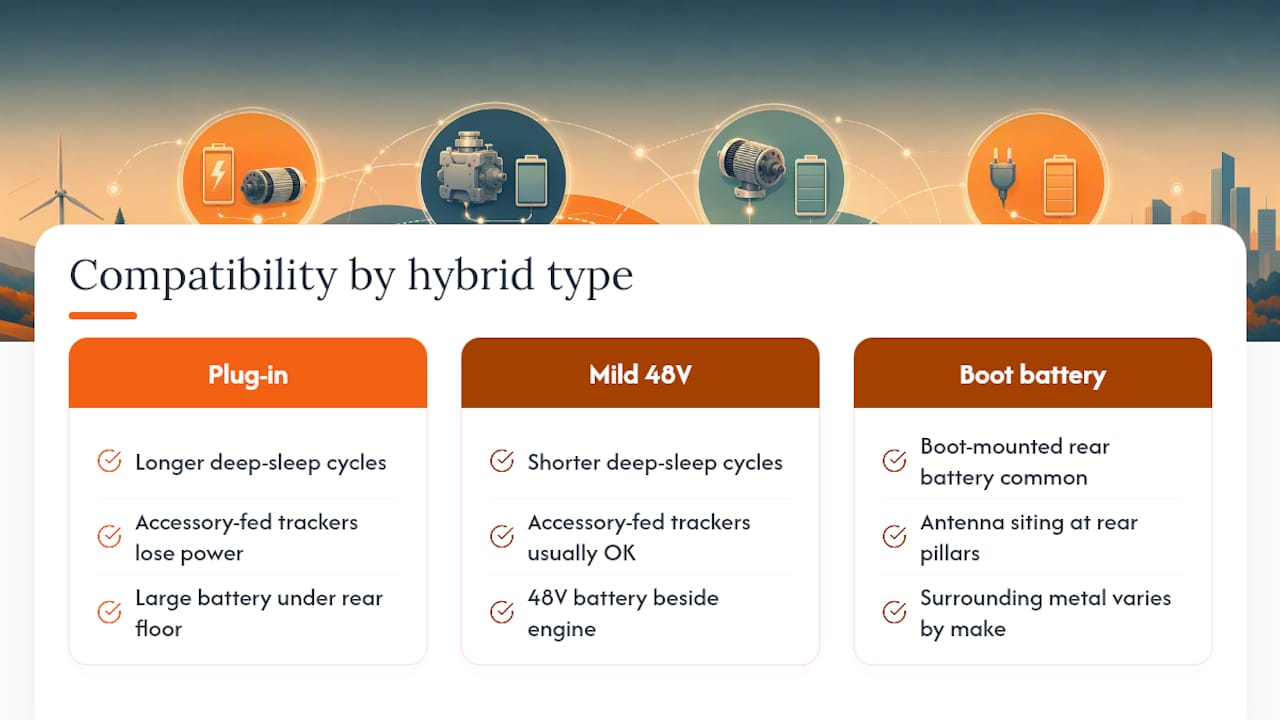
Not all hybrids present the same challenge, and not all trackers handle them equally well. A plug-in hybrid with a large battery pack under the rear floor behaves very differently from a mild hybrid with a small 48V system bolted alongside the engine bay. The plug-in’s deep-sleep cycles tend to be longer and more aggressive, since the manufacturer is protecting a much bigger, more expensive battery. That means a tracker relying on a trickle feed from the accessory circuit is more likely to lose power for extended stretches on a plug-in than on a mild hybrid.
Boot-mounted battery packs, common on many mid-size hybrid SUVs, also push installers toward the rear pillars or under the parcel shelf for antenna siting, areas that vary considerably between manufacturers in how much metal surrounds them. A Land Rover hybrid’s chassis layout, for instance, isn’t the same as a Japanese hybrid saloon’s, and a fitter who’s worked across both knows where the dead spots typically sit.
Tracker brand matters here too, mostly in how the firmware handles power states. Devices that recognise a charging state and suppress unnecessary wake-up pings tend to preserve backup battery life far better than units that treat every power fluctuation as an alert-worthy event. Real-world review patterns across different tracker models show satisfaction hinges heavily on fit quality and model choice rather than the badge on the box, which is exactly why matching the device to the specific hybrid platform, not just “hybrid” as a category, is worth the extra conversation with your installer.
Troubleshooting hybrid vehicle tracker installation issues
Most hybrid tracker problems trace back to one of three causes, and working through them in order saves a lot of wasted callouts.
Intermittent signal drops. If pings arrive in bursts and then stop for hours, check whether the pattern lines up with the car’s sleep cycle rather than a random fault. A firmware update or a repositioned antenna usually resolves this; a full unit swap rarely does.
Dead zones while charging. If the tracker consistently goes quiet only when plugged in, that’s electromagnetic interference from the charging system, not a hardware failure. Ask your installer whether the antenna can be moved further from the charge port and onboard charger, since even a few centimetres can make a measurable difference.
Location drift or stale last-known positions. This usually points to a weak GPS fix caused by shielding rather than a cellular problem. If the device can still send a signal but can’t pin an accurate location, the antenna is probably sitting in a metal-heavy cavity and needs relocating.
Keep a simple log of when faults occur, tied to what the car was doing at the time (charging, parked overnight, just driven). That pattern is the single most useful thing you can hand an installer, because it turns a vague “it doesn’t work sometimes” into a diagnosable fault.
How firmware updates affect tracker performance on hybrids
Firmware is doing more work on a hybrid tracker than most owners realise. A well-written firmware update teaches the device to recognise a charging state and suppress the wake-up events that would otherwise drain the backup battery chasing a signal it doesn’t need yet.
Older firmware, by contrast, often treats every power interruption as an event worth reporting, which on a conventional car is harmless but on a hybrid means constant false alerts every time the vehicle drops into deep-sleep or starts a charge cycle. That’s one of the most common causes of “my tracker keeps sending weird alerts” complaints installers hear, and it’s usually solved with an update rather than a replacement.
Keep firmware current, and ask your installer or provider how updates get pushed, over the air or requiring a workshop visit, since that affects how quickly a fix for a newly discovered hybrid quirk reaches your car. A tracker installed two years ago on last year’s firmware may behave noticeably worse on the same hybrid than a freshly updated unit, purely because the manufacturer has since learned more about that model’s power behaviour and refined how the device responds to it.
Is it legal to fit a GPS tracker on your hybrid car?
Fitting a tracker to a vehicle you own outright is legal, and it’s the standard route insurers expect for high-value hybrids seeking a security discount. The legal complexity arises less around ownership and more around who else drives the car and what they’re told.
If you share the vehicle with a partner, family member, or company driver, they should reasonably know the car is tracked. Covertly monitoring someone else’s journeys without their knowledge sits in murkier territory under UK data protection principles, particularly where location data could reveal sensitive patterns like regular visits to a medical practice or place of worship.
Company-owned hybrids raise a further layer: employers tracking staff vehicles typically need a clear policy explaining what’s monitored and why, rather than relying on the tracker’s mere presence to imply consent. If you’re financing or leasing the hybrid rather than owning it outright, check the finance agreement too. Some lenders have their own rules about modifications, even non-invasive ones like a hardwired tracker, though Thatcham-approved installations rarely cause issues here.
Keep records of who’s told about the tracker and why it’s fitted. It’s a small step that avoids awkward disputes later, particularly if the vehicle changes hands or the tracking data ever becomes relevant to a dispute.
Installer perspective: what fitters actually run into on hybrids
Relocating the antenna away from a battery pack cavity is the single most common fix on a hybrid fit. What looks like a dead unit is usually just a signal that never had a clear path out.
Pro Tip: Ask to see the signal strength reading before and after the antenna is repositioned. It’s the quickest way to confirm the fit, not the device, was the problem.
Get a Thatcham-approved fit that’s built for your hybrid
There are DIY plug-in trackers on the market, but they’re the ones most likely to fall over the moment your hybrid drops into deep-sleep or starts a charge cycle. Lrd-track skips that gamble entirely: every device is fitted by a trained installer who tests it through a real power cycle before leaving your driveway, not left to guesswork after the fact.
Whether you need the S5 Plus with immobiliser for full driver ID and remote immobilisation, or the S7 Classic where S7 cover suits your policy better, both come with 24/7 monitoring and direct police liaison if the worst happens. Subscription activation is straightforward and happens right after fitting, so there’s no gap between installation and live cover.
Compare the options against your hybrid’s specifics on the product finder and book an installation appraisal today.
Frequently asked questions
Are hybrid cars trackable in the same way as petrol cars? Yes, hybrid cars are trackable, but the tracker needs to be wired and sited to cope with deep-sleep power modes and charging interference that petrol cars don’t have.
What’s the best tracker for hybrid cars needing insurance approval? A hardwired Thatcham S5 or S7 device, professionally fitted, is the standard insurers recognise for high-value hybrids seeking a security discount.
Can EV interference stop a GPS tracker working? High-voltage charging systems can cause temporary electromagnetic interference, which is why installers test devices through a full charge cycle before signing off the fit.
Do I need professional installation for a hybrid car tracker? Professional installation is strongly recommended, since fitters need to account for battery management, sleep-mode timing, and antenna shielding specific to that hybrid model.
Will a tracker drain my hybrid’s 12V battery? A properly wired hardwired unit shouldn’t cause a meaningful drain, but confirm during installation how the device draws power, particularly during extended parking.