
If you own an INEOS Grenadier, most insurers will require a high level of Thatcham tracker approval, though some accept lower grades with the right monitoring in place. Meeting Grenadier tracker requirements means three things: a professional fit with an approved tracker, a monitored subscription, and written confirmation from your insurer before you rely on it. Skip that last step and you could find your cover invalid exactly when you need it most.
TL;DR:
- Insurers prefer Thatcham S7 trackers for Grenadier coverage, but some accept S5 or S5 Plus if professionally fitted and monitored.
- Proper installation must conceal the unit, include tamper alerts, backup power, immobiliser integration, and driver identification to meet insurer standards.
- Verifying that your tracker has written confirmation, serial numbers, and activation certificates from a specialist installer avoids claim disputes.
- UK GDPR rules require clear lawful basis, driver awareness, limited data retention, and potential impact assessments for tracking used by multiple drivers or companies.
- Regular testing, firmware updates, and accurate record-keeping of the tracker details are vital to ensure ongoing compliance and reliable recovery support.
Table of Contents
- What are the Grenadier tracker requirements insurers actually check?
- What UK data protection rules apply to vehicle trackers?
- What should a professional Grenadier installation look like?
- How does monitoring and recovery actually work?
- How do you confirm your tracker meets your insurer’s requirements?
- Why choose a Land Rover specialist for your Grenadier fit?
- Steps to register your tracker with police and recovery services
- How do you maintain and test your Grenadier’s tracker?
- How do you update your tracker’s software and firmware?
- What Grenadier owners consistently get wrong about tracker compliance
- Get your Grenadier fitted with an insurer-ready tracker
- Where to check the details yourself
- Sources
What are the Grenadier tracker requirements insurers actually check?
Insurers do not reference “tracker requirements” as a single standard. They reference Thatcham approval categories, and each one guarantees something specific.
Thatcham S5 covers driver identification and a battery backup, designed to keep transmitting even if a thief disconnects the vehicle’s power supply. Thatcham S5 Plus adds tow-away detection, so the system flags movement even when the engine isn’t running, which matters if a Grenadier is winched onto a flatbed. Thatcham S7 goes further still, combining tamper detection, tow-away alerts, backup battery power, and full 24/7 monitoring centre response.
For a vehicle in the Grenadier’s price bracket, S7 product pages built for the Grenadier show why many underwriters treat it as the reference class, though some insurers still accept S5 or S5 Plus when it’s professionally fitted and monitored.
Look for wording like this in your policy document:
- “Thatcham category 5, 6 or 7 tracking devices”
- A specific reference to “TSC” codes (Thatcham Security Certification), such as TSC 527
- A requirement for “active monitoring” or “24 hour response centre”
- A clause distinguishing “fitted” from “factory or dealer supplied” devices
If your Grenadier already has a dealer-fitted telematics unit, check whether it carries a Thatcham certificate number. Many factory systems are built for connectivity and location services, not for the tamper and tow-away detection insurers specify. Don’t assume it qualifies. Call and ask.
What UK data protection rules apply to vehicle trackers?
Vehicle tracking is legal in the UK, but only when it’s handled in line with UK GDPR and data protection law. For a privately owned Grenadier used purely by you and your family, the obligations are light. Once another driver, an employee, or a business use enters the picture, they tighten considerably.
The rules that matter in practice:
- You need a lawful basis for processing location data, usually “legitimate interests” for private theft protection.
- Anyone else who regularly drives the vehicle should know tracking is fitted and roughly what data it captures.
- Location data should not be kept longer than necessary for security or insurance purposes.
- If the Grenadier is used by employees or shared across a household in a way that could affect someone’s rights, a data protection impact assessment becomes the sensible next step.
Statistic to note: the ICO recommends running a DPIA wherever processing is “likely to result in a high risk” to someone’s rights, a threshold that catches most fleet or mixed-use tracking setups even when the vehicle itself is privately registered.
A company-owned Grenadier used by staff sits under stricter expectations than a personal vehicle. Employers should document the purpose of tracking, tell drivers in writing, and be ready to justify how long data is retained.
What should a professional Grenadier installation look like?
A Grenadier is not a Defender, and fitting kit designed for one onto the other without adjustment is how insurers end up rejecting claims. The body structure, wiring routes, and factory security layer are all different, so vehicle-specific fitment isn’t a nice-to-have. It’s the difference between a device that works and one that quietly fails a tamper test six months in.
A proper installation covers:
- Concealment of the main unit somewhere a thief won’t find it during a quick search.
- Tamper-alert wiring connected so any attempt to cut power or remove the unit triggers a notification.
- Backup battery fitted and tested independently of the vehicle’s main supply.
- Immobiliser integration, where the tracker’s remote-disable function is properly linked to the Grenadier’s systems.
- Driver-ID pairing, setting up fob or tag recognition for each regular driver.
- Tow-away sensor calibration, checked to confirm it triggers on movement without the engine running.
Before the installer leaves, ask them to demonstrate three things: a live activation test through the app, a simulated tamper alert, and the paperwork trail. Grenadier owner forums have flagged fob and battery interaction quirks on some fitted systems, so it’s worth confirming the fitter knows how to remotely adjust or disable the unit if it misbehaves later.
Pro Tip: Ask the installer to write down the unit’s serial number and IMEI on your invoice, then hand you the activation certificate on the spot. Insurers ask for exactly this when you submit proof of compliance, and chasing it up later wastes time you don’t have during a claim.
How does monitoring and recovery actually work?
Insurers don’t just want a tracker fitted. They want it watched. A 24/7 UK monitoring centre is what turns a GPS chip into a genuine deterrent, verifying a theft alert before contacting police and, on some systems, triggering remote immobilisation.
What to expect from the monitoring side:
- Tamper and tow-away alerts route to the monitoring centre first, not straight to you, so false alarms get filtered before anyone panics.
- Backup battery power keeps the unit transmitting for a defined window after the main power is cut.
- Subscription costs for Grenadier-specific systems typically start from around £16 a month for entry-level monitored plans, rising for S7-level cover.
- Budget for fitting cost plus the first year of monitoring together when comparing quotes, not just the hardware price.
During an actual recovery, the monitoring centre verifies movement, alerts police with a location, and hands over tracking data. The ICO’s guidance on law enforcement data sharing sets the boundaries on what can be shared and when, so a legitimate provider won’t hand over data outside a genuine theft response.
How do you confirm your tracker meets your insurer’s requirements?
Don’t guess. A five minute phone call now saves a rejected claim later.
- Read your policy wording carefully for the exact Thatcham category and any specific TSC code mentioned.
- Call your insurer before booking a fit and ask them to confirm, in writing or email, which category satisfies your policy.
- Book a Thatcham-approved installation with a fitter who works specifically with Land Rover and Grenadier platforms.
- Collect the activation certificate, product approval reference, and the unit’s serial or IMEI number from the installer.
- Keep the monitoring contract number and provider contact details somewhere you can find them fast.
Ask your insurer directly: “Which Thatcham category satisfies this policy, and do you need written proof of fitment?” Ask your installer: “Can you provide a Thatcham certificate and activation paperwork I can send to my insurer today?” Missing either answer is how disputes start.
Why choose a Land Rover specialist for your Grenadier fit?
Lrd-track specialises in Thatcham-approved trackers built for Land Rover platforms, including the Grenadier, with UK-wide installation, app-based tracking, and 24/7 monitoring. That specialisation matters because a fitter who works with these vehicles daily knows the concealment points, wiring routes, and immobiliser quirks specific to the platform, not a generic aftermarket fit adapted on the fly.
The practical payoff is fewer insurer disputes: correct paperwork issued at the point of fitting, faster activation, and a monitoring centre trained to respond to your vehicle type. Before booking anywhere, check the supplier’s site or invoice states the Thatcham category, TSC reference, and monitoring provider name in writing. If any of that is missing, ask before you pay.
Steps to register your tracker with police and recovery services
A monitored Thatcham system already links to a response network, but a few extra steps make recovery faster if the worst happens.
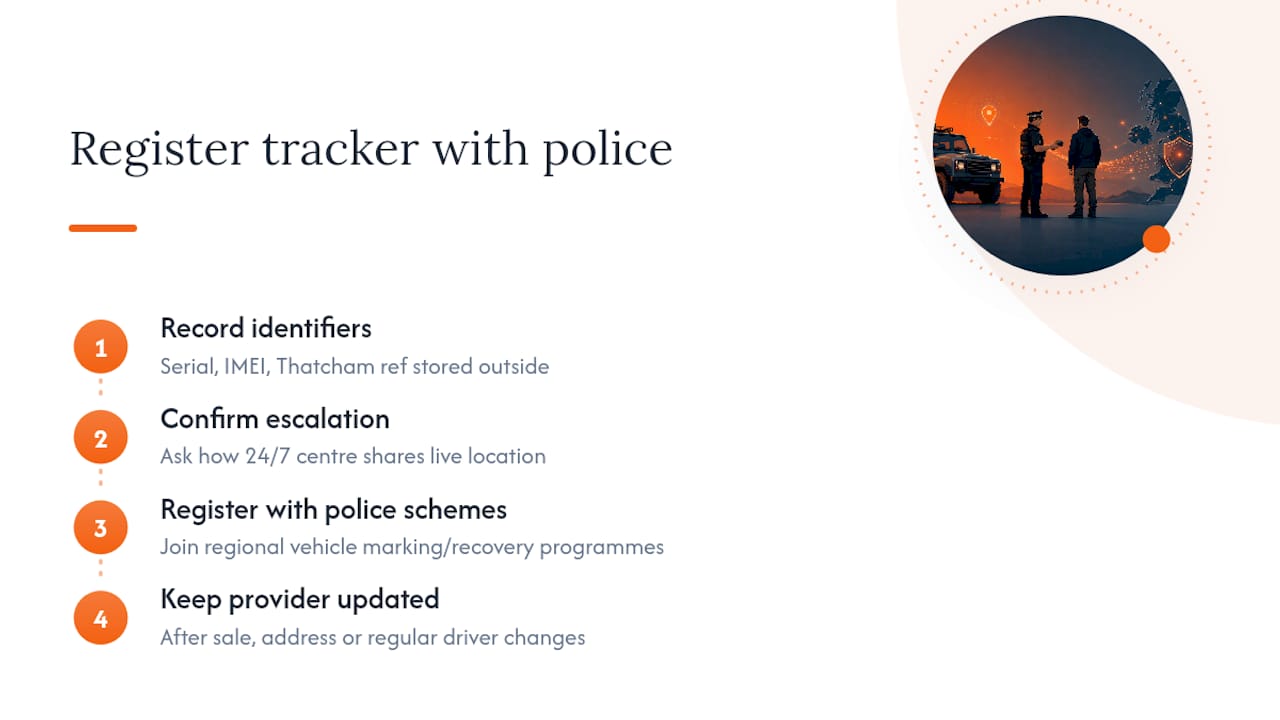
First, keep a written record of your tracker’s serial number, IMEI, and Thatcham certificate reference somewhere outside the vehicle. Police recovery teams and your insurer will both ask for this if a theft occurs, and hunting for it during a stressful moment wastes precious time.
Second, confirm with your monitoring provider exactly how they escalate a confirmed theft. Most 24/7 centres verify unusual movement or tamper alerts, then contact the relevant police force directly with a live location before calling you. Ask what information they pass on, and whether they need any details from you in advance, such as registered keeper information or vehicle description, to speed that handover.
Third, register the vehicle with any regional police-backed vehicle marking or recovery schemes your local force supports, where available. These sit alongside your tracker rather than replacing it, and some insurers view combined physical and electronic security favourably.
Finally, update your monitoring provider immediately if you sell the vehicle, change your registered address, or add a regular driver. An outdated contact record is one of the most common reasons recovery calls get delayed, and it’s entirely avoidable with a five-minute update.
How do you maintain and test your Grenadier’s tracker?
A tracker fitted and forgotten is a tracker that might fail exactly when you need it. Insurers increasingly expect evidence of basic upkeep, not just a fit-and-file certificate from three years ago.
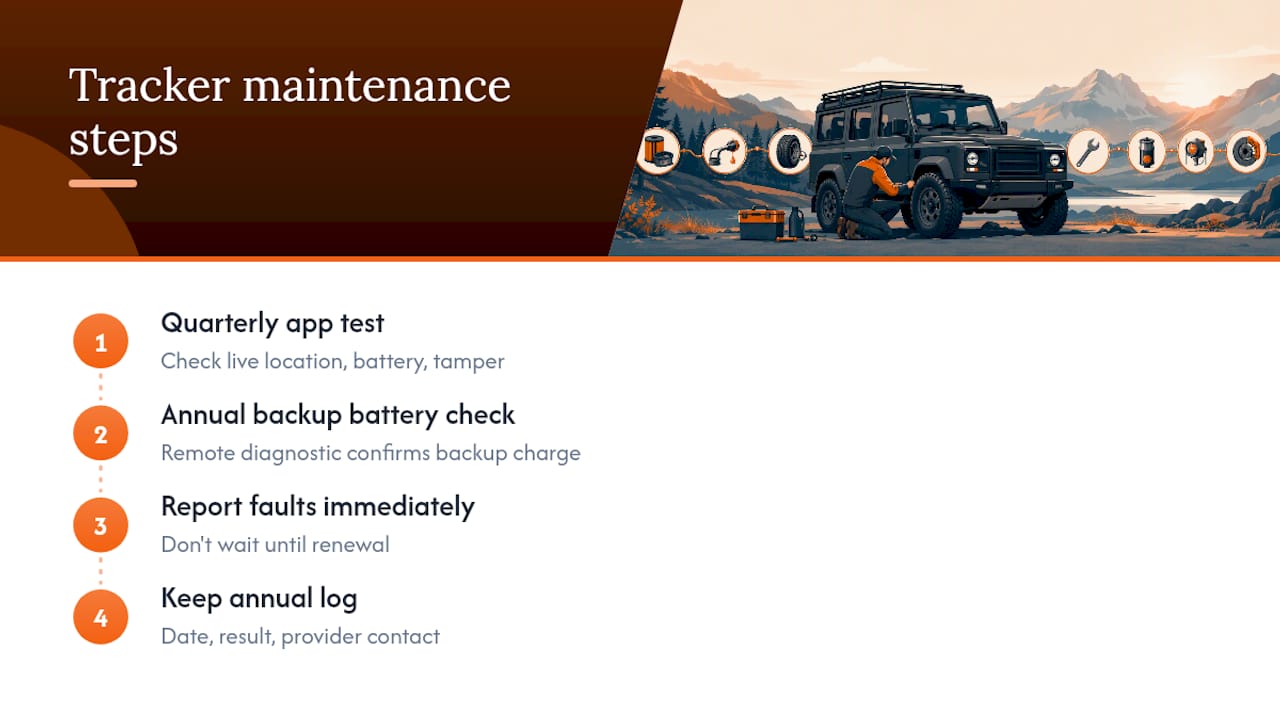
Test the system every few months using the manufacturer’s app, checking that live location updates, battery status, and tamper alerts all show as active. Most apps display a simple status dashboard, so this takes under a minute once you know what to look for.
Check the backup battery specifically at least once a year. These are designed to keep the unit transmitting after main power is cut, and like any battery, performance degrades over time. A monitoring provider can usually run a remote diagnostic to confirm backup power is holding charge without you needing to visit a garage.
Report any fault immediately rather than waiting for a renewal date. Owner forums have noted occasional fob or battery interaction issues on some fitted systems, and a professional installer can usually diagnose or adjust these remotely rather than requiring a full refit.
Keep a simple annual record: date tested, result, and who you spoke to if you contacted your provider. If you ever need to prove functioning cover to your insurer after an incident, that log is worth more than memory.
How do you update your tracker’s software and firmware?
Compliance isn’t a one-off certificate. Thatcham-approved systems rely on firmware and app software that both need to stay current to keep detection features working as designed.
Most monitoring providers push firmware updates to the tracker unit remotely, without requiring you to bring the vehicle in. Check with your provider whether this happens automatically or whether you need to request it, and ask how you’d be notified if an update is pending.
The companion app on your phone should update through the normal Apple or Google app store process. Turn on automatic updates if you haven’t already, since an outdated app can occasionally lose sync with a unit that has moved to newer firmware, leaving you with a gap in visibility you won’t notice until you need it.
If your Grenadier changes hands, gets a major electrical modification, or the monitoring provider changes its platform, ask explicitly whether the tracker firmware needs reconfiguring. A specialist Land Rover installer will know whether a Grenadier-specific update affects your device, which is one more reason to keep the original fitter’s contact details rather than relying on a generic call centre for support years down the line.
What Grenadier owners consistently get wrong about tracker compliance
The mistake I see repeated across owner forums and insurer complaints alike is treating “Thatcham approved” as a single tickbox rather than a spectrum. Owners fit an S5 device, assume it satisfies a policy that actually specifies S7, and only discover the gap when a claim is being assessed rather than when it would have cost them nothing to check.
The conventional advice, “get a tracker fitted,” undersells the task. A tracker fitted without written insurer confirmation is a tracker that might not count. The paperwork trail, serial number, activation certificate, monitoring contract, matters as much as the hardware itself, and it’s the piece most guides skip entirely.
If you take one thing from this, prioritise the phone call to your insurer before the purchase, not after. It costs nothing, takes ten minutes, and removes every guessing game that follows. Everything else, the Thatcham category itself, the installer’s checklist, the GDPR basics, is secondary to having your insurer’s own words in writing about what satisfies your policy.
— Will
Get your Grenadier fitted with an insurer-ready tracker
Certain companies supply Thatcham-approved S7 and S5 options designed for Land Rover platforms, including the Grenadier, with UK-wide installation and monitored subscriptions handled comprehensively.
Specialist fitters working exclusively with Land Rover models ensure concealment points, immobiliser integration, and paperwork match insurer expectations better than generic aftermarket fitters. You won’t be the one explaining Thatcham categories to a fitter who’s never handled a Grenadier before.
Your next steps are straightforward: check the S7 Grenadier tracker product page for specification details, book a UK-wide installation slot, and gather your activation paperwork ready for your insurer. If you’re weighing up categories first, the full Grenadier tracking collection sets out S5 and S7 options side by side so you can match one to your policy wording before you commit. Once fitted, many owners also look at complementary protection like paint protection film to guard the bodywork alongside the electronic security layer.
Where to check the details yourself
- ICO DPIA guidance for legal confirmation on data protection duties.
- Thatcham S7 tracker guide for certification evidence and process detail.
- S5 tracker product page for fitment and monitoring specifics on the alternative approval class.
This article is general information, not a substitute for advice from a qualified lawyer. Consult a qualified legal professional about your own circumstances before acting on anything here.