
GPS jamming detection means spotting when a radio signal is deliberately drowning out satellite navigation, and yes, it works, right now, using tools most fleets and security platforms already have. You don’t need a lab to catch it. Here’s what actually flags an attack:
- A sudden, simultaneous drop in C/N0 (carrier-to-noise density) across multiple satellites at once
- An automatic gain control (AGC) spike as the receiver tries to compensate for noise
- Total loss of position fix with no gradual degradation beforehand
This guide covers receiver-level checks, spectrum monitoring, machine learning models, and what to do the moment you spot trouble.
Key Takeaways
Reliable GPS jamming detection combines receiver-level metrics, spectrum monitoring, and machine learning classification, because no single method catches every jamming or spoofing pattern.
| Point | Details |
|---|---|
| Watch multiple observables | Cross-check C/N0 drops, AGC excursions, and PVT anomalies together rather than trusting any one alone. |
| Statistical detectors work | Chi-Square tests on raw IF samples reached over 99% accuracy in field-tested evaluations. |
| ML adds speed and accuracy | Hybrid models have reported detection rates above 99.9% with prediction times near 20 microseconds. |
| Localisation needs multiple points | Direction-of-arrival tools like KrakenSDR work well but need cross-checking in urban multipath. |
| Report through proper channels | Preserve evidence, then contact Ofcom for spectrum interference and police for suspected theft. |
| Choose trackers with fallback resilience | Lrd-track’s Thatcham-approved devices retain last known position and reconnect fast once jamming ends. |
Table of Contents
- What’s the difference between GPS jamming and spoofing?
- How do jammers work, and what are the warning signs?
- What does receiver-based jamming detection actually measure?
- Can spectrum monitoring catch jammers that receivers miss?
- What does current research say about machine learning detection?
- How do you locate a jammer once you’ve detected one?
- What commercial detectors and live monitoring tools exist?
- How do you judge whether a detector actually works?
- What should you do immediately after detecting jamming?
- What should you look for when choosing a detection solution?
- How is GPS jamming regulated?
- Why does jamming threaten critical infrastructure, not just vehicles?
- What have real jamming incidents taught the industry?
- Publisher’s note
- Get a Thatcham-approved tracker built for real interference
- Frequently asked questions
- Sources
What’s the difference between GPS jamming and spoofing?
Jamming blocks the signal with noise. Spoofing fakes it with a false one, tricking the receiver into reporting a location that isn’t real. Both attack GPS signal integrity, but they leave different fingerprints.
- Jamming causes C/N0 to collapse across all visible satellites and usually ends in total loss of fix
- Spoofing often keeps C/N0 readings looking normal while the reported position quietly drifts or jumps
- Detecting GPS spoofing typically needs cross-checks against expected trajectory or timing, not just signal strength
The overlap matters: many detection systems monitor both, but a jammer alert built purely around C/N0 collapse won’t catch a well-executed spoofing attempt.
How do jammers work, and what are the warning signs?
Most GPS jammers are cheap devices that flood the L1 band with radio noise, whether continuous wave, chirp, or pulsed. Some combine multiple waveforms to hit more than one frequency band at once, which is harder for a single-metric detector to catch.
On a monitoring platform, the symptoms are usually blunt:
- A vehicle “teleports” in a straight line between two points, skipping the actual route
- The device goes offline mid-journey with no prior signal weakening
- Concurrent C/N0 drops across every tracked satellite, not just one or two
- AGC readings spike as the receiver boosts gain to chase a signal that isn’t there
Pro Tip: Don’t confuse a real jamming event with normal GPS signal interference detection noise from tunnels, multi-storey car parks, or dense urban canyons. Genuine jamming tends to hit every satellite at once and recovers the instant the vehicle clears the affected area, rather than fading in and out gradually.
What does receiver-based jamming detection actually measure?
Every GNSS receiver already carries the raw material for GPS jammer detection. The trick is reading it correctly and cross-referencing more than one device.
C/N0 measures signal strength relative to background noise per satellite. AGC shows how hard the receiver is compensating for weak or noisy input. PVT (position, velocity, time) integrity flags when the calculated fix stops making physical sense, like a vehicle “moving” 40 miles in two seconds.
| Observable | What it reveals | Typical sensitivity |
|---|---|---|
| C/N0 drop | Signal power loss across satellites | Detectable within seconds of onset |
| AGC excursion | Receiver compensating for RF noise | Fast, often near-instant |
| PVT anomaly | Fix has become physically implausible | Depends on update rate, usually seconds |
Comparing C/N0 trends across two or more nearby receivers cuts false alarms sharply. A single unit losing signal might just be a bridge; three units losing signal in the same postcode at the same time is a jammer.
Pro Tip: Set thresholds too tight and you’ll get flooded with false positives from car parks and tunnels. Set them too loose and a genuine jamming event slips through. Most working systems tune AGC and C/N0 thresholds together rather than relying on either alone.
Can spectrum monitoring catch jammers that receivers miss?
Yes, and it catches them earlier. Wideband spectrum sensing scans the RF environment directly rather than waiting for a GNSS receiver to struggle, which means it can flag a jammer before any tracked device even loses its fix.
Networked monitoring takes this further by aggregating C/N0 or carrier power readings across many receivers spread over an area, turning isolated anomalies into a confirmed pattern. Statistical detectors add rigour to this process:
- A Chi-Square goodness-of-fit test applied to raw IF samples produced anomaly detection accuracies consistently above 99% in evaluations that included the JammerTest2023 field campaign, with near-zero false alarms at the chosen thresholds
- Some spoofing scenarios in the same evaluation proved harder, with accuracy dropping to roughly 87 to 93%, a reminder that no single test catches everything
Flightradar24 offers a public example of this principle at scale: its crowdsourced ADS-B network has repeatedly surfaced GPS interference zones by cross-referencing anomalous aircraft position reports across thousands of independent receivers.
Statistic Callout: Chi-Square based detectors evaluated against public datasets and 2023 field trial data reached over 99% detection accuracy with near-zero false alarm rates at optimised thresholds.
What does current research say about machine learning detection?
Detection technology is moving away from single-metric alarms toward hybrid models that combine statistical pre-alerts with machine learning classification. That shift shows up clearly in recent published results.
A windowing method paired with an XGBoost classifier reported a detection rate of 99.97%, with average prediction times around 20 microseconds per sample on low-latency hardware, catching onset and cessation of jamming before full receiver saturation. Separately, time-frequency and deep learning approaches have pushed detection sensitivity for composite interference down to roughly −20 dB JNR, useful against jammers that mix waveforms across bands. A dual-frequency C/N0 heatmap method built into a cloud-edge framework reported about 99% accuracy on a public dataset and 98% on real-time test data.
- These figures come from controlled or curated test conditions, not messy real-world deployments
- Field performance tends to run lower than lab performance, especially in multipath-heavy urban settings
Pro Tip: Treat a vendor’s headline accuracy figure as a ceiling, not a guarantee. Ask what dataset and JNR range produced it before assuming your fleet will see the same number.
How do you locate a jammer once you’ve detected one?
Detection tells you something’s wrong. Direction finding tells you where it’s coming from, and that’s a genuinely different technical problem.
Antenna arrays estimate direction-of-arrival (DOA) by comparing phase differences across multiple elements, with beamforming and null-steering used to isolate the strongest source. Low-cost software-defined radio kits such as KrakenSDR have proven capable of reliable DOA estimates in controlled drive and static tests, though multipath in dense urban environments noticeably reduces accuracy. Controlled receiver arrays (CRPA) achieve similar goals in higher-end fixed installations, often on critical infrastructure sites.
Common deployment patterns include:
- A vehicle drive-by sweep, triangulating bearing readings as the source strengthens or weakens
- A stationary array fixed on a suspected corridor or site
- Drone-mounted scanning for elevated line-of-sight over obstructions
Pro Tip: Urban canyons produce false bearings from reflected signal, not the real source. Cross-check at least two independent measurement points before committing resource to a location.
What commercial detectors and live monitoring tools exist?
Commercial options split roughly into four categories: embedded receiver flags, dedicated spectrum monitors, cloud-based monitoring platforms, and crowdsourced maps.
Chip and receiver manufacturers including u-blox build jamming indicators directly into their GNSS modules, exposing flags that downstream software can act on. Fleet telemetry providers such as Geotab describe practical indicators in fleet data, including missing trip segments, straight-line jumps, and debug logs explicitly tagged “GpsJammingDetected.” At the infrastructure end, RF monitoring specialists like CRFS deploy sensor networks that detect and geolocate interference across wide areas for airports, ports, and utilities.
A typical commercial detection report includes:
- Timestamp of onset and duration
- Severity or signal strength estimate
- Affected frequency bands
- A likely cause classification (jamming, spoofing, or benign interference)
Pro Tip: A live map alert covering your region is situational awareness; a local receiver alarm on your own vehicle is confirmation. Treat the two as complementary, not interchangeable.
How do you judge whether a detector actually works?
Vendor claims vary wildly, and the metrics that matter aren’t always the ones on the box. Detection accuracy, false alarm rate (FAR), detection latency, and robustness across a range of jamming-to-noise ratios (JNR) all deserve scrutiny before you trust a system.
Ask any vendor for:
- Field trial results, ideally against public benchmarks or events like JammerTest2023
- Performance across multiple receiver front-ends, not just one reference unit
- Test data from both open-sky and urban multipath conditions
Statistic Callout: Peer-reviewed evaluations report accuracies from roughly 87% in the hardest spoofing scenarios to over 99% for straightforward jamming detection, depending heavily on test conditions.
What should you do immediately after detecting jamming?
Act in this order:
- Log the exact timestamp and duration of the anomaly
- Preserve raw data where possible, C/N0 traces, AGC readings, and telemetry logs, before it’s overwritten
- Switch to fallback navigation rather than trusting a degraded or lost GNSS fix
- Report the incident to your national telecoms regulator, which in the UK means Ofcom, and to local police if theft or targeted interference is suspected
- Notify your fleet or monitoring centre with the affected location, time window, and any raw evidence collected
Pro Tip: Jamming doesn’t erase stored location history. A tracker that loses live signal usually retains its last known fix, which gives recovery teams a genuine starting point even during an active jamming event.
What should you look for when choosing a detection solution?
Match the tool to the job. A private vehicle owner and a fleet operator need very different things from a detection system.
- Confirm which observables it actually monitors: C/N0, AGC, raw IF access, or all three
- Check whether it supports networked monitoring across multiple devices, not just single-unit alarms
- Ask about alert latency and how false alarms are managed
- Confirm it can export evidence in a format usable for reporting or insurance claims
Vehicle owners should also weigh installation quality, warranty terms, and whether the device carries Thatcham or insurance approval, since that status affects both premiums and claims. Enterprise operators care more about integration with existing monitoring platforms and per-unit cost at scale.
Pro Tip: Insist on seeing field validation data, not just lab figures, and ask explicitly how the detector integrates with whatever monitoring dashboard you already run.
How is GPS jamming regulated?
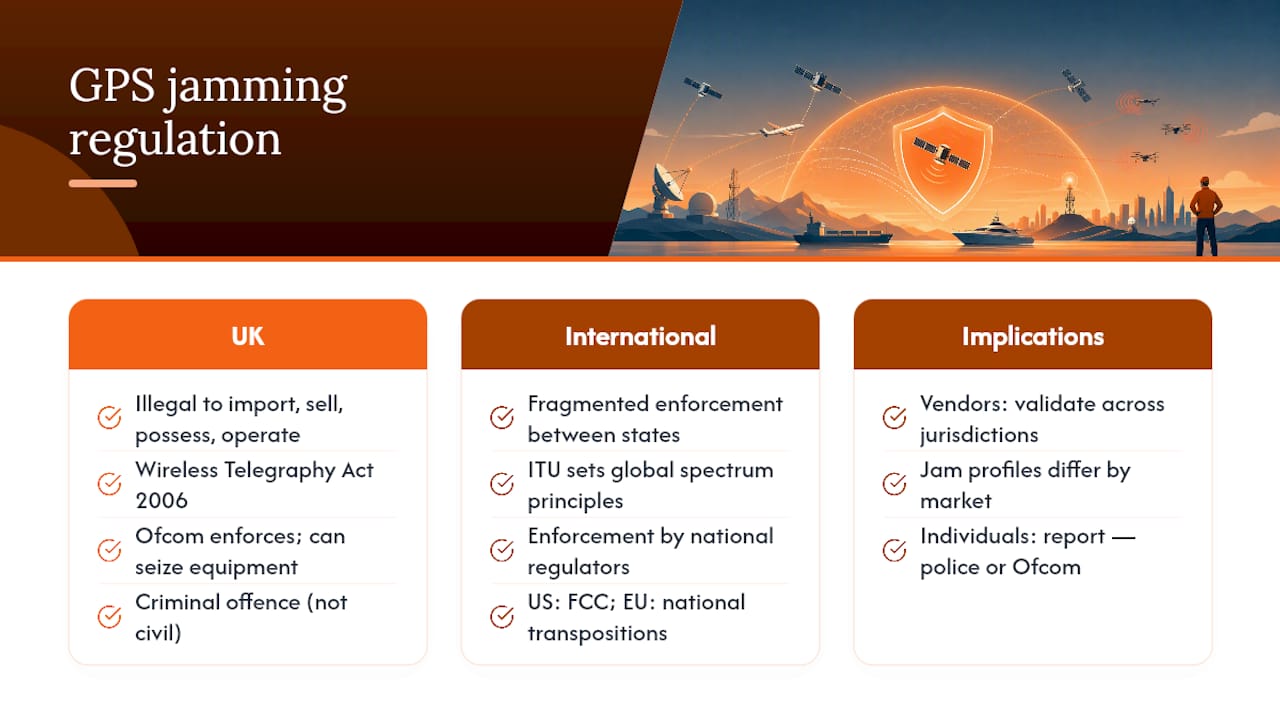
GPS jamming devices are illegal to import, sell, possess, or operate in the UK, governed under the Wireless Telegraphy Act 2006, with Ofcom holding enforcement powers and the ability to seize equipment. This isn’t a grey area; deliberate interference with radio spectrum is a criminal matter, not a civil dispute.
Internationally, the picture is similar but fragmented. The International Telecommunication Union (ITU) sets global spectrum allocation principles that member states are expected to protect, but enforcement sits with individual national regulators rather than any single global body. The United States enforces jamming bans through the Federal Communications Commission, while EU member states apply their own transpositions of shared radio equipment directives.
For anti-jamming technology development, this fragmented enforcement matters practically. A detection system built for one jurisdiction’s typical jammer profile (frequency bands, power levels, common device types sold locally) won’t necessarily generalise perfectly elsewhere. Vendors selling internationally need to validate against multiple regulatory and RF environments, not assume a single test campaign covers every market.
For individual owners, the regulatory reality is reassuring rather than alarming: if you detect jamming, you’re the victim of an offence, and reporting it through proper channels (police for suspected vehicle theft, Ofcom for spectrum interference) is both legitimate and expected.
Why does jamming threaten critical infrastructure, not just vehicles?
GPS timing, not just positioning, underpins far more infrastructure than most people realise. Power grids use GNSS timestamps to synchronise distributed generation. Financial markets timestamp transactions against GPS-derived clocks for regulatory compliance. Telecoms networks lean on GPS timing to keep cell towers synchronised.
Aviation and maritime navigation are the most visible casualties of jamming, precisely because loss of GPS signal integrity there has immediate safety consequences rather than just inconvenience. An aircraft or vessel that loses reliable positioning mid-transit needs fallback procedures ready before the interference starts, not after.
The Baltic Sea has become something of a live case study for this risk. National authorities including Finland have publicly reported jamming and spoofing incidents affecting maritime and civil positioning services in the region, incidents serious enough to prompt coordinated monitoring responses between neighbouring states.
For vehicle security specifically, the infrastructure angle is a smaller but real concern: a tracker that depends entirely on GNSS with no fallback, no cellular triangulation backup, no last-known-position memory, is more fragile than one built with redundancy in mind. The lesson from critical infrastructure scales down neatly: build systems that degrade gracefully rather than fail completely the moment satellite signal disappears.
What have real jamming incidents taught the industry?
Three types of incidents keep recurring, and each has sharpened detection practice in a different way.
Fleet operators using platforms like Geotab have documented straight-line trip anomalies and sudden telemetry gaps as reliable early indicators, patterns now built into standard alerting workflows across the vehicle telemetry industry. The lesson: don’t wait for total signal loss, watch for the gradual pattern that precedes it.
Aviation has provided some of the clearest public evidence through ADS-B crowdsourcing. Flightradar24’s network has surfaced GPS interference zones by spotting clusters of aircraft reporting anomalous positions simultaneously, a pattern no single receiver could confirm alone but which becomes obvious across thousands of independent data points. The lesson: networked, crowdsourced detection catches what isolated monitoring misses.
Field trials at test ranges have repeatedly shown a less comfortable truth: not every commercial detector catches every jamming signal. AGC-based detectors and dedicated units performed reliably against a wide range of test signals, but some narrowband cases slipped past receiver-embedded indicators, and Android C/N0 apps struggled specifically in dynamic, moving-vehicle scenarios versus static ones. The lesson: layer your detection methods rather than trusting a single indicator.
Publisher’s note
Recovery, in our experience, hinges less on stopping jamming outright and more on what a tracker does the moment signal returns. A device that logs its last known position and reconnects fast beats one that simply goes dark and hopes. That’s the practical standard we hold our own tracking systems to. If you’re weighing whether to upgrade ageing kit, prioritise last-known-position retention and fast reconnection over flashy detection claims alone.
Get a Thatcham-approved tracker built for real interference
The detection methods above matter most when they sit inside a system built to keep working once a jammer switches off. That’s exactly where Lrd-track focuses its engineering, insurance-approved trackers purpose-built for Land Rover Defender, Discovery, and Range Rover models, with 24/7 monitoring and immediate theft alerts rather than a generic device bolted onto a premium vehicle.

Every unit retains last known position through a jamming event and reconnects the moment signal returns, backed by professional UK-wide installation and driver recognition features that flag unauthorised use before a vehicle even leaves your Land Rover Discovery drive. If you’re unsure which model suits your Land Rover, the LRD Track product finder matches you to the right device and package in a couple of minutes. Defender owners specifically should look at the S7 tracker, built around Thatcham approval and the resilience this guide has covered throughout.
Frequently asked questions
Can car trackers be jammed? Yes. Any device relying on GNSS signal can be blocked by a sufficiently strong jammer within range. Quality trackers mitigate this by retaining last known position and alerting monitoring teams the instant signal drops, rather than simply going silent.
How do you detect GPS jamming in real time? Real-time detection relies on monitoring C/N0 and AGC readings continuously, flagging simultaneous anomalies across satellites, and cross-referencing against nearby receivers or networked monitoring platforms to confirm the pattern isn’t isolated interference.
What’s the difference between a jammer alert and a normal signal loss? A jammer alert typically shows simultaneous C/N0 collapse across every visible satellite and an AGC spike, then a sharp recovery once the source is out of range. Ordinary signal loss in tunnels or car parks tends to degrade and recover more gradually.
Is GPS jamming illegal? In the UK, possessing, selling, or operating a GPS jammer is illegal under the Wireless Telegraphy Act 2006, and Ofcom has enforcement powers. Report suspected jamming to Ofcom and, if theft is suspected, to the police.
What’s the most reliable single indicator of jamming? No single indicator is fully reliable on its own. Combining C/N0 drop, AGC excursion, and PVT anomaly detection consistently outperforms any one metric used alone, particularly for reducing false alarms.
Sources
- Real‑Time jamming detection using windowing and hybrid machine learning models for pre‑saturation alerts - PMC
- A deep learning GNSS spoofing and jamming detection method with dual‑frequency C/N0 heatmap - IOPscience