
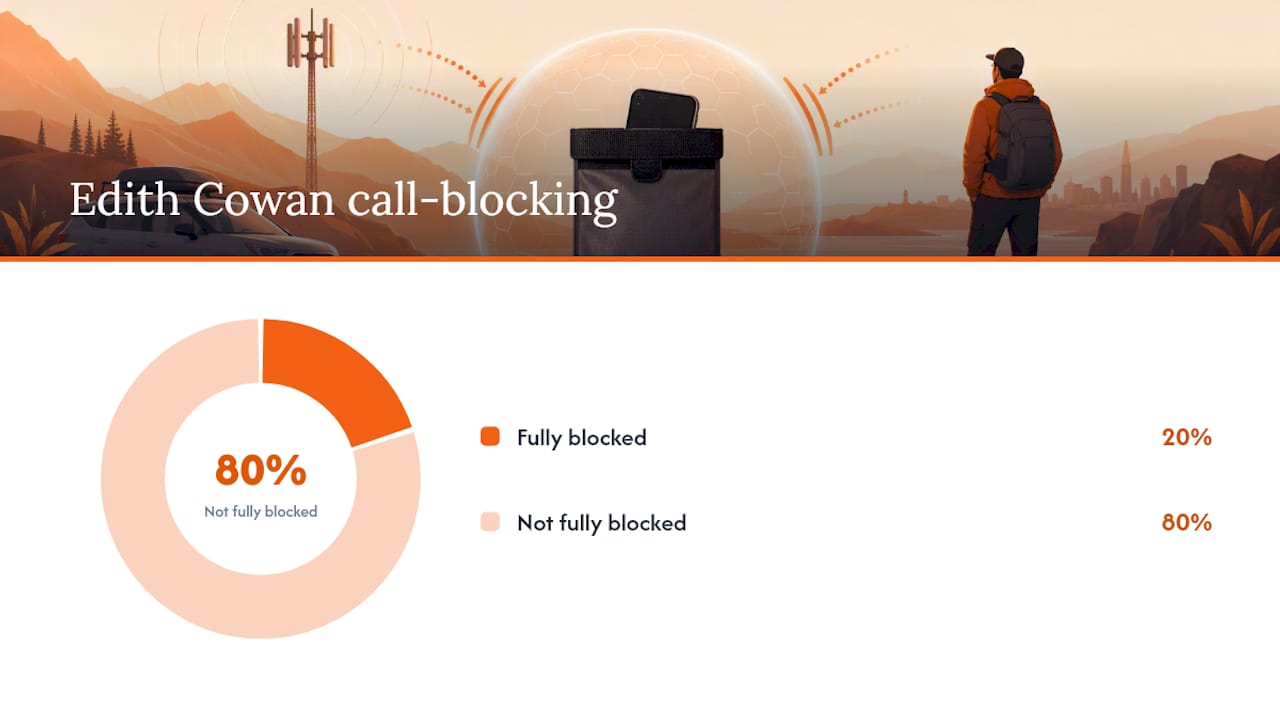
Yes, a properly built and sealed Faraday pouch will block most common wireless signals. That is the short answer. The longer answer is that “properly built” does a lot of work in that sentence. Academic forensic testing from Edith Cowan University found that only some commercial Faraday bags consistently blocked calls, Wi-Fi, and Bluetooth across multiple phone models. The concept is sound. The marketplace is not.
Here is what that means for you right now:
- ✅ Closure and seam quality are the most common failure points. A loose fold or worn Velcro strip can let signals through even on an otherwise well-made pouch.
- ✅ Frequency matters. A pouch that blocks 900 MHz cellular signals may still leak at 5.8 GHz Wi-Fi or 5G bands.
- ✅ Wear and tear degrades performance over time. Pinholes, frayed conductive layers, and stretched closures all reduce shielding.
- ✅ Your specific device matters. Phones with stronger transmitters can punch through weaker pouches.
- ✅ Test your own pouch. Manufacturer claims are not a substitute for a simple walk-up or call test on your actual device.
If you own a Range Rover, Defender, or Discovery, relay theft is a real and growing threat. A Faraday pouch for your key fob is one layer of protection. But it is only one layer, and only if it actually works.
Table of Contents
- What actually determines whether a pouch works?
- What do independent tests actually show?
- How do you test your own Faraday pouch at home?
- Do household alternatives like foil or tins actually work?
- What should you look for when buying a Faraday pouch?
- Are Faraday pouches police-recommended in the UK?
- Key takeaways
- Why a pouch alone is not enough for your Land Rover
- Lrd-track: layered security for Land Rover owners
- Useful sources
What actually determines whether a pouch works?
Material, closure, layering, and documented test data. Those four factors separate a pouch that protects from one that merely looks the part. JEMIC Shielding Technology’s independent testing shows that seams and closures are the primary failure modes, and that construction quality varies enormously across the consumer market.
Damage and wear checklist
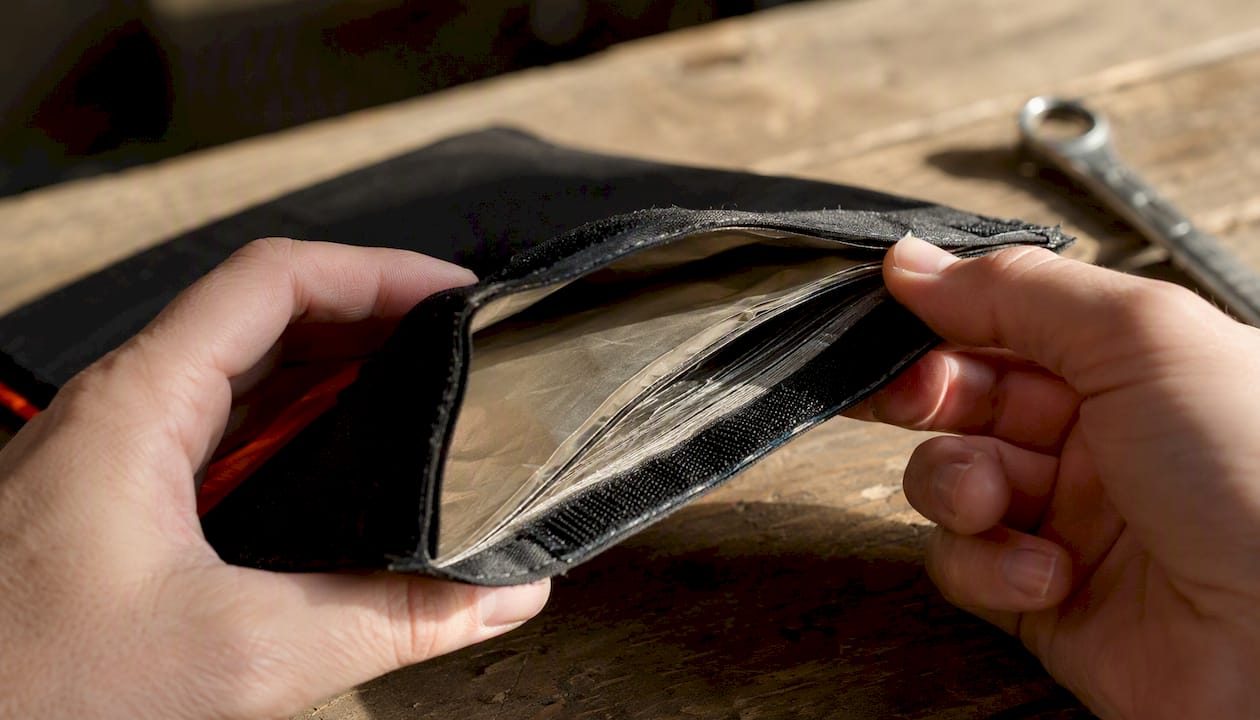
Inspect your pouch regularly. Look for:
- Pinholes or tears in the conductive layer (hold it up to a bright light)
- Fraying at the edges where conductive thread is exposed
- Velcro that no longer closes flush
- Stiff or cracked fabric (indicates the conductive coating is breaking down)
- Any non-conductive thread used in repairs
Pro Tip: The most common hidden failure mode is a pouch that looks fine on the outside but has a delaminated inner conductive layer. Squeeze the pouch gently — if you hear a crackling sound, the layers are separating and attenuation is compromised. Replace it.
What do independent tests actually show?
The overall pattern is clear: some bags reliably block across all tested bands; many consumer pouches leak on at least one frequency or one phone model. The gap between the best and worst products is not small.
| Source | Test method | Signals tested | Key outcome |
|---|---|---|---|
| Edith Cowan University (forensic study) | Live call attempts, multiple phones | Cellular (calls) | Only 1 of 5 commercial bags blocked all 18 calls; aluminium foil matched the best bag |
| JEMIC Shielding Technology | Lab attenuation measurement | 600 MHz–6 GHz | Nickel-copper and silver-coated fabrics achieved >85–90 dB; stitched seams leaked |
| Packet Moat (consumer field test) | Walk-up key fob test | Key fob RF | Multiple consumer pouches failed the 30-second walk-up test |
| TINFOIL buyer’s guide | Closure gap analysis | 900 MHz vs 5.8 GHz | Bags blocking 900 MHz failed at 5.8 GHz due to closure gap size |
The Edith Cowan University forensic study is the most rigorous academic source available. Its methodology used live call attempts across multiple phone models and multiple bag types, which is a more realistic test than a single-frequency lab measurement. The finding that aluminium foil matched the best commercial bag in call-blocking tests is striking, and worth keeping in mind when you reach the DIY section below.
Key finding: In the Edith Cowan University study, the EDEC Black Hole bag and aluminium foil each shielded all 18 call attempts. Every other commercial bag tested let at least one call through.
JEMIC’s lab testing adds the construction detail: nickel-copper woven fabric and silver-coated textiles consistently achieved greater than 85–90 dB attenuation, while stitched seams leaked measurably. The methodology matters here. Lab attenuation figures are measured under controlled conditions; real-world performance with a worn closure or a slightly different phone model will typically be lower.
Consumer field tests from Packet Moat add a sobering data point: multiple inexpensive consumer pouches failed a simple 30-second walk-up test. No specialist equipment required. Just a car and a key fob.
How do you test your own Faraday pouch at home?
Simple functional tests are the most reliable verification available to a consumer. For car key protection specifically, the walk-up test is the one that matters most. Run it before you trust any pouch with your vehicle’s security.
- Walk-up key fob test (most important for vehicle owners) — Place your key fob inside the pouch and seal it. Walk to your car and try the door handle. If the car unlocks, the pouch has failed. Repeat three times at different distances. Packet Moat’s field testing confirms this is the most direct consumer verification for relay theft protection.
Distance and repeatability: Run each test at least three times. Vary the orientation of the pouch. A pouch that passes once at arm’s length may fail when the phone is positioned differently or when you are closer to a base station.
Pro Tip: Test a new pouch the day it arrives, before you rely on it. Then retest every three months, or immediately after any visible damage. A pouch that passed six months ago may not pass today.
A brief legal note: these tests are for your own devices and your own security verification. For seized devices or forensic evidence, do not attempt home testing. Contact a qualified forensic professional or your local police force.
Do household alternatives like foil or tins actually work?
Aluminium foil and metal tins can work for some bands and some devices. The Edith Cowan University forensic study found that aluminium foil matched the best commercial bag in call-blocking tests. That is a genuine result, not a myth. But performance is variable, and the seal is everything.
Aluminium foil
- ✅ Blocks cellular calls when wrapped tightly with no gaps
- ✅ Inexpensive and immediately available
- ❌ Difficult to seal reliably; any gap degrades performance
- ❌ Tears easily; single-use in practice
- ❌ No consistent attenuation across Wi-Fi or Bluetooth bands
Biscuit tin or metal container
- ✅ Rigid structure makes a better seal than foil alone
- ✅ Can block cellular and some Wi-Fi signals if the lid fits tightly
- ❌ Lid-to-body contact is rarely conductive enough for high-frequency bands
- ❌ Size limits which devices fit
- ❌ No documented attenuation data
Nested layers (foil inside a tin)
- ✅ Adds a second barrier; improves consistency
- ❌ Still no guarantee at 5 GHz or above
Quick improvised shield instructions
If you need emergency shielding right now:
- Wrap the device in at least three layers of aluminium foil, folding each layer tightly with no gaps.
- Place the wrapped device inside a metal tin with a close-fitting lid.
- If the device has Wi-Fi, disable it manually before sealing, to reduce its transmit power.
- Do not rely on this for anything beyond a short-term measure.
Avoid DIY solutions entirely when handling forensic evidence, protecting high-value assets over extended periods, or when you need documented, verifiable shielding. A tested, certified pouch is the only acceptable option in those situations. For everyday Range Rover keyless protection, a purpose-built key fob pouch is worth the modest cost.
What should you look for when buying a Faraday pouch?
The single most important criterion is documented attenuation across multiple frequencies, combined with a reliable closure. Everything else is secondary. TINFOIL’s buyer’s guide makes the point plainly: a bag that blocks 900 MHz may fail at 5.8 GHz because closure gaps are large relative to the shorter wavelength.
Buying checklist
- ☑ Published attenuation figures across the full 600 MHz–6 GHz range (not a single frequency)
- ☑ Named material specification (nickel-copper, silver-coated textile, or equivalent)
- ☑ Seam construction detail (RF-welded preferred; conductive stitching acceptable)
- ☑ Closure type and how it maintains a continuous conductive seal
- ☑ Independent test reports (not just manufacturer self-certification)
- ☑ Durability warranty and return policy
- ☑ Size appropriate for your device (key fob pouches and phone pouches are different products)
Red flags
- ❌ Attenuation claimed at a single frequency only
- ❌ No closure construction details provided
- ❌ No independent testing or third-party certification
- ❌ Marketing copy focused on appearance rather than shielding performance
- ❌ Suspiciously low price with no published specification
For key fob protection specifically, purpose-built pouches such as the Key Shield from Disklabs are designed for that use case and list police approval for the product. For phone-sized pouches, the construction standards above apply in full. The Lrd-track RFID signal blocking pouch is designed specifically for Land Rover key fobs and is worth considering alongside a tracker for layered vehicle security.
Also worth considering alongside any electronic security measure: Protect A Plate addresses number plate cloning, another common attack vector for UK vehicle owners.
Are Faraday pouches police-recommended in the UK?
Forensic teams and some police units do use Faraday pouches, but they rely on tested, certified products and strict handling procedures. The distinction matters. A consumer pouch from an online marketplace is not the same as a forensic-grade enclosure with documented chain-of-custody procedures.
Key points for UK users:
- ✅ Forensic teams use Faraday enclosures to prevent remote wiping or alteration of seized devices during evidence handling.
- ✅ The Edith Cowan University forensic study confirms that Faraday pouches are used in evidence preservation, but recommends tested products and documented procedures for forensic admissibility.
- ❌ Improvised solutions (foil, tins) are not acceptable for forensic evidence handling in court proceedings.
- ❌ Chain of custody requires documented, independently verified test results. A pouch with no published attenuation data cannot satisfy that requirement.
For civilians: If you are preserving a device as potential evidence, do not attempt to handle it yourself. Contact your local police force immediately. If you are asked to preserve a device, place it in aeroplane mode if possible, then in a tested Faraday pouch, and hand it to officers as quickly as possible.
One practical note: UK police forces have issued public guidance recommending that keyless car owners store key fobs in a Faraday pouch or signal-blocking box as a theft deterrent. That recommendation applies to consumer-grade pouches for everyday use, not to forensic evidence handling, which requires a different standard entirely.
This article provides general information only and is not legal or forensic advice. Confirm current requirements with a qualified professional or the relevant authority.
Key takeaways
A Faraday pouch works reliably only when it is built from conductive materials, sealed correctly, tested on your specific device, and inspected regularly for wear.
| Point | Details |
|---|---|
| Verdict on effectiveness | Properly built pouches block signals, but academic tests show most consumer bags fail on at least one band or phone model. |
| Most critical failure point | Seams and closures leak first; RF-welded seams and roll-top closures outperform stitched or Velcro alternatives. |
| Essential home tests | Run the walk-up key fob test and a two-phone call test on every new pouch before trusting it. |
| Buying rule of thumb | Demand published attenuation data across 600 MHz–6 GHz; reject any product with single-frequency claims or no independent testing. |
| Lrd-track recommendation | For Land Rover owners, pair a tested RFID pouch with a Thatcham-approved GPS tracker for layered protection that works even if the pouch fails. |
Why a pouch alone is not enough for your Land Rover
Here is the uncomfortable truth about Faraday pouch effectiveness: even a perfect pouch only protects while the key is inside it and the closure is properly sealed. The moment you take the key out to use it, the protection stops. Thieves know this. Relay theft attacks happen in seconds, often in car parks and driveways, precisely when the key is in transit between your pocket and the pouch.
That is not an argument against using a pouch. It is an argument for not treating it as a complete solution. The independent test evidence makes clear that the concept works, but the market is full of products that do not deliver on it. And even the best pouch cannot track your vehicle if it is stolen, cannot immobilise it remotely, and cannot alert you the moment it moves.
For everyday key fob protection, a tested pouch with RF-welded seams and documented multi-frequency attenuation is the right choice. Inspect it every three months. Test it with the walk-up method. Replace it at the first sign of wear. For forensic or high-stakes use, only a certified product with documented test results is acceptable.
The three routines worth building: inspect the pouch for physical damage monthly, run the walk-up test quarterly, and replace the pouch after any impact or visible wear. A pouch that cost £15 and has been in a coat pocket for two years is not protecting your £80,000 Defender. Treat it like the security layer it is, not a permanent solution you can forget about.
Lrd-track: layered security for Land Rover owners
A Faraday pouch is one layer. A GPS tracker with 24/7 monitoring is another. For Land Rover owners, the gap between those two layers is where thieves operate.
Lrd-track’s Thatcham-approved GPS trackers are built specifically for Defender, Discovery, and Range Rover models. They include real-time tracking, remote immobilisation, driver identification, and tow-away alerts. If your key fob pouch fails or your key is taken, the tracker keeps working. Professional installation is included, and the 24/7 monitoring team responds immediately to alerts.
A pouch stops relay theft when it works. A Lrd-track tracker recovers your vehicle when everything else fails. That is the combination worth having.
Find the right tracker for your Land Rover and add the layer of protection that works even when a pouch cannot.
Useful sources
-
A forensic examination of several mobile device Faraday bags and materials — Edith Cowan University academic study. The most rigorous independent test of commercial Faraday bags available; covers call-blocking, Wi-Fi, and Bluetooth across multiple phone models and bag types. Essential reading for anyone who wants to understand real-world variability.
-
What real testing reveals about Faraday bag performance and risk — JEMIC Shielding Technology. Lab-measured attenuation data with construction analysis. Covers seam failure modes, recommended materials, and minimum attenuation benchmarks.
-
EXPOSED: 90% of Faraday bags fail this 30-second test — Packet Moat. Consumer field testing of the walk-up key fob method. Practical and repeatable; directly relevant to vehicle owners.
-
Faraday bag buyer’s guide: what actually works — TINFOIL. Technical buyer’s guide covering closure gap physics, frequency-dependent attenuation, and construction standards. Useful for understanding why cheap bags fail at higher frequencies.
-
Do Faraday bags work? — Cape blog. Consumer-focused overview of the concept, common misconceptions, and home-test ideas. Good starting point for readers new to the topic.
-
What is a Faraday bag and do you need one? — Carwow. UK-focused consumer explainer covering practical use cases and common misunderstandings about pouch performance.
-
Lrd-track RFID signal blocking pouch — Lrd-track. Product and installation information for Land Rover key fob protection, designed to complement Thatcham-approved GPS tracking systems.