
If your car has been stolen, report it to the police immediately by calling 101 (or 999 if you are in danger) to get a crime reference number, then contact your insurer straight away. Those two steps unlock everything else: the claim, the DVLA update, and any tracker-assisted recovery.
Your immediate checklist:
- ✅ Call 101 (or use your local force’s online portal) and note the exact time you called
- ✅ Write down when and where you last saw the vehicle
- ✅ Contact your insurer and give them the crime reference number
- ✅ Secure any spare keys and change passwords on any connected apps
- ✅ Note your registration, VIN, make, model, and colour for both calls
Three named entities you will need right away: your local police force / 101 (crime reference number), DVLA (ownership and tax updates after a payout), and your tracker provider if you have one.
Pro Tip: If you have an active, insurance-approved tracker fitted, contact the tracker provider as soon as you have called 101. Many providers, including Lrd-track customers, have 24/7 monitoring teams who can attempt a locate and liaise directly with police.
Prompt reporting is the single biggest factor in recovery. The sooner police have the crime reference logged, the sooner every other process — insurer, DVLA, tracker team — can move.
Key takeaways
Reporting a stolen vehicle to police immediately and obtaining a crime reference number is the single action that unlocks every subsequent step: the insurance claim, the DVLA update, and any tracker-assisted recovery.
| Point | Details |
|---|---|
| Report to police first | Call 101 or use online reporting to get a crime reference number before contacting anyone else. |
| Notify your insurer same day | Supply the crime reference, vehicle details, and key location; your insurer will register the claim and advise on interim cover. |
| Gather precise evidence | Record the exact last-seen time, CCTV locations, and VIN; a written timeline speeds both the police investigation and the claim. |
| Contact your tracker provider | If you have an active tracker, call the provider’s 24/7 line immediately; they can locate the vehicle and liaise with police. |
| Lrd-track for Land Rover owners | Thatcham-approved GPS trackers with 24/7 monitoring give police a live locate signal and may reduce your insurance premium. |
Table of Contents
- How to report a stolen car to the police
- How to contact your insurer after a theft
- What to tell DVLA after a theft or insurance payout
- What to do if your car is recovered
- Evidence to gather for police and your insurer
- If you have a tracker: who to contact and what Thatcham approval means
- What to expect: timelines for police, recovery, and your claim
- Lrd-track: Thatcham-approved tracking built for Land Rovers
- Sources
How to report a stolen car to the police
Police guidance confirms that most forces handle initial theft reports by telephone, so you do not need to wait for an officer to attend before the process begins. Call 101 for a non-emergency report, use your local force’s online crime-reporting portal, or dial 999 only if a dangerous situation is unfolding.
Before you call, have this ready:
- Registration number, make, model, and colour
- VIN (if you know it — check your V5C or door frame)
- Exact time and location where you last saw the vehicle
- Any CCTV cameras nearby or dashcam footage details
- Details of any witnesses
Gloucestershire Constabulary’s guidance also recommends double-checking where you parked and contacting your local council’s impound service before assuming theft. Cars are sometimes moved by councils or tow companies without notice.
Once the report is logged, police will issue a crime reference number. Write it down immediately. Your insurer requires it to open a claim, and DVLA uses it to update the vehicle’s status on the national register. Police notify DVLA automatically about both the theft and any subsequent recovery, but the crime reference is your proof that the report exists.
How to contact your insurer after a theft
Citizens Advice is clear: tell your insurer immediately. Do not wait to see if the car turns up first. Delays can complicate your claim.
When you call, have ready:
- Your policy number
- The crime reference number
- Vehicle registration, make, model, colour, and VIN
- Location of all keys and key fobs
- A list of any personal items stolen from inside the vehicle
- Any photos, CCTV footage, or dashcam evidence
Your insurer will register the claim and assign a claim reference number. Keep that number alongside the crime reference. What happens next depends on your level of cover. Comprehensive policies cover theft; third-party only policies do not pay out for the vehicle itself, though contents may be covered separately under home insurance.
Insurers typically hold final settlement while police investigate or while the vehicle remains on the missing register. This waiting period commonly runs for 30 days, though it varies by insurer and policy. During that window, many insurers offer a courtesy car — check your policy terms.
Watch for these common exclusions:
- Keys left in the vehicle or ignition
- Vehicle left unlocked or in an insecure location
- Failure to maintain reasonable security measures
- Modifications not declared to the insurer
Excesses apply to theft claims just as they do to accident claims. Your policy schedule will state the amount. If your vehicle had aftermarket upgrades, provide receipts — undeclared modifications can affect settlement value.
What to tell DVLA after a theft or insurance payout
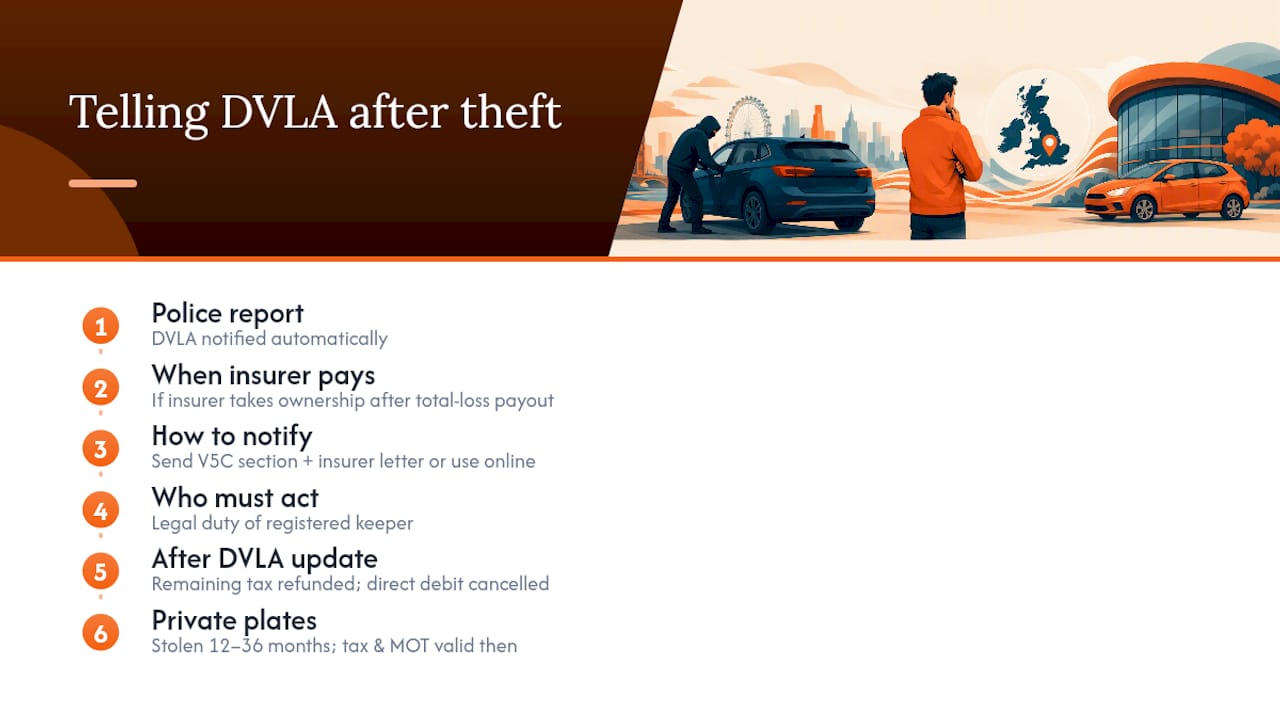
Police notify DVLA automatically when a vehicle is reported stolen, so you do not need to contact DVLA at the point of reporting. Your obligation kicks in later, if the insurer pays out.
GOV.UK guidance states that if your insurer takes ownership after settling a total-loss claim, you must tell DVLA you no longer own the vehicle. This is typically done by sending the relevant section of your V5C logbook along with a letter containing the insurer’s details, or by using the DVLA’s online service. Your insurer will usually guide you through this step, but the legal responsibility to update the record sits with you as the registered keeper.
Once DVLA updates ownership, any remaining vehicle tax is refunded automatically and any direct debit for tax payments is cancelled.
Private registration plates: if your stolen vehicle carried a personalised plate, West Yorkshire Police’s guidance notes that DVLA rules require the vehicle to have been recorded as stolen for at least 12 months but no longer than 3 years, and it must have had valid tax and MOT at the time of theft, before you can apply to retain the registration. Do not delay starting that process once the 12-month mark approaches.
What to do if your car is recovered
Recovery is good news, but act carefully. Contact the police force that recovered the vehicle before you attend the scene. Do not approach a car that looks occupied or has been tampered with in a way that raises safety concerns.
Once police confirm it is safe:
- ✅ Photograph the vehicle’s condition from every angle before touching anything
- ✅ Note the police incident number for the recovery
- ✅ Collect any personal belongings, but do not drive the vehicle until police and your insurer confirm it is roadworthy
- ✅ Inform your insurer straight away — even if a claim has already been paid out
If your insurer has already settled the claim, they now own the vehicle. They will arrange an inspection and decide whether to repair it, return ownership to you (sometimes for a fee), or write it off. GOV.UK confirms that DVLA must be updated to reflect any change in ownership resulting from this process.
Police Scotland’s guidance encourages owners to supply any CCTV or dashcam evidence to the recovering force, as this can support prosecution if suspects are identified.
Evidence to gather for police and your insurer
Speed matters here. The more precise your evidence, the faster both the police investigation and your insurance claim move.
Capture immediately:
- Exact time and location where you last saw the vehicle
- CCTV camera locations nearby (note addresses so police can request footage quickly)
- Dashcam footage — copy it to a separate device or cloud storage now, before the dashcam is gone
- Names and contact details of any witnesses
- Receipts for recent work, upgrades, or accessories (supports valuation)
Vehicle identifiers to have on record:
- Registration number, make, model, and colour
- VIN (Vehicle Identification Number)
- Any unique marks, stickers, or aftermarket parts
- Key fob serial numbers
Keep a written timeline of events: when you last used the car, when you noticed it missing, and every call you made and to whom. Police and insurers find precise timelines especially useful when building a case or assessing a claim.
If you have a tracker: who to contact and what Thatcham approval means
If your vehicle has a tracker fitted, contact your tracking provider as soon as you have called 101. Gloucestershire Constabulary’s guidance confirms that tracker providers can often locate the vehicle and liaise directly with police, which can speed recovery significantly.
What to do:
- ✅ Call your tracker provider’s 24/7 monitoring line immediately
- ✅ Give them the crime reference number so they can coordinate with police
- ✅ Keep your tracker account number and device serial number in your evidence pack
Thatcham Research publishes security certifications for vehicle trackers, and insurers and law enforcement recognise Thatcham-approved devices as meeting the industry security standard. A Thatcham-certified tracker can reduce your insurance premium and, critically, gives police a legally recognised locate signal to act on.
A Thatcham-approved tracker does not guarantee recovery — police resources and legal process still govern what happens next. Never attempt to recover your vehicle yourself. Always let the tracker provider and police coordinate.
Pro Tip: Keep your tracker provider’s emergency number saved separately from your phone’s main contacts. If your phone was in the car, you will still need that number.
Practical limitations are worth understanding. Trackers help locate; they do not physically stop a vehicle. Recovery depends on police availability and the vehicle’s location. That said, vehicle tracking features like tow-away alerts and driver identification mean a theft can be flagged within seconds of it starting.
What to expect: timelines for police, recovery, and your claim
Most theft reports are handled by telephone initially. West Yorkshire Police confirms that the essential outcome of that call is the crime reference number, even when no officer attends in person. Local searches may follow, but investigative depth varies by force and circumstance.
On recovery rates, NICB data (US-based, cited as an industry reference) indicates that around 35% of recovered vehicles are found the same day and approximately 45% within two days. Prompt reporting is the clearest lever you control.
| Stage | Typical timeframe | What happens |
|---|---|---|
| Crime reference issued | Same call | Police log the theft; DVLA notified automatically |
| Insurer claim registered | Same day | Claim reference issued; investigation begins |
| Police search / investigation | Days to weeks | Local searches, ANPR checks, tracker data reviewed |
| Insurer settlement decision | 30 days (typical) | Final payout or repair offer once search period closes |
| DVLA ownership update | After settlement | Registered keeper updated; tax refund processed |
Insurers rarely settle within the first week. The 30-day waiting period exists to allow for recovery. If the vehicle is found during that window, the claim process pauses while the insurer assesses damage.
The part most people skip — and why it matters
The steps in this guide are straightforward, but the gap between knowing them and having them ready when panic sets in is where most people lose time. A stolen vehicle is disorienting. The crime reference number, the insurer’s claims line, the tracker provider’s emergency number — none of these feel urgent until the moment you need them.
The owners who recover their vehicles fastest are not the ones who react quickest. They are the ones who had a tracker already active, a claims number already saved, and a V5C already photographed. Legal responsibilities — reporting to police, notifying DVLA after a payout, maintaining insurance during the claim period — do not pause because the situation is stressful. The insurer expects prompt notification. DVLA expects an ownership update. Both are your responsibility as the registered keeper, regardless of how the theft unfolded.
If you drive a high-value Land Rover, the risk is not theoretical. Land Rovers are a consistent target for organised theft in the UK. A Thatcham-approved tracker is not a luxury add-on at that point. It is the difference between a locate signal police can act on and a crime reference that sits in a queue.
Lrd-track: Thatcham-approved tracking built for Land Rovers
If your Land Rover does not have an active tracker, this is the moment to change that.
Lrd-track supplies and professionally installs Thatcham-approved GPS trackers built specifically for Defender, Discovery, and Range Rover models. Every device includes real-time app alerts, tow-away detection, driver identification, remote immobilisation, and 24/7 monitoring. When a theft happens, the monitoring team contacts police directly with a live location — the kind of coordinated response that turns a crime reference into a recovery.
The S7 Classic Defender Tracker is engineered for older Defenders where standard fitment options fall short. The S5 adds driver ID and is recognised by most major UK insurers for premium reductions. Both are Thatcham-certified.
Trackers support police recovery — they do not replace reporting to 101. Always file the police report first. Use the Lrd-track product finder to match the right device to your vehicle and insurance requirements.
Sources
These are the official pages you will need for reporting, DVLA updates, and tracker certification:
- Gov
- How to report a lost or stolen vehicle | Gloucestershire Constabulary
- My car has been stolen, what should I do? | West Yorkshire Police
- Thatcham security certifications
- Vehicle insurance – making a claim if your car or its contents are stolen | Citizens Advice
- How to Report a Stolen Vehicle | National Insurance Crime Bureau